Taking the heat out of 3D printing
A new approach to volumetric additive manufacturing (VAM) seeks to control temperature build-up to stabilise the process.
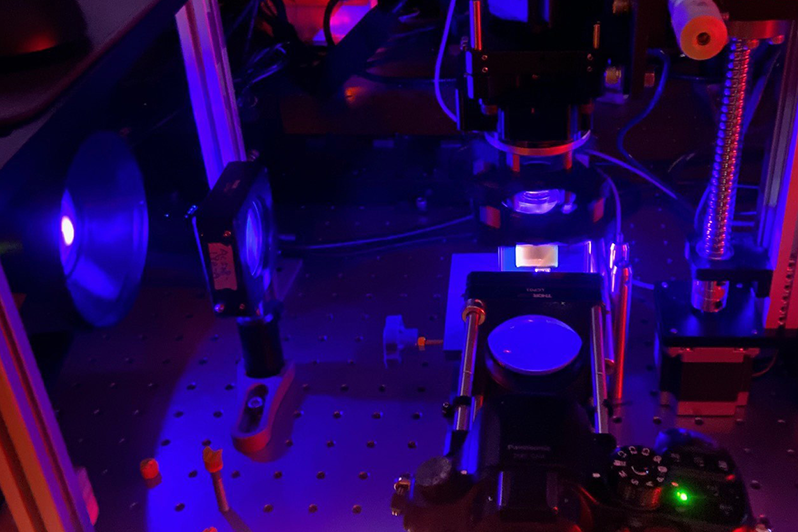
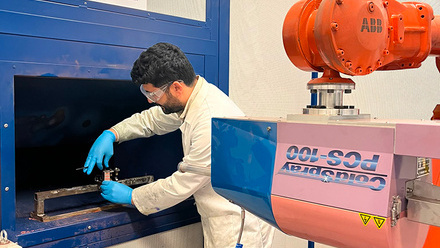
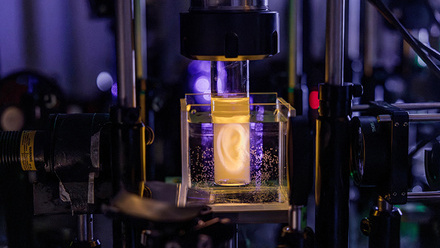
The volumetric printer used in the 3D printing process
© University of NottinghamInstead of building objects layer-by-layer, as in conventional 3D printing, VAM uses patterns of light to produce an entire structure inside a liquid resin. This allows fast printing and the ability to create complex shapes. It also avoids delamination between layers that occurs in standard 3D printing techniques.
However, the process is limited by the heat produced during the chemical reaction, where temperatures can rise by more than 60°C. This heat can cause the reaction to run out of control, leading to distortions, loss of detail and a limit to how large the printed objects can be.
A joint UK-US team now claims they can control temperature build-up through a process called reversible addition-fragmentation chain transfer (RAFT) polymerisation.
Unlike standard free radical polymerisation where a radical can react in an unrestricted fashion until it is terminated – and the rate of the chain growth reactions is very rapid, producing significant heat levels – RAFT’s control agent mostly remains attached to the chain’s end, preventing reaction with a monomer.
According to the researchers at Nottingham University, UK, and the University of California, Berkeley, USA, RAFT polymerisation therefore acts like a built-in regulator. It slows and regulates material formation while simultaneously preserving the strengths of VAM. Indeed, they claim the resulting printing process is even quicker than VAM, delivering parts within seconds.
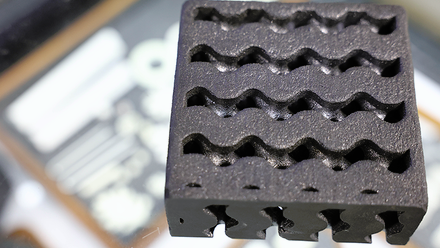
The technique has reportedly demonstrated how more complex builds, closer part packaging and different-sized components can be 3D printed rapidly without distortions.
'RAFT is a good choice as it is centred on the use of sulphur control agents,' says Professor Derek Irvine at Nottingham.
'Occasionally, the formal bond to the RAFT agent breaks to leave a radical on the chain end,' adds Dr Eduards Krumins, a Postdoctoral Researcher at Nottingham.
'This radical-containing chain end then undergoes a number of propagation steps to grow the chain slightly. After this short growth period, the RAFT agent re-engages to the chain end to stop the radical from reacting with a monomer and making the chain dormant once again.'
This continuous debonding/rebonding process prevents too many chains from reacting rapidly and simultaneously, and reduces the likelihood of the radical’s uncontrolled termination, say the scientists.
'This controlled shuttling spreads the polymerisation activity more evenly and over a longer timescale, so reducing sudden release from the exothermic reaction and preventing localised temperature spikes,' expands Irvine.
Many of the parts produced using VAM are intended for a medical application, which is why RAFT was deployed rather than the organometallic species used for atom transfer radical polymerisation or catalytic chain transfer polymerisation.
Another important consideration is the ability to use the common monomers deployed in additive manufacturing, namely acrylates and methacrylates.
After identifying the most suitable RAFT agents, the team optimised the process to achieve the best balance between reaction control and print performance, while checking for heat generation reduction and improved thermal stability.
'During printing, the main improvement observed was RAFT’s ability to print both multiple parts closer together and articles of different sizes in the same build without over-curing or inconsistent quality,' adds Associate Professor Hayden Taylor at Berkeley.
Larger and/or very close packed objects usually generate more heat in resin printing due to the higher level of reaction that occurs. By carefully adjusting the RAFT agent type and loading, the team could apply enough control over heat generation to print high-quality small, large and closely located parts.
The Berkeley team is designing larger VAM reactors and will next validate the process for industrial-scale applications.