Sphere of influence
Leveraging national capability in defence materials.

The Royal Air Force Protector from 31 Squadron is the RAF’s new Remotely Piloted Air System
© Sgt Babbs Robinson UK MOD / Crown copyright 2025 www.gov.uk/government/publications/crown-copyright-mod-news-licence/mod-crown-copyright-news-editorial-licenceAdvanced materials research has long been a cornerstone of the UK’s defence capability, industrial resilience and technological sovereignty. The criticality of materials in delivering this technological strategic advantage has not always been fully recognised, but is re-emerging as a foundational capability that underpins the UK Government’s industrial and defence strategies.
Materials innovation is now recognised as a national priority within the UK’s Advanced Manufacturing Plan and is central to the Defence Industrial Strategy’s aims of strengthening sovereign capability, accelerating innovation, building resilient supply chains and achieving mission success.
At the centre of this effort is the Defence Materials Centre of Excellence (DMEx), led by the University of Manchester. The centre expands on the Henry Royce Institute for Advanced Materials (Royce) by bringing together researchers from academia, industry, and research and technology organisations to develop the next generation of advanced materials systems for UK Defence.
Its work focuses on researching, creating and prototyping materials that can perform under extreme and hostile conditions. These environments place distinctive demands on defence platforms, infrastructure and supply chains. By accelerating the transition from fundamental research to deployable capability, DMEx plays a critical role in maintaining the UK’s operational edge.
The University of Manchester was awarded £42.5mln over five years to deliver the Advanced Materials Programme for Materials in Extreme Environments by the Defence Science and Technology Laboratory (Dstl) on behalf of the Ministry of Defence (MOD). The bid was led by Royce and was intended to build upon and leverage its national reach, facilities and organisational structure.
The programme has:
- Brought together 25 industrial research organisations and academic institutions from across the UK, engaging more than 600 active researchers.
- Supported more than 90 defence and dual-use projects, with a current value of approximately £25mln and a further £9.5mln in development, responding to both the Defence Investment Plan and the Modern Industrial Strategy.
Strong structure
The centre focuses primarily on structural materials and their behaviour under the extreme conditions found across five defence domains – air, land, maritime, space and effectors. Since its inception, the programme has evolved from undertaking ‘explore’ tasks in its first two years – exploratory projects that evaluate the viability of early-stage technologies – to delivering a smaller number of larger-scale ‘accelerate’ activities, which mature technologies so they can be fully evaluated in representative environments.
In parallel, the technical focus has been refined in response to a rapidly changing external environment. The recently published Defence Investment Plan highlighted the critical importance of autonomy and robotics, artificial intelligence (AI)-enabled systems, and cyber and electromagnetic countermeasures. This has significant implications for the portfolio of defence equipment and capability required, and therefore for the materials technologies needed to support it.
Global events have demonstrated the need to produce low-cost, attritable and expendable materials, as well as high-performance materials for exquisite platforms. Recent conflicts have demonstrated that innovation cycles can be as short as two weeks for software and six weeks for hardware. This is a radical departure from the multi-year, or even multi-decade, procurement cycles that have become standard in advanced Western countries, and it is driving the need to reconfigure both procurement processes and technology development cycles to operate at a very different pace.
Although materials technology is inherently dual use, the defence domain brings specific challenges that the programme seeks to manage. These include blast and shock loading, extended operation in extremes of weather and temperature, corrosion and degradation, and the performance of materials under novel conditions such as laser strike.
Examples of work on-going within the centre include:
- The evaluation of adhesives in Arctic conditions at -25°C to 40°C.
- Development of large-format additive manufacturing (AM) to enable rapid or bespoke repairs and first-off production parts for both maritime and land applications.
- The development of sovereign materials synergistic test capability for satellite materials operating in Low Earth Orbit.
- Production and testing of ultra-high temperature materials.
- Materials development for next-generation platforms, including high-temperature, lower-cost and more resilient systems for blast, impact and shock environments.
- Creation of modelling and simulation tools to support faster, better-informed decision-making, alongside advancement of digital twins through enhanced materials understanding and more effective exploitation of materials information.
Ready to go
The programme focuses on early-stage technology development, typically at Technology Readiness Levels 1-3. However, a key objective is to stimulate the active exploitation and deployment of the technologies developed. This may involve working directly with potential end-users, including defence primes and supply chain companies, or with intermediaries that can support technology translation, such as research and technology organisations and the Catapult network.
To support this technology transfer initiative, DMEx has established pathfinder projects with partner organisations to map the research and technology programme required to bring specific materials or processing technologies to the point where industry or the MOD could directly use them.
For example, DMEx is working with the High Value Manufacturing Catapult to develop technology roadmaps for three current materials, covering capabilities from ceramics and large-format AM to the reuse of recycled titanium. In most cases, a key challenge is effectively scaling the technology and supporting infrastructure to enable a transition from the laboratory to the factory floor, while the need to retain and recycle strategic materials is becoming increasingly central to MOD’s thinking.
In addition to working with the research and technology organisation base, DMEx has built strong relationships with defence industry primes and their supply chains. The Materials Technology Exploitation Group is a panel of expert users covering all five defence domains. It represents major UK defence primes, Tier 1 contractors and supply chain organisations, as well as key funding bodies such as the Aerospace Technology Institute and Innovate UK. These companies and funders help to steer individual research projects, guide and coordinate the overall programme within the wider national context, and create routes for technologies to be pulled through into industrial application.
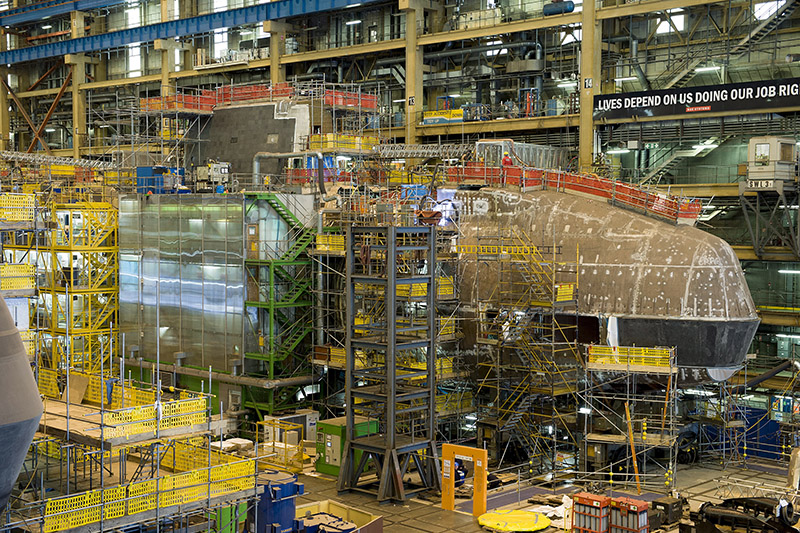
Astute Class submarine Audacious under construction at Barrow-in-Furness shipyard in Cumbria. Audacious is the fourth of the seven Astute Class submarines being built for the Royal Navy
© Andrew Linnett / Crown Copyright 2013 www.nationalarchives.gov.uk/doc/open-government-licence/version/3/Sovereign power
A central consideration is the need to strengthen UK capability. Rapid geopolitical change is prompting a fundamental reassessment of defence supply chains, with particular attention on vulnerabilities in strategic materials. The challenge, however, extends well beyond sourcing raw materials – the UK must consider the whole supply chain, including processing, manufacturing and system integration.
While few countries can achieve complete sovereignty across such diverse supply chains, strategic decisions are needed on what the UK must own, where it can collaborate and where assured access is sufficient. Recognising that these decisions may be most consequential in a defence and security context, both Royce and DMEx are supporting this process by identifying specific capability gaps in advanced materials and contributing to wider cross-sector supply chain studies.
It is important to consider the UK’s international partnerships, where and who it shares the technology with, and how capability can be developed or accessed securely. The UK has longstanding international relationships in the defence arena. These relationships are led out of the MOD, with technical support provided by Dstl and drawing upon the UK’s wider industrial and academic expertise.
Many activities are delivered in partnership with NATO and the Five Eyes alliance – an intelligence-sharing alliance between Australia, Canada, New Zealand, the UK and the US. Activities include materials coordination panels, bilateral agreements with key partner countries, and specific capability development programmes such as AUKUS and the Global Combat Air Programme (GCAP).
The AUKUS partnership brings together Australia, the UK and the US to accelerate industrial collaboration, advance capabilities, secure technology sharing, and progress major nation-building projects. It represents a transformational alignment across manufacturing, science, workforce development, nuclear-powered submarine production and high-end technology innovation.
The GCAP is a truly international endeavour that will see the UK, Italy and Japan work together with a shared ambition to develop next-generation fighter aircraft. In both cases, materials technology is a fundamental underpinning requirement, and close attention will be needed to determine what materials capability and associated supply chains are required.
One of the major challenges facing the sector is the need to upskill the existing workforce while developing the skills required by a new workforce. The sector is likely to experience significant growth in personnel in the coming years, alongside rapidly changing skills requirements. New entrants will join an environment that is becoming increasingly automated, using AI tools and techniques, with greater emphasis on modelling, simulation and digital twins across all levels of operation.
The DMEx is supporting this challenge through bespoke courses tailored to the needs of Dstl and the MOD, helping to create suitably qualified and experienced personnel, and by bringing together academia, industry and Dstl/MOD teams to learn and work on specific technology areas.
Nationwide
A central tenet of both the Defence Investment Plan and the Modern Industrial Strategy, and its associated eight high-growth sectors, is that the government’s defence and industrial strategies should support economic growth across the UK.
This will come through investment in sovereign UK defence equipment and its supporting supply chains. The economy will also benefit from the exploitation of dual-use applications, with knowledge and innovation flowing between the defence and civil sectors.
As identified in the recently published National Materials Innovation Strategy, the wider materials sector is a major economic asset for the UK. It contributes £49bln annually in gross value added, with more than 70% of activity located outside the Southeast, supporting regional growth, skills development and high-value employment.
The development of the National Materials Innovation Strategy, and the National Materials Innovation Programme that followed it to support investment in materials research, infrastructure and talent, is an example of cooperation between the Department for Business, Innovation, Science and Trade and the MOD to support a coherent approach and seek to optimise the opportunities to exploit dual-use technologies. DMEx is supporting the MOD to explore further opportunities to engage with the materials supply chain across the UK.
DMEx provides a model for future centres of excellence by expanding cross-sector collaboration, reducing barriers between defence needs and academic innovation, and aligning skills and infrastructure investment with long-term defence priorities. In an era of heightened strategic competition and supply chain vulnerability, a coherent, well-funded national approach to defence materials research is essential to safeguarding the UK’s security, industrial resilience and technological leadership.
More like this...