Making an impression
3D printing leaves its fingerprints on security and forensic science.
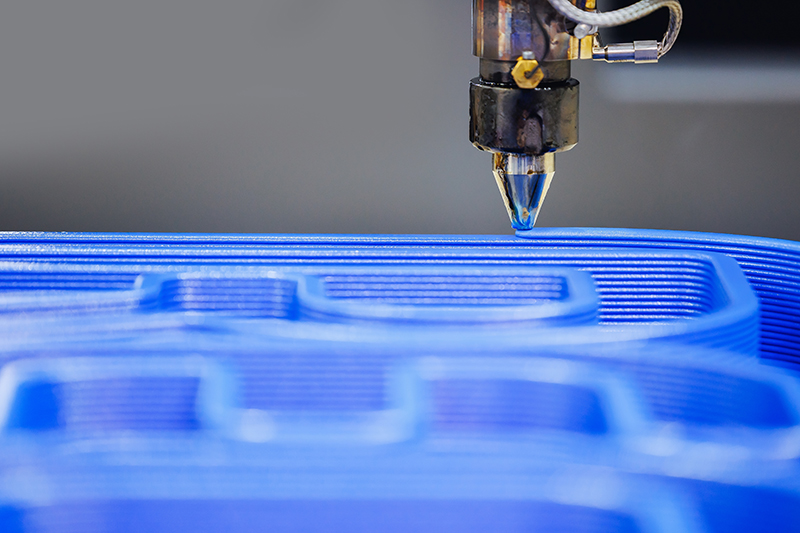
A component manufactured from carbon-fibre-reinforced nylon may perform the same engineering function as one machined from aluminium, yet the two behave very differently when examined by a security screening system or analysed during a forensic investigation. As additive manufacturing (AM) continues to evolve, the most significant changes are no longer just confined to printer hardware or manufacturing speed. Instead, they are being driven by advances in materials science, with important implications for engineering, security and forensic investigation.
Every new printable material not only expands what can be manufactured, but also influences how printed objects can be detected, characterised and ultimately interpreted as evidence.
Fused Filament Fabrication (FFF) is a form of AM that has undergone a remarkable transformation since its introduction as a rapid prototyping technology. The affordability of desktop FFF printers, combined with improvements in reliability, user-friendly software and the growing availability of printable materials, has enabled a much broader community of users to adopt the technology. It has evolved from a niche technology for producing prototype models into an established manufacturing process capable of producing functional components for applications ranging from aerospace and automotive parts to medical devices and customised engineering components.
This transformation has extended far beyond manufacturing, fundamentally changing how products are designed and produced. Today, online repositories contain countless computer aided design (CAD) files, allowing users to download and manufacture everything from action figures and household items to replacement parts for traditionally manufactured products with relative ease. The ability to move rapidly from a digital design to a physical object has become one of the defining strengths of FFF.
However, the same accessibility has also introduced new security considerations. Publicly accessible CAD repositories now contain designs for a vast array of objects, including components that may have military, criminal or public safety considerations, such as imitation weapons, knives and firearm components.
Crucially, the manufacturing process to produce these objects is no different from that used to print a legitimate model. The printer does not distinguish between a permitted and prohibited object, it will simply deposit material according to a digital design.
While discussions surrounding AM security have often focused on the increasing availability of desktop printers, this represents only part of the story. Equally as important is the rapid evolution of printable materials.
Modern engineering polymers, fibre-reinforced composites and functional filaments have transformed the performance of FFF components, enabling applications that were unimaginable only a decade ago. These advances have also challenged longstanding assumptions regarding material identification, security screening and forensic interpretation. Understanding the security implications requires more than an appreciation of printer capabilities, it demands a deeper understanding of the materials themselves and the distinctive signatures they leave behind.
Changing the landscape
The earliest generation of consumer FFF printers relied predominantly on a small number of thermoplastics, including polylactic acid (PLA), acrylonitrile butadiene styrene (ABS) and polyethylene terephthalate glycol (PETG). These materials offered an accessible route to rapid prototyping, allowing designers and engineers to evaluate form, fit and function quickly. Although well suited to visual models and proof-of-concept parts, their mechanical performance and thermal stability limited their use in demanding engineering environments.
The printable materials landscape has since expanded considerably. Engineering polymers such as nylon and polycarbonate have extended the capabilities of FFF into applications that require greater toughness, wear resistance and thermal performance.
In contrast, composite filaments reinforced with carbon or glass fibres allow for improved strength and dimensional stability. More recently, conductive, flame-retardant and metal-filled filaments have broadened the functional possibilities of printed components. FFF has consequently evolved from a prototyping technology into a manufacturing process capable of producing application-specific engineering components.
This expansion in material choice represents an important shift in the development of FFF. The material is no longer selected simply to produce a particular shape, but is an increasingly important component in the manufacturing process itself. Understanding how these materials behave during printing, and how that behaviour influences the properties of the finished component, is therefore essential to understanding the capabilities and limitations of modern FFF.
Unlike conventional polymer processing methods where the material is typically moulded into a homogeneous holder, FFF components are created by depositing successive lines of molten polymer, known as raster lines, that fuse together as they cool.
During this process, polymer chains diffuse across the interface between adjacent rasters and become entangled, forming the interlayer bonds that give the component its structural integrity. The quality of these bonds is a critical determinant of mechanical performance and is influenced by both the material properties and the processing conditions.
This relationship between material behaviour and manufacturing process distinguishes FFF from many conventional technologies. The performance of a printed component cannot be predicted solely from the published properties of the filament. Factors including melt viscosity, crystallisation behaviours, thermal conductivity, cooling rate, and the presence of reinforcing fibres or functional additives all influence interlayer adhesion and the formation of internal defects. So, two visually identical components manufactured from different materials, or even the same material using different processing conditions, may exhibit markedly different mechanical behaviour.
Materials exhibiting strong interlayer bonding generally demonstrate improved mechanical performance, whereas poor bonding introduces weak interfaces that become preferential sites for crack initiation and failure. The consequence of this manufacturing approach is that FFF components are inherently anisotropic, meaning their mechanical properties vary depending on the directions in which they are loaded. Components are typically stronger within deposited layers than across the interfaces between adjacent layers, where fracture is more likely to occur.
This anisotropic behaviour has important implications that extend beyond engineering performance. Fracture surfaces, crack propagation and failure mechanisms often preserve evidence of how a component was manufactured. Layer separation, void distribution and fracture morphology can therefore provide valuable evidence of the conditions under which a component was printed, supporting both engineering failure analysis and forensic investigation.
Security check
The material dependent behaviours of FFF components have important implications beyond engineering performance. As printable materials have become more diverse, the physical characteristics of a printed object can no longer be inferred reliably from its appearance or geometry alone. This creates challenges for both security screening and forensic investigation.
Security screening systems have been designed around objects manufactured from traditional engineering materials such as steel, aluminium and other metallic alloys. Walk-through and hand-held metal detectors identify conductive materials by detecting disturbances in electromagnetic fields, while X-ray imaging systems exploit differences in density and X-ray attenuation to distinguish between materials of varying composition. These technologies have proved highly effective for conventionally manufactured components, where material composition and manufacturing routes are relatively well understood.
However, modern FFF materials present a far more diverse materials landscape. Engineering polymers, carbon- and glass-fibre reinforced composites, metal-filled filaments and conductive polymers each possess distinct physical and chemical characteristics that influence how they interact with detection technologies. Carbon-fibre reinforced nylon, for example, derives its mechanical performance from carbon reinforcement rather than metallic content.
Conversely, metal-filled filaments may exhibit a metallic appearance despite behaving mechanically as polymer composites. Therefore, the response of an FFF component to security screening depends not only on its geometry, but also on the chemistry, density and composition of the material from which it is manufactured.
This changing landscape highlights a fundamental shift in perspective. Rather than considering all 3D-printed objects simply as plastic components, each should be viewed as a unique material system possessing its own physical, chemical and mechanical characteristics. As printable materials become increasingly sophisticated, effective security strategies will need to become equally materials-informed, recognising that material composition is often as important as geometry in determining how a printed component performs, how it can be detected and what forensic evidence it may contain.
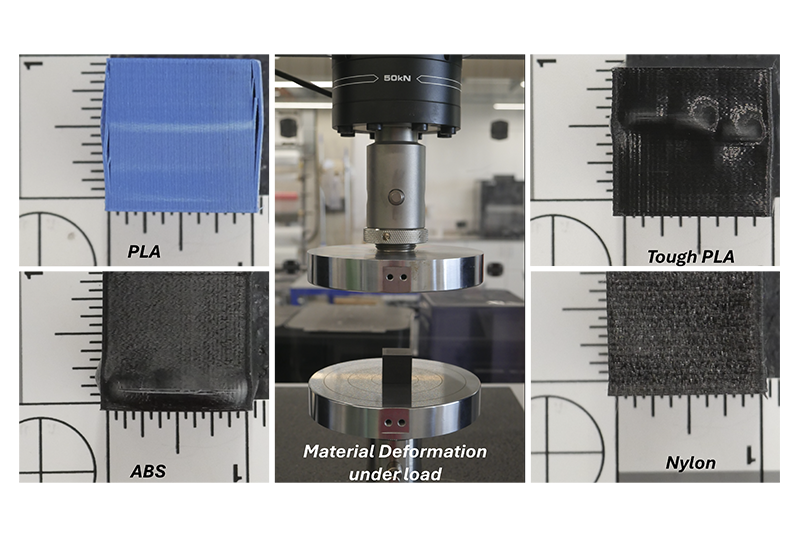
Polylactic acid (PLA), acrylonitrile butadiene styrene (ABS), tough PLA and nylon tested under load, highlighting the differences in strength, stiffness and deformation between common 3D-printed materials
© Laura Vera Stimpson and Breeshea DraysonLeaving a trace
More than a century ago, the forensic scientist Dr Edmond Locard proposed what has become one of the most enduring principles in forensic science, namely, ‘every contact leaves a trace’. Whenever two objects come into contact, material is exchanged, depositing evidence that can assist an investigation. While Locard’s principle was originally developed in the context of crime scene investigation, the same philosophy can be applied to AM. Every FFF component carries evidence of its manufacture, transferring a distinctive record within the finished component.
Each deposited raster is influenced by a combination of material behaviour and process conditions. Variations in extrusion consistency, nozzle wear, thermal fluctuations, cooling rate and machine calibration influence the formation of each layer. This affects surface morphology, porosity, crystallisation behaviour and interlayer bonding. Although these variations are often regarded simply as process variability, together they create unique manufacturing signatures embedded within every printed component.
This manufacturing signature exists across multiple layers. At the macroscopic scale, layer architecture, raster orientation and dimensional accuracy provide evidence of how the component was produced. At the microscopic scale, void distribution, fracture morphology and interlayer bonding reveal details of the manufacturing process. At the molecular scale, polymer chemistry, pigments, reinforcing fibres and functional additives provide information regarding the material system itself. Collectively, these characteristics transform every printed component into a repository of material evidence.
This concept has important implications for forensic science. Just as forensic scientists use tool marks and ballistic striations to associate evidence with a particular source, the microscopic characteristics of an FFF component may reveal valuable information about how, and potentially where, it was manufactured.
Consider, for example, two visually identical FFF components recovered during separate criminal investigations. Both appear to have been manufactured from black polymer and exhibit similar dimensions. However, microscopic examination reveals markedly different fracture behaviour. Spectroscopic analysis identifies different polymer chemistry, while X-ray computed tomography demonstrates significant differences in internal porosity and raster architecture.
Although indistinguishable to the naked eye, the components were produced using different material systems and diverging manufacturing conditions. Such variations may provide valuable investigative intelligence, helping to distinguish separate manufacturing sources, or to reconstruct the circumstances surrounding component failure.
For forensic scientists, this changing materials landscape presents both challenges and opportunities. Every FFF component contains information that extends beyond its external geometry. However, at present, there are no internationally recognised forensic methods for the routine examination of FFF components. Although many of the analytical techniques are well established within materials science and failure analysis, their systematic application to AM evidence remains in its infancy.
As the use of FFF continues to expand, there is an increasing need to develop validated forensic protocols, reference databases and standardised approaches for interpreting material evidence recovered from printed components.
Unique characteristics
Research at Canterbury Christ Church University, UK, is exploring how the unique material characteristics of FFF influence the recovery and persistence of forensic evidence. Our research has found that trace evidence persists differently to that encountered on traditionally manufactured items such as plastic and metal, due to both the filament type and the texture associated with FFF-printed objects.
For example, PLA, one of the most widely used printable polymers, exhibits hygroscopic behaviour that alters the interaction between a latent fingermark residue and the printed surface. Under controlled laboratory conditions, fingermarks deposited on FFF-printed PLA were found to degrade in less than 24 hours, so that the fingermark was no longer of suitable quality for expert examination.
In real-world environments, where fluctuating temperature, humidity and weather accelerate degradation, this persistence is likely to be even shorter. These findings demonstrate that printable materials should not be simply regarded as alternatives to conventional plastics, they create fundamentally different substrates that require materials-informed approaches for evidence recovery.
Interestingly, the same layer-by-layer architecture that reduces the persistence of some forms of evidence may enhance the preservation of others. The characteristic surface topography produced during FFF can retain nozzle marks that reflect the manufacturing process, while the internal network of deposited rasters creates a complex pathway capable of trapping microscopic debris. Rather than behaving as a smooth, impermeable surface, an FFF component acts as a 3D repository for trace material, protecting fibres, particulates or other microscopic evidence within its internal architecture. Understanding how different material systems influence the retention of such evidence is an emerging area of research with significant forensic potential.
Intensifying the investigation
FFF is also one of the most material-intensive AM processes in terms of waste generation. Support structures, purge lines, discarded filament, failed prints and calibration artefacts are routinely produced and are typically viewed simply as waste. However, these by-products retain valuable information regarding material composition, processing conditions and manufacturing history.
Our research is investigating how these discarded materials can contribute to forensic investigations. In many cases, these seemingly insignificant remnants may provide evidence that is not available from the finished component alone.
As printable materials continue to evolve, so too will the forensic challenges and opportunities they present. The future of AM security will depend not only on advances in detection technologies, but also on a deeper understanding of material behaviour, manufacturing signatures and evidence persistence.
Overcoming these challenges will require close collaboration between materials scientists, engineers, forensic scientists and the security community. By combining expertise across these disciplines, it will become possible to develop new analytical methods, establish robust forensic protocols and ensure that advances in printable materials continue to benefit society while supporting safe and responsible AM adoption.
More like this...