Flexible armour
A patent for a flexible armour system that combines ceramics and aramid fibres.

From steel plates on armoured vehicles to the advanced synthetic fibres used in personal body armour, the primary goal of defensive armour is always to protect against ballistic threats. Historically, however, achieving this goal has often involved a trade-off between protection, weight and flexibility.
In particular, traditional armour for vehicles is often made of steel or other hard metals that offer excellent protection but are extremely heavy. In contrast, for personal protection, aramid materials like Kevlar and Twaron have become standard, offering lightweight and flexible fabrics for stopping lower-velocity projectiles.
To defeat higher-velocity threats, such as rifle rounds, flexible fibre-based vests can be supplemented with rigid ceramic ballistic plates. These plates are often made of materials like boron carbide or silicon carbide, which are hard and effective, but also heavy, bulky and inflexible, significantly restricting the wearer’s mobility and comfort.
Researchers are therefore continuing to seek improved armour systems that combine the high-level protection of ceramics with the flexibility of fibre-based materials.
A recent US patent, US12435955B2, granted to the United States of America (as represented by the Secretary of the Navy) in October 2025, claims protection for a multi-layered composite material intended to provide ballistic resistance while retaining flexibility.
The armour comprises two outermost layers of a fibre-weave material, an inner ceramic layer between them and a shear-thickening fluid (STF).
A key innovation is the design of the inner ceramic layer. Unlike a conventional solid plate, it is described as a single continuous piece of interlinked ceramic material. This structure can be visualised as a flexible, chain-mail-like, mesh of linked ceramic elements. It is intended to bend and conform to a wearer’s body, while retaining the ceramic component for its hardness and impact resistance.
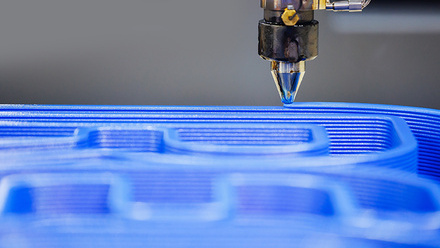
The patent explains that this interlinked ceramic layer can be produced by 3D printing. More specifically, the patent identifies resin-based stereolithography and powder-based binder jetting as possible ceramic-printing techniques. Such methods allow the armour to be scaled and tailored to fit any individual, or to cover objects of various shapes such as vehicles or equipment.
The patent also identifies alumina, boron carbide, silicon carbide and titanium diboride as possible ceramic materials.
After printing, the ceramic layer is enclosed between the fibre-weave layers such as by stitching. The patent suggests Kevlar or ballistic nylon, or a combination thereof, as suitable fibre-weave materials. These outer layers act as a durable and flexible casing for the inner ceramic mesh and provide additional tensile strength to the composite structure.
The final component is the STF. It can be applied before final assembly or introduced through an opening left in the textile enclosure. In some claimed embodiments of the invention, this fluid coats the inner ceramic layer and fills open spaces within the interlinked ceramic. In other embodiments, the STF is coated onto one or more of the layers of fibre-weave material and/or the inner ceramic layer.
The STF is a type of non-Newtonian fluid whose resistance to flow increases when it experiences sufficiently rapid deformation or high-shear stress. Under normal conditions and slow movement, the STF behaves like a liquid and remains relatively compliant. Under rapid loading, it can become substantially more resistant to flow. The patent describes using a polyethylene glycol-silica colloid as the STF.
According to the patent, the synergistic action of these three components is what gives the armour its unique properties. During normal wear, the interlinked ceramic mesh and the liquid STF allow the armour to remain flexible. However, under rapid deformation, for example, when struck by a projectile, the STF becomes more resistant to flow. In combination with the linked ceramic layer and surrounding fibre layers, that response helps the composite material resist local deformation.
The patent explains that the claimed design offers significant advantages over existing armour technologies. It combines a ceramic component, selected for its favourable hardness-to-weight characteristics (compared to steel and other hard metals), with a more conformable geometry than a monolithic rigid plate.
The patent therefore presents the design as a potentially lighter and more flexible armour system, intended to improve mobility and range of motion while remaining scaleable across protective applications.