3D printing leak-tight ceramic components for chemical reactors
A 3D printing technique has reportedly been deployed for the first time for large, leak-tight ceramic parts in next-gen chemical reactors.
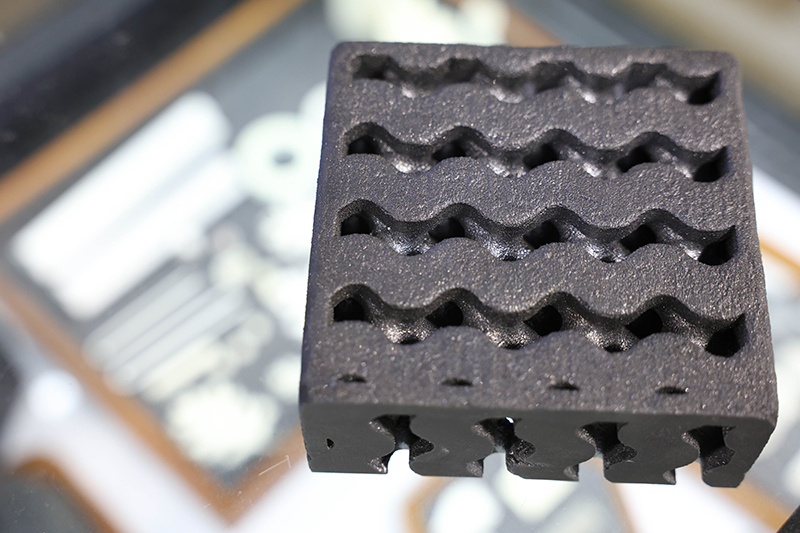
Technology and engineering firm Dimensional Energy, with assistance from the US Department for Energy’s (DoE) Oak Ridge National Laboratory, developed the robust joining technique.
It fits smaller, individual, 3D-printed ceramic parts together to form a leak-tight reaction vessel tube, which, they say, demonstrates high-temperature resistance, chemical stability and mechanical strength.
The partners explain how they first evaluated multiple design configurations to determine the optimal structures for gas-tight integrity in high-throughput reactors.
Dimensional Energy’s method involves leveraging binder-jet additive manufacturing (BJAM) to fuse silicon carbide (SiC) powder layers with a binder. This creates solid parts with complex part geometries and connection points for assembling them into a larger single component.
Brad Brennan, Chief Science Officer at Dimensional Energy, explains that the binder-jet 3D printer is loaded with a specific blend of SiC powders that provide a high-density packed bed during manufacturing.
'The complex part geometrics are printed in a layer-by-layer process using a chemical glue to shape the powders during each layer. After printing is complete, the parts are heated and then separated from unbound powder,' he explains.
Next, the partners assemble the multiple parts into a single component and deploy advanced post-processing techniques to improve bonding and sealing. This involves filling the assembled component with a SiC pre-ceramic polymer that 'infiltrates' the pores in both parts and seals them together.
'The component is heated in a high-temperature furnace to fuse the SiC powder into a more stable structure and the glue decomposes into [it],' explains Brennan. He notes that the process applied means there is no second material component that could create future corrosion issues or affect mechanical durability.
As the single SiC piece still retains some porosity, the partners resolve this issue by soaking the component with pre-ceramic polymer in another treatment cycle to fill the pores.
The final step, Brennan explains, involves 'filling-in' any imperfections and remaining porosity using chemical vapour infiltration (CVI), as this is 'particularly good at forming pure SiC in the tiniest of crevices'.
Once complete, the final part was examined using pressurised hydrogen gas to confirm that it does not leak.
Brennan credits funding from the US DoE’s Advanced Research Projects Agency-Energy for enabling this 'first-of-a-kind' technology.
He continues, 'As we were developing the designs for forming our multi-part joints, we quickly realised that they were all identical to those of woodworking,' he reveals.
'Wood is also a rigid structure where you must lock together multiple parts,' so the developers studied woodworking to save themselves valuable time on how to build the stable parts.
Although the innovation brings together the contributing technologies to benefit multiple industries, Brennan anticipates that industrial scale-up will take time due to the limitations of each technology.
'The 3D printer scales for single parts, [while] the furnaces and the CVI chambers all provide structure limits. And all are being scaled by different industries for different reasons,' he says.