Under the skin of a thorny problem
Durian skin fibre finds new life as a filler in 3D printing.
Malaysia is home to an extraordinary richness of natural resources, with over 8,000 species of plants, trees, palms and bamboo. Yet, much of this abundance remains underutilised and is often treated as waste rather than a valuable resource.
At the same time, growing concerns over climate change and the impact of petroleum-based materials have intensified the need for more sustainable alternatives. Converting biomass into functional materials offers a meaningful pathway forward. It not only reduces reliance on fossil fuels and lowers carbon emissions, but also creates new economic opportunities, particularly within the agricultural and manufacturing sectors.
In this context, the rise of 3D printing provides a powerful platform to transform natural resources into high-value products, linking sustainability with advanced manufacturing.
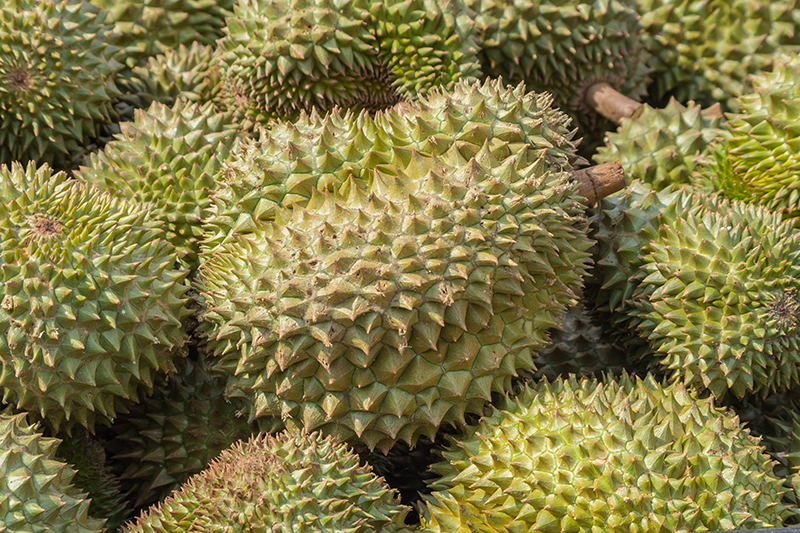
Durian skin fibre (DSF) is a natural fibre obtained from the Durio zibethinus Murray plant, commonly known as durian. Perhaps surprisingly for those in the Northern hemisphere, it is available throughout the year, every year. The increased demand for durian fruit has consequently led to higher plantation output and a significant rise in durian skin waste, posing environmental challenges if not managed efficiently.
To minimise this problem and add value to this agricultural waste, conversion into natural fibre could offer a fruitful alternative. Even more so as a filler in 3D printing.
At the International Islamic University Malaysia, the Materials Engineering group has focused on developing a reinforced biopolymer with locally sourced natural fibres.
Fruits of our labour
Polylactic acid (PLA) is a biodegradable thermoplastic originating from renewable reserves. But its inherent brittleness and limited thermal stability have restricted broader industrial application. Blending with bio-based thermoplastic polyurethane (bTPU) is effective in enhancing PLA’s flexibility and toughness, but challenges remain in achieving optimal compatibility and uniformity. Reinforcing PLA/bTPU with DSF potentially enhances the mechanical properties.
The development and application of a 3D-printable PLA/bTPU-DSF biocomposite is a compelling solution at the intersection of agricultural waste management, advanced manufacturing and sustainable tourism. The filament can be used to produce value-added products such as souvenirs and corporate gifts.
Here, PLA serves as the matrix, with DSF acting as a cost-reducing filler. However, several challenges remain, including compatibility between blend components, consistency of filament diameter and moisture absorption due to the hydrophilic nature of natural fibres.
Moisture uptake can negatively affect mechanical properties, dimensional stability and long-term durability, particularly under fluctuating humidity conditions. This is especially critical in additive manufacturing processes such as 3D printing, where consistent filament properties are required to achieve accurate dimensions and reliable print quality.
Similarly, 4D printing relies on responsive materials capable of shape-morphing under environmental stimuli. Addressing the hygroscopic behaviour of PLA/bTPU–DSF biocomposites is vital to unlocking new possibilities in additive manufacturing.
Previous lab-scale studies have demonstrated promising results. In particular, alkali treatment using 4wt.% sodium hydroxide helps improve interaction between the hydrophilic DSF and the hydrophobic polymer matrix.
The treatment enhances interfacial adhesion by removing surface impurities such as hemicellulose and surface wax, improving fibre–matrix adhesion. This leads to more effective stress transfer between the PLA matrix and the fibre. The treated DSF composites demonstrate an increase in impact strength of about 20% compared to untreated systems, especially at around 30wt.% fibre loading, where the performance was found to be comparable to neat PLA.
Meanwhile, thermogravimetric analysis indicates that treated DSF improves thermal stability, with an increase in degradation temperature of approximately 10°C compared to untreated composites. This is mainly attributed to better interfacial bonding, which enhances the resistance of the material to thermal breakdown.
At the same time, the presence of natural fibres introduces multiple degradation stages associated with the decomposition of hemicellulose, cellulose and lignin.
In terms of durability and overall performance, the PLA/DSF biocomposites show low moisture uptake, with less than 5% water absorption after 60 days of immersion and resilience against UV irradiation for up to 1,000 hours, indicating good interfacial adhesion of the biocomposite elements. This limits water penetration and reduces the formation of defects such as micro-voids.
Additionally, the ability to replace up to 30wt.% of PLA with DSF, without significant loss in properties, highlights its potential as a cost-effective and sustainable reinforcement.
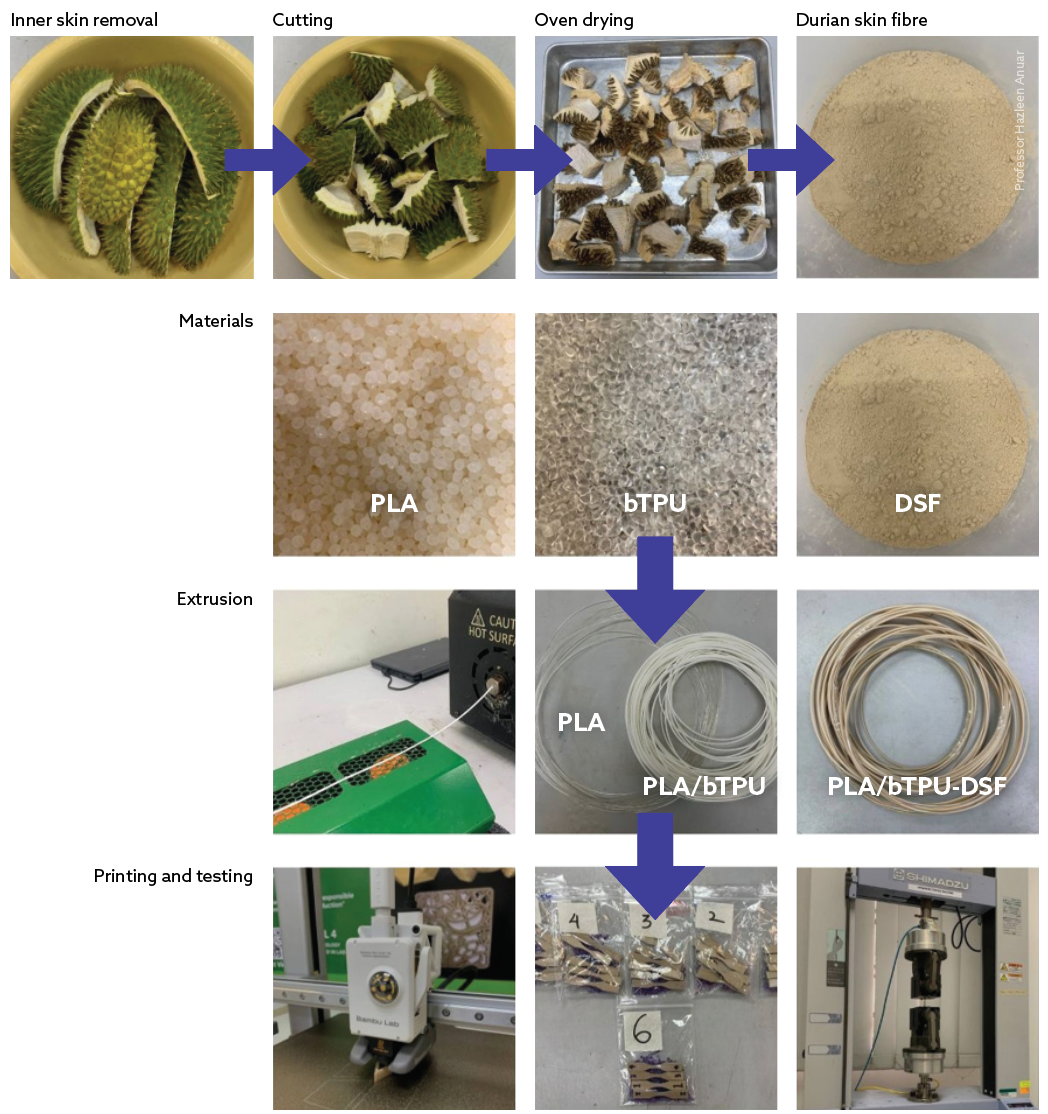
Top row: Process of obtaining durian skin fibre
Bottom three rows: Workflow to fabricate and test the polylactic acid/bio-based thermoplastic polyurethane–durian skin fibre biocomposite
© Professor Hazleen AnuarPrinting parameters
For 3D printing, the fibres are first cleaned, dried and reduced to a consistent size before undergoing the alkali treatment to improve compatibility with the PLA matrix. This treatment helps enhance interfacial adhesion and ensures more uniform dispersion, reducing issues such as agglomeration.
The composite formulation is then optimised by controlling the fibre content to strike a balance between mechanical performance and printability. The materials are processed into filaments through extrusion, with attention given to achieving consistent diameter and stable flow behaviour.
Moisture-related issues are mitigated through proper drying of raw materials before processing and storing the produced filaments in low-humidity conditions. These measures help prevent defects such as porosity, poor surface finish and weak interlayer bonding during printing.
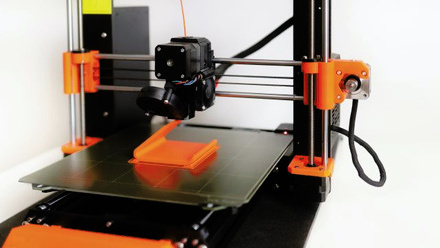
The filaments are subsequently used in standard fused deposition modelling (FDM) systems, where digital designs are translated into physical objects through a layer-by-layer process.
Fibre loading is carefully controlled to ensure uniform dispersion and to minimise agglomeration, which can otherwise weaken the material and affect processing stability.
The optimum DSF content for 3D printing was identified by systematically varying fibre loading and examining its influence on printability, filament integrity and mechanical behaviour. Rather than focusing solely on strength, the selection prioritises a balance between material flow during extrusion and structural performance after printing. This ensures that the final composition could be processed reliably, avoiding common issues such as nozzle clogging, poor interlayer adhesion and filament instability.
To further understand how DSF modifies PLA filament properties, comparative analyses were carried out across mechanical, thermal and morphological aspects. The introduction of DSF alters the internal structure of the material, influencing stress transfer, chain mobility and crystallisation behaviour.
Observations from fracture surfaces and thermal response highlighted the importance of fibre-matrix interaction and dispersion quality in determining performance. These findings show that DSF functions not merely as a filler, but as an active component that reshapes the behaviour of the material under different loading and environmental conditions.
Together, these approaches improve the overall reliability, printability and durability of the biocomposites, making them more suitable for advanced 3D and 4D printing applications.
Pieces of the puzzle
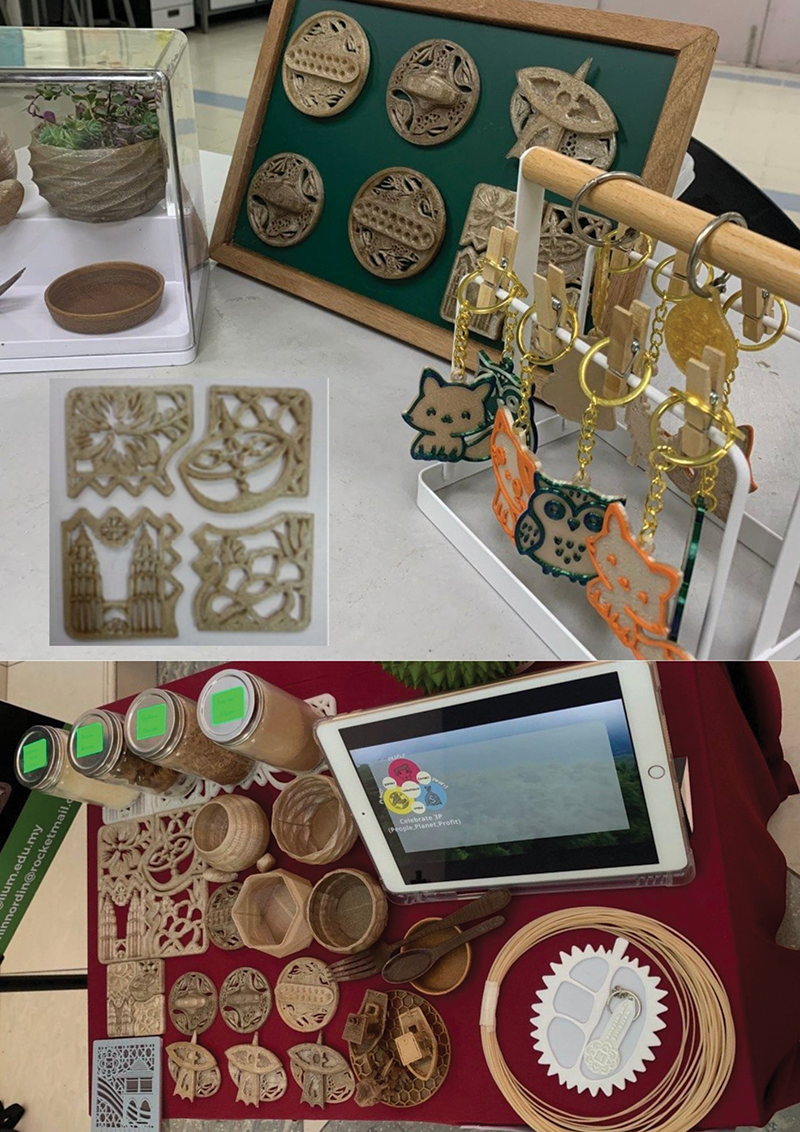
3D-printed polylactic acid/durian skin fibre biocomposite products developed as souvenirs, including coasters, keychains, and decorative items
© Professor Hazleen AnuarThe images above include a puzzle coaster showcasing elements of Malaysian tourism. The design incorporates iconic symbols such as the national flower, flying moon kite (locally known as wau bulan), Petronas Twin Towers at Kuala Lumpur City Centre and the Rafflesia flower.
The coaster was designed as a puzzle to encourage people to buy it and complete the design themselves. The initial design phase involved brainstorming and organising ideas, using Canva to visualise the positioning of each element on the puzzle. The design was traced using AutoCAD, detailing the engraving patterns.
Special attention was given to avoid creating designs that were too small or intricate, ensuring they could be processed accurately by the 3D printer. After tracing, the design was converted into a 3D model and adjusted to an optimal thickness for functionality.
From an application perspective, the developed filament meets the functional requirements of the tourism industry in terms of printability and product quality. But beyond the technical achievement, this work highlights a meaningful step towards environmental, social and governance-driven innovation, effectively transforming durian waste into functional materials.
Combining Malaysia’s natural resources with advanced manufacturing supports waste valorisation, encourages local resource utilisation and opens opportunities for community involvement and circular economy practices.
What makes this approach particularly impactful is its potential for real-world adoption. Because the filament can be processed using existing 3D printing technologies, it lowers the barrier for entry into manufacturing. This creates opportunities for decentralised production, where local communities and small enterprises can produce value-added products on demand. In the context of tourism, such products not only serve as mementos but also carry a narrative of sustainability, connecting visitors to environmentally responsible practices rooted in the local context.
The development of DSF-based biocomposites points toward a new generation of materials that extend beyond simple substitution. With further refinement, these materials could be tailored for more advanced applications, including responsive or functional systems in 3D and 4D printing. This work illustrates how innovation at the material level can drive meaningful change across manufacturing, design and environmental stewardship.