3D printing tissue-like structures with light
Holograms are being used to guide laser light for volumetric 3D printing at scales suitable for biomedical applications.
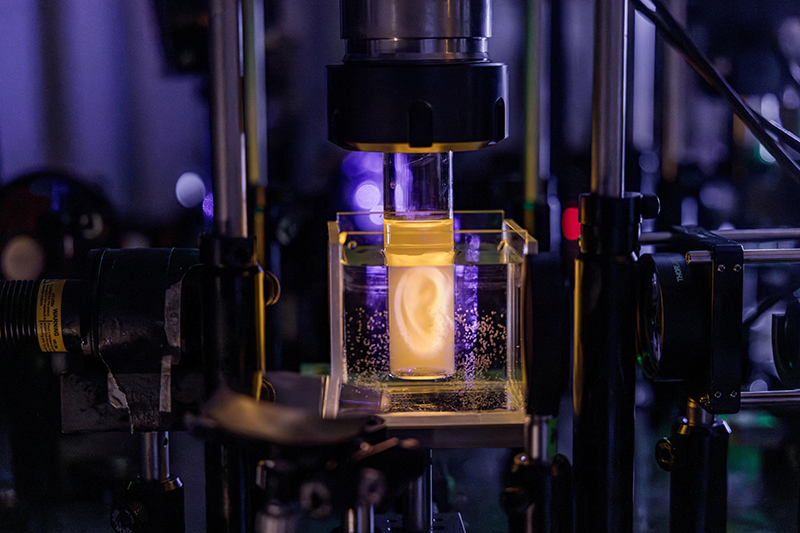
The innovation reportedly enables cell-compatible, high-resolution 3D printing, say researchers at EPFL, Switzerland.
This builds on their previous work on tomographic volumetric additive manufacturing (TVAM).
The 3D printing method uses laser light to harden a rotating vial of photosensitive resin into a desired shape. In that work, the researchers use holograms to encode 3D forms by modulating the alignment (phase) of light waves rather than their brightness (amplitude), as previous methods had done, preserving far more of the laser’s power.
The team has now implemented a new platform for the holographic approach, which they claim makes it 70 times more efficient than previous techniques. It reportedly controls the phase of a light beam in a volumetric 3D printing system for the first time.
The researchers report how ‘the method’s phase control enables holographic printing with self-healing beams, which produce higher-fidelity 3D-printed objects in light-scattering media, such as those containing living cells’.
For an experiment that used a 150-mW laser diode, they printed a life-sized human ear model in a gelatin-based resin. When they deployed a smaller print construct (volume 64 mm3), the researchers confirm the embedded living cells were still viable after six days and had even formed organised networks.