Operational advantage for the front line
Reflecting on 25 years of defence technology development.
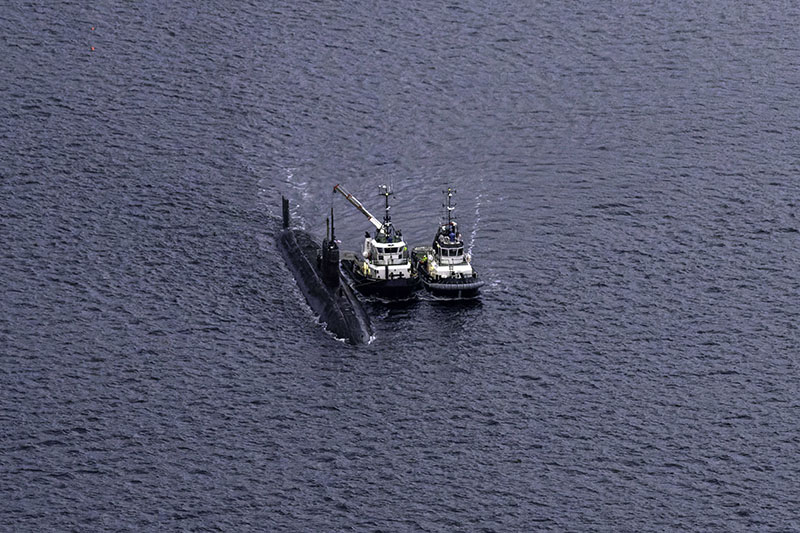
Submarine operations at the British Underwater Test & Evaluation Centre, a critical sovereign capability supporting the Royal Navy’s acoustic and weapons testing
© QinetiQOver the past 25 years, materials technologies have delivered transformative advances, enabling significant improvements in efficiency, performance and capability to provide military advantage across land, sea and air domains.
During this time, highly exotic materials have been explored, such as diamond-coated boron and nano-hairy carbon fibres, alongside innovative adaptations of existing systems – including hollow carbon fibres and hybrid shape-memory reinforced composites. While many demonstrated significant promise, only a small proportion achieved widespread adoption.
One of the greatest challenges facing innovation is the gap between research and operational deployment, often referred to as the ‘valley of death’. Transforming technical breakthroughs in the laboratory into operational capability is considerably more difficult. Technical superiority and scientific excellence alone rarely guarantee success.
The technologies that ultimately succeed are those able to navigate the complex ecosystem between invention and adoption. Alongside performance gains, successful innovations require certification pathways, manufacturing scaleability, supply-chain resilience, affordability, supportability and a compelling commercial case.
So, why and how do some defence materials technologies succeed while others fall by the wayside, and how has the criteria for success continued to evolve?
Drivers for novel materials
The UK’s Ministry of Defence (MOD) requires innovative technologies to maintain military advantage against rapidly evolving threats while adapting to future security challenges. At the same time, defence organisations face increasing pressure to deliver greater capability with reduced cost and risk.
Advanced materials have long offered potential solutions. Smart and multifunctional materials can respond to changing environments, shape-memory systems can alter form to optimise performance, while self-healing materials can improve resilience at the same time as reducing maintenance burdens.
Increasingly, research is focused on areas such as metamaterials, where carefully engineered structures can deliver combinations of properties that do not exist naturally.
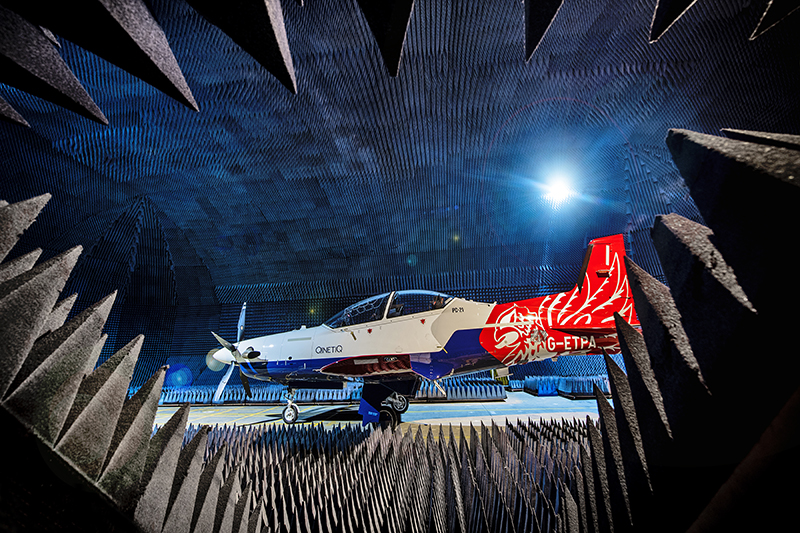
A Pilatus PC-21 advanced turboprop trainer aircraft inside QinetiQ’s Anechoic Test Facility at the UK Ministry of Defence Boscombe Down site. The chamber walls, floor, and ceiling are lined with spike-shaped, radiation-absorbent material designed to completely absorb radio frequency waves
© QinetiQEmerging digital technologies are accelerating this trend. Artificial intelligence and machine learning are helping researchers identify novel material combinations and structures that were previously impractical to investigate via conventional experimentation.
The opportunity is significant. However, adoption depends on far more than material performance alone.
In many commercial sectors, a material demonstrating clear technical superiority can find a relatively direct route to market. Defence operates under very different conditions.
A material may offer improvements in strength, weight, thermal performance, survivability or electromagnetic behaviour, yet these benefits alone are rarely sufficient to justify adoption. Defence organisations must be confident that a material can perform reliably throughout decades of service, often under extreme and unpredictable operating conditions.
The challenge is amplified by the multifunctional nature of defence systems. Materials frequently need to satisfy competing requirements simultaneously. Components must often balance lightweighting with durability, survivability, affordability and environmental resistance while maintaining signature-driven operational effectiveness.
Unlike many commercial applications, operational requirements may also evolve throughout a platform’s lifespan. Materials selected today may need to perform against threats and mission profiles that do not yet fully exist.
Consequently, extensive evidence is required to demonstrate performance across a broad range of conditions, including temperature extremes, fatigue loading, impact events, corrosion, electromagnetic effects and battlefield damage. New materials inherently possess less historical data than established alloys, polymers and composites, increasing programme risk and making qualification more challenging.
The development of naval structures illustrates this complexity. A lightweight structure must also remain corrosion resistant, maintainable, damage tolerant and capable of surviving decades of operational use. Additional requirements, including acoustic performance and shock resistance, further increase the challenge. Success rarely depends on optimising a single property. Instead, it relies on achieving the right balance across numerous interacting requirements.
The same challenge exists across domains. Materials developed for maritime applications may offer significant benefits in aerospace systems, but the performance criteria can differ dramatically. For example, a lightweight composite that performs exceptionally in a naval structure may require entirely different optimisation when used within a radar dome, where electromagnetic performance becomes equally important.
Our experience has shown that understanding failure mechanisms is often the key enabler. The deeper the understanding of how a material behaves under operational conditions, the greater the opportunity to transfer knowledge and qualification evidence between applications.
Making the grade
Generating trusted performance data is one of the most significant challenges facing materials innovation in defence.
Qualification programmes often require substantial investment in testing, analysis and demonstration long before adoption is guaranteed. Historically, material evidence has commonly been generated on a programme-by-programme basis, creating fragmented datasets across organisations and platforms.
This challenge is especially pronounced in the defence sector, where the potential market volume for materials is generally lower than in civil applications. As a result, technologies with possible application across multiple programmes often enjoy a significant advantage. Spreading development and qualification costs across several users improves the business case while generating broader evidence of capability.
A strong example is the adoption of non-crimp fabric (NCF) composites. These materials offer high stiffness, low weight, damage tolerance and more efficient manufacturing routes than conventional composites. Their successful adoption was supported by a succession of collaborative European and then UK programmes involving civil and defence industry, academia and government organisations.
By generating evidence across multiple applications, development costs could be shared while creating wider confidence in the technology.
As part of these collaborative programmes, QinetiQ focused on creating the challenging evidence required for defence applications, such as performance data in extreme temperatures or with battlefield damage. These areas typically don’t have defined industry standards against which performance can be measured, but were vital in the subsequent release-to-service work required for the Airbus A400M Atlas adoption, the most advanced airlifter that used NCF in areas such as the cargo door.
This highlights an important lesson – successful material technologies often extend beyond a single platform and frequently deliver value across both defence and civilian sectors. Dual-use opportunities can significantly improve the likelihood of success by expanding market size and leveraging existing industrial capability.
One example is QinetiQ’s application of low-observable expertise to the renewable energy sector. Wind turbines can generate unwanted radar reflections that affect surveillance and air traffic control systems. By applying decades of experience in radar-absorbing materials and electromagnetic design, QinetiQ developed solutions that reduced radar signatures while preserving structural and aerodynamic performance. The technology addressed a challenge facing renewable energy developers while exploiting established manufacturing processes and supply chains.
However, not every technically successful material achieves adoption. Some technologies fail because manufacturing complexity outweighs performance advantages. Tufted composite structures, for example, can significantly improve delamination resistance and impact performance. Despite extensive research and proven benefits, adoption has remained limited. The additional manufacturing processes introduce variability that prove difficult to control consistently at industrial scale.
Consistency is key
For defence applications, manufacturing consistency is often as important as material performance. A change in material behaviour can affect structural integrity, thermal management, electromagnetic performance, maintenance procedures and platform signatures simultaneously.
Over the last 25 years, many promising technologies have struggled not because they lacked performance, but because they could not be manufactured reliably, affordably and repeatedly at scale.
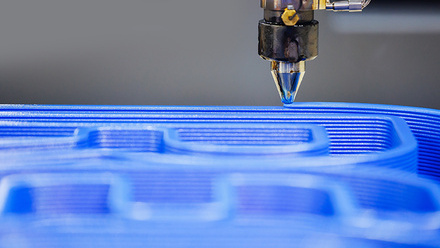
Advanced manufacturing therefore acts as a critical bridge between research and deployment. This is increasingly recognised within defence. The MOD’s Defence Advanced Manufacturing Strategy highlights the growing importance of manufacturing technologies in delivering operational capability, supply-chain resilience and sovereign industrial capacity. Additive manufacturing (AM) provides a particularly strong example. Advances in process control, digital engineering and qualification approaches have increased confidence in the technology and enabled wider adoption.
For example, QinetiQ is working on enabling AM within the Royal Navy’s submarine-related activities at HM Naval Base Clyde. Enabling components to be manufactured closer to the point of need reduces supply chain dependency while improving operational responsiveness and platform availability.

Air-deployed underwater sensing operations at QinetiQ’s British Underwater Test and Evaluation Centre supporting high-barrier test, evaluation and certification services for UK anti-submarine warfare programmes
© QinetiQCrossing the ‘valley of death’
Effective innovation requires an ecosystem that extends beyond research, including technology transfer, intellectual property management, industrial partnerships, investment and market engagement.
Successful technology transfer begins during research rather than after it. Future applications are not always obvious at the outset, meaning development programmes must remain flexible enough to respond to emerging opportunities and changing customer needs.
This is particularly challenging for smaller organisations. While they may possess exceptional technical expertise, they often lack the commercial resources required to navigate complex defence markets. As a result, potentially transformative technologies can struggle to gain visibility or attract the support necessary for adoption.
Equally important is productisation. Defence customers do not buy research, they buy solutions to operational problems. Materials therefore need to be translated into products that can be integrated, qualified, manufactured, maintained and supported throughout their service life. This requires collaboration between scientists, engineers, commercial teams and end-users.
Intellectual property plays a critical role in enabling organisations to protect their competitive advantage, while also providing confidence to investors and industrial partners. This is particularly important given the potential lengthy timescales associated with developing and deploying new materials, which can take 15-20 years to progress from concept to widespread adoption. During this period, operational priorities, procurement budgets and programme requirements may change significantly.
This gap between technical readiness and market adoption remains one of the most persistent barriers to successful defence innovation.
Supply chain resilience
Supply chain resilience and long-term supportability are becoming increasingly important drivers of adoption decisions.
Unlike many commercial sectors, defence platforms often remain in service for several decades. Aircraft, ships and land systems must therefore be supported throughout lengthy operational lifecycles, often under changing geopolitical conditions.
As a result, organisations must consider the resilience of supply chains on which technologies depend. Questions around raw material availability, manufacturing capacity, supplier stability and geopolitical dependency increasingly influence adoption decisions.
Supply chain weaknesses can rapidly become strategic vulnerabilities. Dependence on scarce materials, single-source suppliers, or foreign manufacturing capability may limit deployment regardless of technical merit.
Similarly, materials must remain maintainable throughout their service lives. Inspection, repair, replacement and eventual obsolescence management are all critical considerations when evaluating novel technologies for defence use.
The environmental factor
Traditionally, defence materials innovation has focused on reducing weight, improving survivability, increasing performance and lowering operating costs. While these priorities remain essential, sustainability is becoming an increasingly influential factor.
Future materials must demonstrate environmental responsibility alongside operational effectiveness. Regulatory pressures, circular economy principles and growing scrutiny of manufacturing sustainability are creating new challenges for developers.
This can create difficult trade-offs. Some advanced materials improve operational efficiency, but introduce challenges relating to recyclability, resource use, or end-of-life disposal. Future success is therefore likely to depend on balancing military effectiveness with environmental responsibility.
The shift in battery and energy storage technologies illustrate this well. Developed to provide higher energy density, improved safety, greater reliability and longer operational life, these technologies are also being designed with lifecycle considerations from the outset.
Alongside performance improvements, attention is given to durability, battery management, maintenance reduction and more efficient use of critical materials. By extending service life and reducing replacement frequency, these technologies help lower environmental impact while preserving the operational resilience demanded by defence users.
Scale and pace
The last 25 years have demonstrated that successful defence materials innovation depends on far more than technical performance. The most successful technologies are rarely those that achieve the highest laboratory results. Instead, they are the technologies that balance capability with manufacturability, certification readiness, affordability, supportability and commercial viability.
Looking ahead, the challenge will become even more complex. Future materials must satisfy growing demands for sustainability, resilience, sovereignty and affordability while continuing to deliver operational advantage.
Digital technologies are likely to become key enablers to meet changing demands. Modelling and simulation tools are increasingly supporting Certification and Qualification by Analysis, helping to reduce physical testing burdens while maintaining the levels of assurance required for defence applications.
Digital twins enhance this capability by creating lifecycle representations of materials, components and systems, integrating manufacturing and operational data to improve understanding of performance over time.
As materials become more sophisticated and multifunctional, digital tools will play an increasingly important role in accelerating development and adoption. The emergence of a genuine digital thread linking design, manufacture, qualification and operation has the potential to reduce risk, shorten development timelines and increase confidence in deployment.
The future of defence materials innovation will be determined by what can be proven, manufactured, supported, sustained and deployed successfully at scale and pace.
More like this...