Rethinking titanium
FAST-forge as an emerging solid-state metal processing technology.
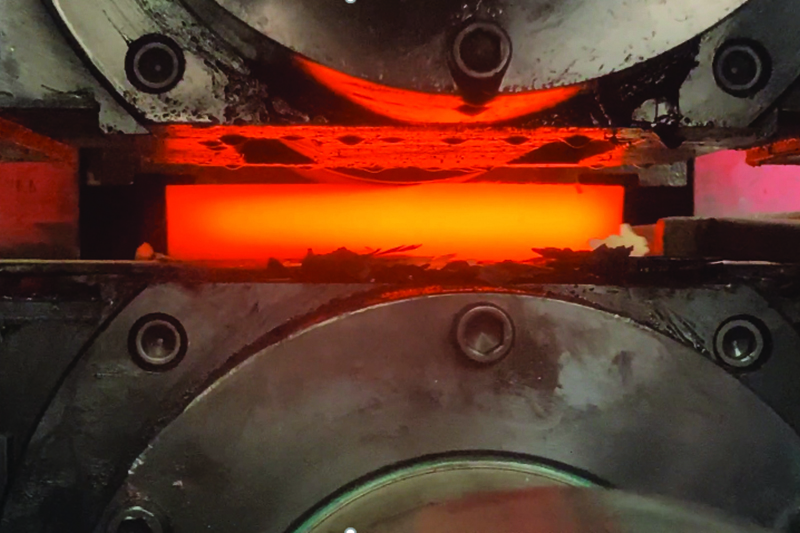
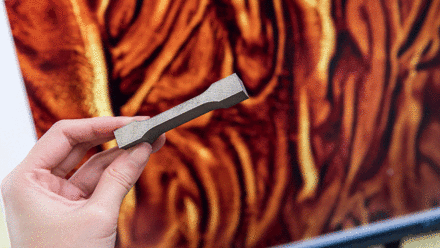
Hot rolling of a FAST Ti 6-4 billet for ballistic testing
© University of SheffieldDesign engineers across all industries are faced with trade-offs when considering material selection. It is a balancing act that involves assessing factors such as weight, strength, operating temperature, cost and lead time.
Titanium alloys are a case in point. They might offer the optimal physical attributes for an application, but are quickly rejected when quotes reveal eyewatering costs and lead times. But what if it were possible to manufacture titanium components quickly and with a cost-competitive price tag?
Field Assisted Sintering Technology combined with traditional forging methods (FAST-forge) is emerging as an industrial process with the potential to deliver more affordable titanium components with implications for a host of sectors including defence.
Weighing up the trade-offs
The defence industry is not unique in terms of customer and supplier requirements when it comes to material selection. For example, a potential customer of an armoured fighting vehicle (AFV) wants a platform that offers:
- Maximum payload to carry fuel and supplies
- Highest possible performance for speed, manoeuvrability, lethality and survivability
- Endurance across a range of load cases and environments without needing repairs
- A reasonable price bracket
The supplier wants to meet these requirements and also:
- Use cost-effective materials to maximise profit margin
- Reduce lead times to meet deadlines
- Keep consistency in performance across parts to reduce the risk of non-conformances
In many cases, cost is ultimately the deciding factor and so compromises and concessions must be made on weight, payload or performance. The use of titanium alloys is often only justified in cases where nothing else will meet the criteria due to the high costs and long lead times. At the time of writing, titanium alloy billets were priced in the region of ~£25/kg compared to aluminium alloys at ~£4/kg and steel alloys at ~£2/kg. The following examples illustrate why it would be a game-changer if titanium could be obtained at a lower cost.
A battle tank, a Challenger 2 for example (see image below), without fuel or payload is estimated to weigh 60t. The tracks are made up of approximately 80 steel links each side, with each link weighing approximately 40kg. The density of a titanium alloy such as Ti 6-4 is approximately 40% lower than a typical high-strength steel alloy, and so this broadly equates to a weight saving of ~3t, or 5% of the vehicle.
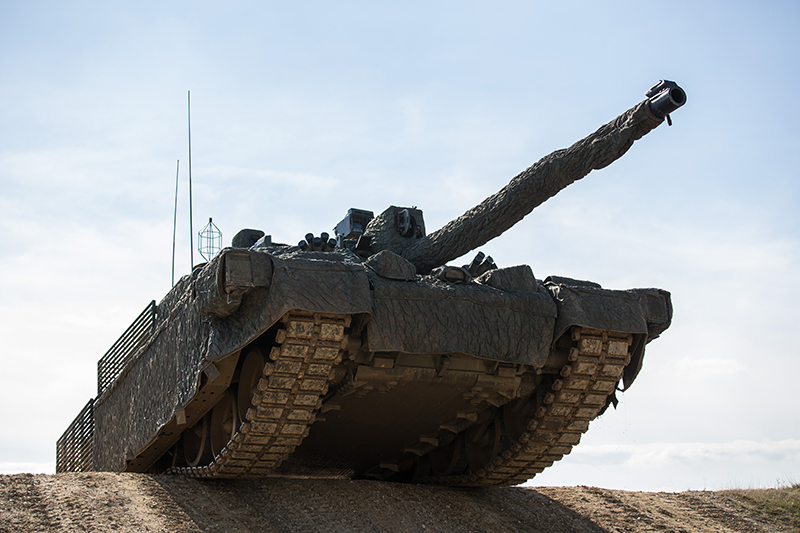
Challenger 2 Battle Tank
© PO Owen Cooban / Crown copyright 2016 https://www.nationalarchives.gov.uk/doc/open-government-licence/version/3/Of course, this does not account for important design factors such as relative stiffness or yield strength, but the principle has been demonstrated through a US Army Tank-automotive and Armaments Command initiative that replaced steel track components with titanium to successfully achieve lower weight.
Track links are merely one of many AFV features made from steel that would benefit from being constructed from titanium for an acceptable cost.
Meanwhile, engineers in the marine industry must consider corrosion resistance a priority requirement.
Steel fixtures, mechanisms and structures require coatings and maintenance schedules to reduce the risk of corrosion-related failures. Stainless steels can be used in certain circumstances, but they typically offer lower yield strengths and are not immune to pitting or crevice corrosion. Titanium offers both high strength and a high level of corrosion resistance as it forms a thin, stable, oxide layer when exposed to oxygen. Titanium can also be used for the joining brackets or fixtures in multi-material structures, i.e. composites, to substantially reduce the risk of galvanic corrosion.
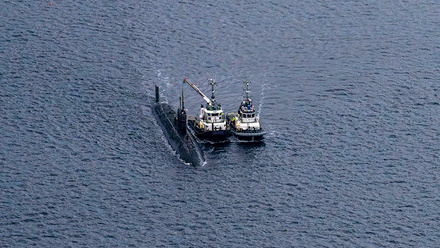
Uncrewed and autonomous platforms have established themselves as an essential component to defence operations. An example being mine hunter platforms (see image below) where the human is taken out of harm’s way. Removing the human from the platform does raise the prospect of reassessing the level of acceptable risk in material design, potentially offering an initial entry point for materials made with recycled feedstock.
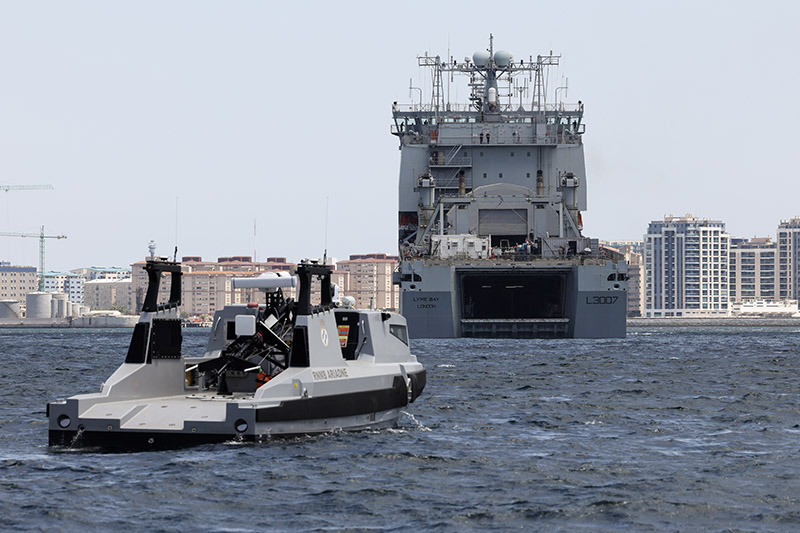
Uncrewed surface vessel RNMB Ariadne designed for mine countermeasure operations seen here approaching RFA Lyme Bay
© LPhot Kevin Walton UK MOD / Crown copyright 2026Forging ahead
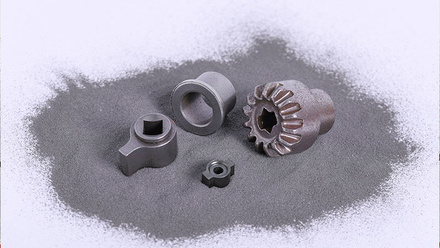
FAST-forge is a metal processing technique that consolidates manufacturing waste into billets of material to be processed into components.
The technology is being developed at the University of Sheffield, UK, in collaboration with the Advanced Forming Research Centre (AFRC) at the University of Strathclyde, UK. The manufacturing waste, or feedstock material, comes from machining chippings known as swarf, or from out-of-spec powder.
FAST-forge can be described in four steps:
- Material feedstock is collected, graded and cleaned
- The feedstock is compacted into briquettes
- A pulsed electric current is applied to the briquette (FAST) while under pressure consolidating the material into a billet
- The billet can then be forged, rolled, or extruded to create near-net shape parts
More recently, the team at Sheffield has demonstrated that solid offcuts of titanium plate can be processed via FAST, as well as other high-spec alloy grades such as nickel superalloys.
Transition Metals Ltd, UK, sorts, cleans and screens the swarf feeding into the process. They organise the collection of manufacturing waste from machine shops and undertake a series of processes to remove contaminants, enhance cleanliness and establish a controlled morphology for satisfactory briquetting. All of this provides a quality-controlled, graded feedstock with full traceability and certification as per AS 9100 standards. This level of quality control is essential because any inclusions will have a detrimental effect on the part quality.
Otherwise, alternative sources of material, such as out-of-spec powder, could come directly from the powder manufacturers even before the material has been handled or exposed to contaminants.
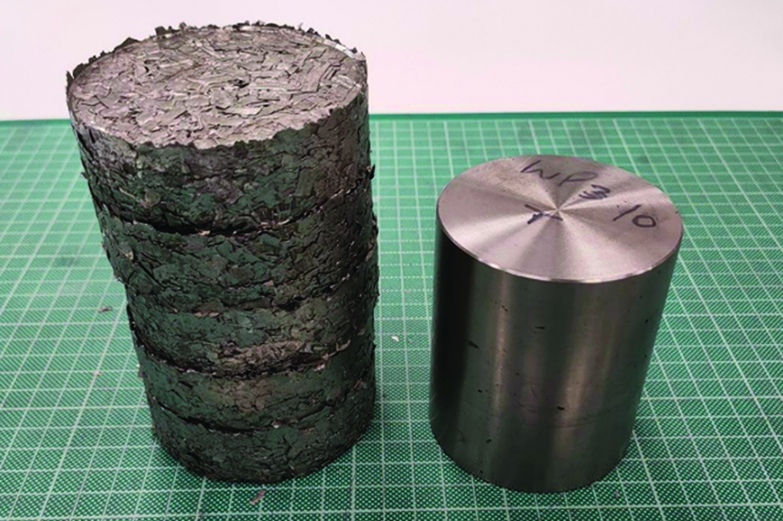
Stacked briquettes made with commercially pure titanium swarf (left) and a FAST-processed billet post machining (right)
© University of SheffieldThe briquetting process uses standard industrial presses and custom-made tooling. The AFRC has led development to optimise the parameters for a well-consolidated briquette. Example 80mm diameter briquettes made from commercially pure titanium swarf are shown on the left in the image above. The tooling can produce briquettes that are up to 250mm in diameter, equating to ~5kg of titanium.
The equipment used for FAST consolidation in the next step is housed at the University of Sheffield, where it has been used for R&D since 2012. An example of a FAST-processed billet is shown above in the same image.
The equipment is currently the largest available in the UK and can process the 250mm diameter briquettes supplied by AFRC. It serves well as a research or developmental tool for manufacturing smaller components, but is not an industrial setup. Progress beyond the current Technology Readiness Level (TRL) 3/4 to reach an economical scale of material processing will require access to larger facilities.
The subsequent forging processes are commonplace in the metal working industry. Demonstrator projects have proven the success of closed-die forging to produce near-net shapes, rolling to produce plate (see image at the top of the article), friction welding to join billets together and extrusion to produce tubes.
These methods, and others, were explored through a four-year project funded by the Ministry of Defence (MOD). The Affordable Titanium for Useable Defence Equipment (ATiTUDE) programme was funded by the Defence Science and Technology Laboratory (Dstl) and delivered by a consortium of industry stakeholders, research institutions and SMEs. The resultant properties from each process are revealed with two examples as follows: a closed-die FAST-forged Ti 6-4 component with ultimate tensile strengths comparable to wrought Ti 6-4, and ballistic testing of a FAST-rolled Ti 6-4 plate meeting the MIL-STD-662F specification for evaluating armour materials using a threat of 30-cal APM2 armour-piercing projectile.
The ATiTUDE project finished in 2024 and, on behalf of the MOD, Dstl is currently supporting follow-on research into FAST-rolled titanium armour plate and near-net-shape components in collaboration with industry stakeholders.
Working on new material
The adoption of new technology first involves a need or an opportunity and then follows a careful review of the risks and barriers. From a technical perspective, the design engineer requires evidence of material quality and consistency, which is preferably qualified against a standard. Without consistency there is limited scope for confidence in the integrity of the resultant part.
From an economic perspective, the supplier needs a business case that accurately assesses the costs, lead times, production volumes and security of supply.
FAST-forge is on a journey to address all of these requirements. It has successfully demonstrated technical performance across several demonstrator projects and is ready for the next level of development and scrutiny. Initial assessments put FAST-forged titanium at a lower price band than wrought alternatives. By exactly how much will depend on the route taken to scale-up production.
It is worth noting that titanium usage in exquisite applications will likely continue using established manufacturing techniques. Aircraft landing gear, for example, will need to be machined from wrought billets of titanium and so the supply chain will continue to generate swarf and off-cuts in the UK. The two manufacturing routes are complimentary.
FAST-forge therefore offers the potential to produce titanium parts at a more affordable price and opens up a range of material solutions for design engineers across all industries. It has successfully progressed towards TRL 4 and work continues to optimise the parameters and fully characterise resultant material properties. This is one of several emerging technologies seeking to extract the value out of a material that is readily available in the UK. Such technologies could give UK metal manufacturers and industries an advantage over competitors.
© Crown copyright (2026), Dstl. This information is licensed under the Open Government Licence v3.0.
More like this...