In the field
IOM3 members share their personal reflections on the defence sector.
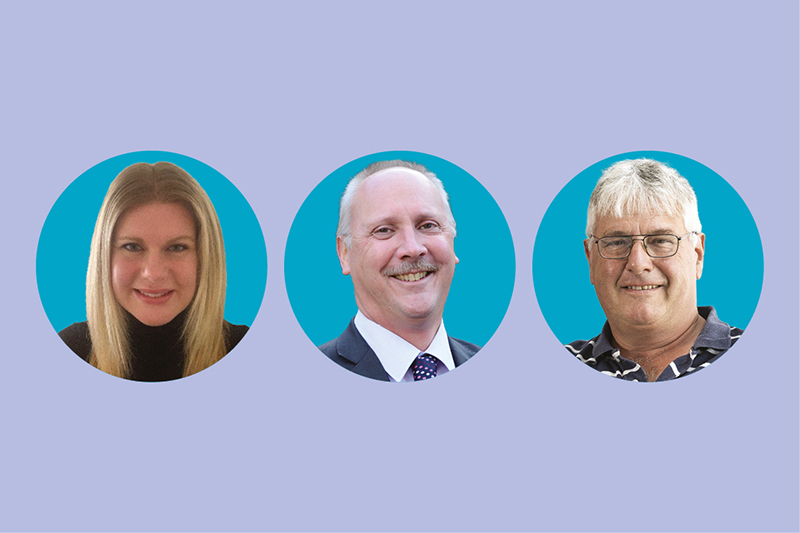
IOM3 members Dr Marina Dawes (left), Jon Binner (centre), Professor Nicholas Bazin (right)
© Marina Dawes, University of Birmingham, Nicholas BazinDr Marina Dawes FIMMM, Director of the Science People Function at AWE
I joined AWE in 2003 on the graduate scheme after doing my degree and PhD in Chemistry. But to take a step back as to how I found AWE – as I flicked through the hard-copy graduate prospectus in the university careers office (sounds very old-fashioned now, but that’s how it was in 2002), what initially got my interest was the mention of ‘exotic actinide materials’ and the vital role AWE plays in defence.
A career in defence or nuclear wasn’t something I had considered, but I was intrigued. Since that introduction, AWE’s mission is something I have always believed in and am proud to play a part in – national security through nuclear science and technology.
When I joined AWE, I felt privileged to be in the Actinide Materials Group, working on materials that most people will (fortunately) never come close to. The working environment was challenging with everything being necessarily contained in gloveboxes within a large and incredibly heavy-duty windowless concrete building.
I’d briefly used a positive pressure glovebox during my PhD to handle air- and moisture-sensitive reagents, but the large network of negative pressure gloveboxes in a nuclear facility was a whole new experience. I very much enjoyed it though. The challenge – both physical and scientific – the uniqueness of the work, the environment and the amazing people. There was a real sense of community within the department, and the professional connections I made during those early years have endured and served me well throughout my career.
Many of the people I worked with back then are still at AWE, and we come across each other and work together again in new capacities as we continue our careers here.
In terms of how my career has progressed, the first decade was focused around technical work and leading teams in my ‘technical home’. I had the opportunity to work on many fascinating projects and take on a range of responsibilities. In the years that have followed, I have discovered that people leadership is what I really enjoy, and my career pathway has developed to being all about people leadership in science. Even though I do little to no purely technical work these days, I believe my technical background serves me well.
I will soon be celebrating my 23rd work anniversary here, and while that might be considered remarkable by today’s standards, I would say I’m a mid-range employee in terms of length of service at AWE.
Like any organisation, of course people come and go, and it’s great to have those fresh, new perspectives. But like me, many people devote their working lives to this company and what we do here. From my perspective, this is due to the unique mission and fascinating and challenging work. It’s also because of what AWE offers as an employer and the people who work here.
Many companies will have a narrative about how they invest in their people – it’s of course morally the right thing to do, but for AWE it also makes absolute business sense. People with the types of knowledge and experience we need simply aren’t always available on the job market, so growing/developing our own, investing in and retaining our people for the long term is a must.
During my time here, I have become a mum to two amazing daughters. The maternity leave provision and commitment to supporting part-time and flexible working are excellent. I’m certainly not saying there isn’t more we can do to improve this, one must never be complacent about such things, but my experience has been very good in this regard. I’ve been able to be the primary carer for my girls, working part-time to do all that entails, while still having a fulfilling career.
Looking back, I would say that my career has progressed due to three factors, which I believe are all critical to success: 1) I have wanted to progress, exploring opportunities and taking on new responsibilities, 2) I have consistently had supportive line managers and colleagues who truly ‘get it’ in terms of the challenges of being a working parent, and 3) Working at an organisation that has both the policies to support working parents and a culture that enables those to be realised – one without the other does not work in my opinion.
I have very much enjoyed my time at AWE and been hugely grateful for all the training, development and support that I have had. The person I was when I joined in 2003 has grown and developed in all sorts of ways. And while life obviously plays a big part in shaping who you become, I am sure that the investment AWE has put into me has been key too. These days, it’s so nice when people approach me to ask me to do some mentoring with them. It’s lovely to be able to offer perspectives and talk through things with people to hopefully help them in the way that so many have helped me.
Jon Binner FIMMM, Professor of Ceramic Science and Engineering, University of Birmingham, UK. Received the 2026 IOM3 Award for Innovation in Defence, Safety & Security Materials
I have worked on the development of advanced ceramics and their composites for defence-based applications for most of my 40-year-plus career. Quite early on, I got involved in work for the defence industry having been approached by the Defence Evaluation and Research Agency, which preceded the Defence Science and Technology Laboratory (Dstl). Since then, I have worked with many defence-based organisations, including primes such MBDA, BAE and Rolls-Royce, smaller companies, Dstl, and the US AirForce and Army Research Labs.
Working on defence-related materials is not something that would suit everyone, but I have always been interested in working on applications that can help protect the UK. Being trusted to both deliver quality research and keep activities confidential where necessary are vital requirements. The work is intellectually stimulating and I would recommend it to others. I have led research into a number of particularly satisfying programmes. Some are outlined below to give a flavour of the variety.
In body armour applications, the work involved two research teams at Loughborough University and the University of Oxford, both in the UK. I was the overall lead at Loughborough. The research involved developing an approach to pinpoint the precise failure mechanisms and material properties that are directly relevant to a verifiable, multiscale ceramic material model. We had to demonstrate that it is possible to reliably produce a range of ceramic materials with controlled and quantified microstructures and properties.
Both teams involved a postdoc and a PhD student, so four researchers all together. The two postdocs are now both academics in their own right, while the PhD students have careers doing research on opposite sides of the world.
Separately, I also developed a functionally gradient metal/ceramic interpenetrating composite backing so that the thickness of ceramic armour could be significantly reduced by minimising acoustic impedance mismatch. The end result was that a 4mm piece of laboratory-grade alumina, plus backing, stopped an armour-piercing round from penetrating. Compared to normal ceramic body armour, which is 10-11mm thick, this development allows armour to be much thinner, so reducing the weight that a soldier needs to carry.
Meanwhile, a programme on stealth-based applications involved developing ceramic matrix composites (CMCs) thathad the required degree of attenuation across appropriate wavelengths over the desired temperature range. Not much can be disclosed about this work, but it was particularly interesting to investigate a whole new class of CMCs. The aim was to maximise the electromagnetic performance and ensure the resulting materials still had adequate strength, hardness and toughness. It made a particularly satisfying PhD programme for a research student who is now furthering their career as a postdoc.
Ceramic matrix composites are a significant research area for the defence sector. Another research programme involved developing a route to make silicon carbide-based CMCs using microwave-heated chemical vapour infiltration (CVI).
Traditionally, CVI yields very high-quality bodies, but is a slow process that can take a few months to make components. This means that the parts are usually too expensive for their intended applications. By using microwave heating, the process occurs from the inside-out, speeding it up by a factor of around 10 while retaining the desirable properties. This programme of work involved two PhD students, who have progressed into other research jobs.
In the field of CMCs, I am now working on oxide-based materials, demonstrating manufacturing routes to achieve the desired properties efficiently and effectively. This involved work as part of the ExCITE research programme, funded by the UK’s Aerospace Technology Institute and involving Rolls-Royce. Among the projects outputs is a heat-shield for the future ultra-fan engine. Made by the NCC (formally known as the National Composites Centre), I helped in the early research stages before supporting the scale up later in the programme. I was delighted to see the resulting large and complex-shaped panel survive thorough testing.
Most recently, research on rocket and hypersonic applications has caught my eye. I have been developing ultra-high temperature CMCs that can withstand temperatures of 3,000°C, simultaneously with Mach 5-6 gas flows, heat fluxes up to and over 15MWm2 and heating rates of around 1000°C s-1.
My team has learnt how to produce these composites in graded form, i.e. the composition changes smoothly across the component with no hard interfaces where stresses can build up. The advantage is that the local composition of components can be controlled. This means one part of a component can be made of the highest-performing material (usually the most expensive), while another is made of something much cheaper and often of lower density, saving both mass and cost. We hope these processes can be scaled up and commercialised in the coming two-to-three years.
I hope all this shows the abundant opportunities available in different aspects of defence materials research. The researchers involved in all these projects have gone on to varied careers in the sector.
Professor Nicholas Bazin FIMMM, Distinguished Scientist, Materials Analytical Science, AWE. Received the 2024 IOM3 Award for Innovation in Defence, Safety & Security Materials
My career in defence materials has spanned nearly 40 years since deciding to study Physical Sciences at university. Previous to this, I was all set for a catering career studying at Camborne College in Cornwall. A sliding doors moment resulted in a change of mind from cheffing to science, sealing the end of one potential career but opening another.
I wasn’t attracted to a defence materials-related career per se, but I was extremely interested in science, particularly Chemistry and Physics from a position of wanting to know why things were the way they were. Why was grass green? Why was mercury a liquid at room temperature, but gold – its next-door neighbour in the periodic table – a golden solid?
After graduating with a BSc in Chemistry and Engineering in the early 90s, I pursued a Master’s in Colloid Science. This again was less of a target career-based decision, but more something to do while the employment market recovered from the early 90s economic crash. This was, however, the seeding of my career in defence.
The topic of the Master’s course resonated with an AWE-funded research project investigating antireflective optical coatings derived from colloidal silica. With my application accepted, I was proud to be working on a project linked to the nation’s nuclear deterrent.
Around my PhD finishing date, a vacancy became available at AWE to set up a chemistry and optical coating research laboratory to support a laser physics programme. So, on my first week of professional work, I was shown an empty room and given a budget with the instruction to 'build us a capability'. This early phase of my career was fascinating, with exposure to some of the cleverest people and the most powerful lasers in the world – an incredibly rewarding experience.
The alkoxide chemistry behind colloidal silica, antireflective, thin films lends itself to aerogels and, at the time, AWE was funding ‘blue skies’ projects for novel materials exploration. I was absolutely fascinated by the concept of aerogels – also known as ‘frozen smoke’. With a small £5,000 funding pot secured, I set up AWE’s aerogels capability, which later grew into the porous structures group.
By the late noughties, I was managing the synthesis of numerous porous structures and running the advanced materials and characterisation lab, where we were about to acquire one of the first micro X-ray computed tomography scanners and state-of-the-art field emission gun scanning electron microscopes (FEG-SEM) – one of only two in the UK at the time. The world through an SEM is truly incredible. I would advise anyone who has never looked at an everyday object through an SEM to do so. It really is a different world down there.
The links with our US partners were also strong and, in 2014, I was offered a year-long secondment in California at the Lawrence Livermore National Laboratories. At the time, this felt like a Division 2 footballer being asked to play in the Premiership. The move was also a brave leap for my whole family – my wife and three children (11, 9 and 8 at the time) and a pet dog. The experience was hugely rewarding and it is something I would always recommend to anyone who is offered the opportunity.
On returning to a very different AWE following a major reorganisation, I was offered the opportunity to head up a high-energy radiography and computed tomography project. This was a perfect balance of work that was new, challenging, interesting and out-of-my comfort zone, but not (completely) out-of-my depth.
This field has been a major part of my work ever since and is something I am still very passionate about. It has led to numerous internal and wider awards, including the 2024 IOM3 Award for Innovation in Defence, Safety & Security Materials.
These awards – especially the IOM3 Award – are hugely appreciated, as by the very nature of scientific research, most of the time things don’t work out. Compound that with the natural, but necessary, secrecy associated with defence work, and it can feel like a very lonely place at times, so celebrating success is a very important aspect of anyone’s career.
As I reach the latter years of my career, I focus on mentoring and advising the next generation – all three of my children are studying STEM subjects at university.
The people I have worked with and have mentored, academic institutions I have built successful collaborations with and been awarded professorships at, and of course our ‘cousins’ across the pond have all contributed towards shaping my career in defence materials.
Although I’ll never know how good a chef I could have been, every day still holds in store a new challenge and you never grow tired of knowing you are part of an essential chain that is keeping the nation safe.
The IOM3 Award for Innovation in Defence, Safety & Security Materials is presented in recognition of innovation in any scientific/technological field in any sector that supports materials for defence, safety or security applications. The award may be at any development stage of the material’s final use, from R&D to application in the field. The award is sponsored by AWE. Find out more below.
More like this...