Delivering the vision for UK critical minerals supply
A Westminster Forum event explores how industry, policymakers and investors can confront the practical challenges of forging resilient supply chains.
The UK currently exports around 200,000t/y of contained copper in waste and scrap
© Dmytro Falkowskyi/ShutterstockLast year, the industry waited with bated breath for the UK’s updated Critical Minerals Strategy. Published in November 2025, Vision 2035 set out ambitious plans to give the UK greater resilience and flexibility in the energy transition amid growing pressure on global minerals supply chains. After years of discussion around the importance of critical minerals and the challenges in securing supply, the question is now shifting to, how can Vision 2035 be delivered?
This question was at the centre of discussions at the Westminster Energy, Environment and Transport Forum’s latest conference on ‘Next steps for UK critical minerals’.
While Vision 2035 offers a framework for action, the event made clear that delivery will depend on clear prioritisation, investor confidence, supply chain intelligence, faster planning and public trust.
Describing it as a 'decisive and ambitious path forward for the next 10 years', Professor Julia Sutcliffe, Chief Scientific Adviser at the UK Department for Business and Trade, built a picture of the strategy.
She drew attention to three key aspects. Firstly, the headline targets to be met by 2035 – meeting 10% of demand through domestic production, meeting 20% of demand through recycling, and ensuring that no more than 60% of any critical mineral is sourced from a single country.
The second aspect focuses on ‘growth minerals’, identifying materials where demand is set to surge and substitution is not possible. This includes a demand aggregation platform for UK-wide visibility of future demand.
The final aspect is funding to expand research and innovation and support commercialisation. This includes government investment of £50mln to bolster critical minerals projects.
But delivery is not simply a matter of hitting numbers. The bigger question is what is required to turn domestic production, recycling and supply diversification into measurable capacity by 2035.
Decision time
Speakers debated where efforts would have the greatest impact and which aspects of the strategy to prioritise.
Dylan Khoo, Battery Materials Senior Analyst at Argus Media, cautioned against attempting to build comprehensive domestic supply chains across all critical minerals. 'If you haven’t already got a resource, you’re not going to be mining that commercially in 2035.' Instead, he argued, focus should be on areas where the UK has either geological potential or existing industrial strength – 'minerals like tungsten and lithium'.
For other materials, resilience will need to come from diversification and international partnerships rather than domestic production. 'It’s more than building small parts of a supply chain,' Khoo continued. '[It’s about] reducing the reliance on single countries and working with international partners to build these alternative supply sources.'
Other speakers challenged assumptions that the UK is resource-poor. Mike King, Vice President of Corporate Affairs at Cornish Lithium, reported on recent exploration in Cornwall that has confirmed existing resources and significantly expanded resources of lithium, tin, tungsten and other critical minerals. 'We have one of the most heavily exploited and under-explored polymetallic provinces in Europe,' he said.
Even where resources exist, Dr Gavin Mudd, Director of the UK Critical Minerals Intelligence Centre, stressed that geology is only the start of the delivery challenge. Projects must still move through planning, permitting, finance and infrastructure hurdles before they become productive capacity. 'I think we have to be very strategic and that means thinking about our international partnerships,' he cautioned.
Robbie Owen, Partner and Head of Infrastructure, Planning and Government Affairs at Pinsent Masons, also emphasised, 'There’s explicit recognition that planning and permitting are key barriers to growth and investment', pointing to a policy shift towards more strategic and nationally coordinated planning.
The midstream bottleneck
For Vision 2035 to translate domestic resources and international supply agreements into manufacturing-ready materials supply, the UK will also need to address the often hidden, yet crucial, middle part of the value chain. Speakers frequently commented on the importance of processing, refining and materials conversion – high-value stages of the supply chain that are also geopolitically vulnerable.
Sutcliffe reported that Vision 2035 is designed to build on UK strengths in midstream, processing and recycling. But other speakers suggested this requires more than acknowledging the opportunity. The UK will need to decide where midstream capacity is most commercially and strategically viable, and how far public support should go in helping it scale.
The midstream gap is not unique to the UK. Mudd noted that, globally, smelting and refining are often among the biggest bottlenecks in supply chains. They are also the stages where geopolitical leverage can accumulate. China’s long-term investment in processing capacity has given the country strong influence.
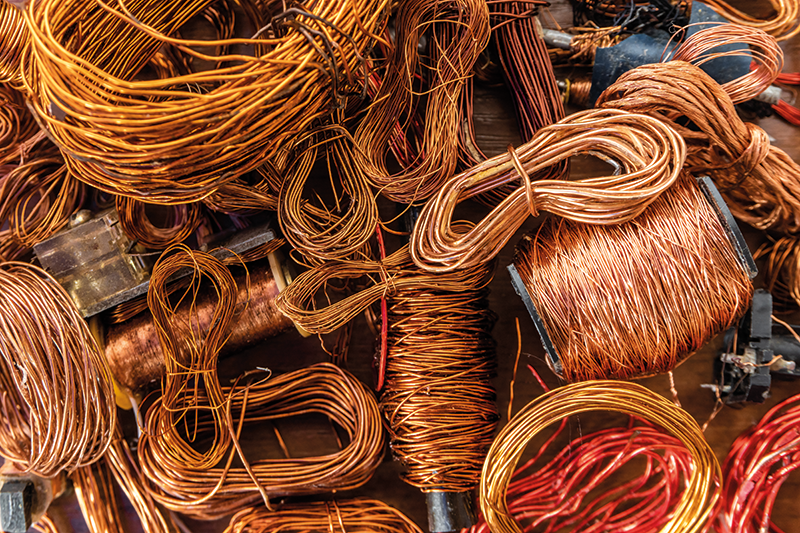
Yet, he highlighted the scale of material already moving through the UK economy, including large volumes of copper and tungsten exported in waste streams. The UK currently exports around 200,000t/y of contained copper in waste and scrap, in part because it no longer has domestic copper refining capacity – the last UK copper refinery closed in 1999.
'That’s a pretty big copper mine that has a value of about £1.4bln,' Mudd observed. 'There’s clearly a good value opportunity there…that means we could increase the circularity of copper in the UK.'
Khoo argued, 'We have an existing automotive industry and electric vehicle sector in the UK. So it makes sense for us to go back to having battery factories. And where we have strong product manufacturing for the end markets, work backwards to build refining and recycling capacity.'
King acknowledged that lack of capacity at scale remains a significant challenge for the UK, but argued that it also represents a major opportunity. He claimed that alongside exploration and appraisal work, by 2030, Cornish Lithium’s Trevalour demonstration plant 'will be producing 10,000t/y of lithium hydroxide monohydrate – which is about 20% of the Critical Mineral Strategy’s lithium target.
'But the challenge is somewhat larger,' he admitted, arguing that bringing projects into production will require private investment and government support to work 'in absolute lockstep', including on planning reform, funding and infrastructure.
Financing resilience
Recognising the midstream gap is only part of the issue, the challenge lies in finding ways to support high-risk, but strategically important, projects that require significant financial backing.
For Kirsty Benham, Founder and CEO of the Critical Minerals Association, this is where the market logic begins to break down. 'The reason why critical minerals are critical is because there’s a strategic risk and a need to diversify that markets are not addressing,' she said.
'It’s a very challenging market for investment at the moment,' added King, who noted that lithium prices have fluctuated dramatically over the last few years, creating uncertainty for investors even as long-term demand remains strong.
Sidd Bhatt, Executive Director at IFM Investors, argued that 'the technologies exist, but they haven’t received the capital needed to scale'. He pointed to the need for blended finance, public-private partnerships and non-standard offtake agreements to support strategically important projects that may not be commercially viable in the short term.
The UK Government is already playing a more active role, through funding programmes, export finance and initiatives such as the National Wealth Fund, which King described as evidence that 'government is a serious player' in enabling the sector’s development.
A broader question also emerged about how the UK can keep jobs, processing capacity and industrial benefit at home. Benham highlighted the need to balance attracting international investment with retaining domestic value, particularly where ownership and offtake arrangements may see material flow overseas.
Benham warned, 'A loss in UK ownership could result in lost opportunities for UK employment and UK offtake agreements in the future, with commodities being sent to the US.'
She further highlighted the need for government intervention to de-risk investment, similar to approaches adopted by China and Japan. China’s pathway, she noted, demonstrates how government can shape markets over the long term, combining overseas resource access, domestic processing capacity and trade levers.
While finance can help build domestic capacity, speakers were clear that the UK will still depend on international supply chains – an element that is fundamental to the strategy. Sutcliffe emphasised that the UK’s ambitions 'can’t be achieved in isolation' and will require 'trusted partnerships, joint investment and a shared commitment to open and transparent markets'.
But in an increasingly complex geopolitical landscape, building and securing these partnerships will be no mean feat. Benham warned that traditional partnerships are fragmenting, with the UK having to navigate shifting relationships with the US, EU, Canada and Australia. The challenge, she argued, is building resilience and reducing reliance 'not just on countries like China, but the US as well'.
She cautioned that the UK 'will need to reconsider and widen its international partnerships and decide which partners it can work with long-term on these issues'.
Sevara Madgazieva, Deputy Country Head of Central Asia at UK Export Finance, emphasised the importance of structuring partnerships in ways that deliver mutual value, including technology transfer and skills development, rather than simply securing resource access.
Inner circle
Around the conversations on the infrastructure needed to recover and process secondary materials, questions were raised about what kind of circular economy the UK should be trying to build.
Libby Peake, Head of Resource Policy at Green Alliance, insisted that while recycling still has a role to play – citing UK success in recycling platinum group metals – 'potentially more significant opportunities' exist elsewhere. She believes the UK is more suited to pursuing the 'inner circles' of a circular economy. 'That means reuse, repair and remanufacturing, given the relatively low levels of extraction and primary manufacturing.'
Peake highlighted the barriers to scaling circular economy approaches, citing limited recycling infrastructure and insufficient visibility over material flows. She suggested looking to wind turbine parts, some of which contain critical raw materials. 'The Coalition for Wind Industry Circularity has suggested that the UK could capture a market of £9.6bln from becoming a centre for remanufacturing for just 10 wind turbine parts – if the UK were the go-to centre for European counterparts as well.'
Mudd added that the British Geological Survey is working to forecast the flow of secondary resources using the vast amounts of data it holds and continues to gather. 'We’ve got the growth of things like wind turbines, electric vehicles and so on. As they reach their end of life, eventually there will be a flow of secondary resources. And so, at what point can we really start to meet our primary demand from secondary resources?'
While Mudd left the question hanging and stressed the data is preliminary, he proposed that 'it does suggest that we are heading in the right direction'.

Enabling delivery
For Mudd, delivery of Vision 2035 depends on bringing together data across the full value chain, from extraction through to recycling, and on improving visibility in areas where current datasets remain incomplete. 'As you go further down the value chain, the data gets harder to be able to really stitch together in detail,' he noted.
Dr Mukesh Kumar, Director of the Global Supply Chain Observatory (GSCO) Lab at the University of Cambridge, UK, shared how GSCO is building a data platform to map the critical minerals global supply chain. It can be used for stress testing as well as risk and resilience analysis.
Kumar compared current supply chain visibility to 'driving a car on a foggy day on the M11 at 70mph', arguing that only a small proportion of global supply chains is visible to major players at any one time. He hopes the platform will create greater visibility and transparency, in turn improving investor confidence.
Skills and research are also critical enablers to the strategy. Speakers highlighted the need to build a workforce capable of supporting the sector’s growth – from geoscience and engineering to processing and manufacturing. Sutcliffe pointed to the UK’s universities and research institutes, including the Camborne School of Mines, as important to support the sector’s growth.
While this may drive innovation, adopting technologies at a commercial scale is a whole other issue. Speakers emphasised the importance of ensuring technologies developed in UK research institutions contribute to domestic capacity, rather than being deployed elsewhere. She said the government is due to announce more details later in 2026 about how it plans to tangibly scale up the UK’s capabilities across the critical minerals supply chain.
One delegate asked whether the UK would benefit from a catapult-style facility to pilot and scale these technologies. 'We certainly need that sort of translational step', Mudd answered, but cautioned that 'the risk is that we throw money at things in a fragmented way'. He argued that limited resources should be focused on areas where the UK has clear strengths, such as midstream and circularity, and where technologies are close to maturity.
Beyond a single facility, Benham argued that scale-up will require stronger coordination between industry, academia and government, aligning commercial activity with strategic objectives. 'It’s important that UK Government works with industry and academia on developing a realistic plan on how these targets will be achieved and what support mechanisms will be used to develop these, ensuring that specific support is provided to strategic organisations in order for these targets to be met.'
This, she added, includes developing the right business conditions, planning permitting processes, clarity of legislation such as waste codes, continued support through financial mechanisms and specific debt finance offerings.
A critical look
Securing supply is only part of the test. The UK also needs to show that those materials are sourced responsibly and to standards others can trust. Sutcliffe acknowledged a need to 'reset the narrative' around mining, linking the sector to the energy transition, skilled jobs and future careers.
Peake, on the other hand, criticised the government for not setting binding rules on supply chains, especially around human rights, labour standards and environmental protections. Quoting from the strategy, she said the government 'expects all UK companies to respect human rights, workers rights and the environment...but we know that’s not happening throughout supply chains'. Adding that expectations mean nothing unless the government is prepared to set standards and enforce them.
When asked how environmental, social and governance (ESG) expectations can be made more predictable for project developers, Mike Blakeney, Head of Government and Public Affairs at the Cobalt Institute, replied that 'the UK [is] acting within an international system with lots of different expectations globally'.
Blakeney added that the ESG credentials of materials sourced through allied countries also need scrutiny, with NGOs playing a role in holding the sector to account. Event Co-Chair Dr Gavin Harper, Critical Minerals Research Fellow at the University of Birmingham, UK, agreed, insisting that the UK must be 'critical of our friends as well as people that we would traditionally take issue with'.
When questioned on the legacy of environmental impacts associated with mining, Mudd believes that long-term stewardship must be built into new projects. He noted that a global mining legacy fund could 'generate a very substantial flow of funding that could actually go and clean up that historic legacy. I think the social license that would be generated from that would be well worth [the] investment'.
All of the above – but not all at once
With Vision 2035 firmly on the table, the direction is set. Its success will depend on how effectively it is implemented and that is still under debate. If there was a single message to emerge from the conference, it was that delivering the UK’s Critical Minerals Strategy will require a coordinated and multi-faceted approach.
The test will be turning the strategy’s broad ambitions into a clear order of priorities. And while Mudd concluded, 'It’s basically all of the above', he reminded delegates, 'everything does start from a rock'.