Bioactive glass to selectively destroy bone tumours
A multifunctional bioglass embedded with gallium oxide could be deployed to fight bone cancer cells.
The bioglass is also said to prevent bacterial colonisation and regenerate bone tissue.
The synthetic grafting material comes from an international research team led by the Royal Orthopaedic Hospital NHS Foundation Trust and Aston University, UK, alongside the Aeronautics Institute of Technology, Brazil.
The bioglass acts as a localised drug delivery system, while providing the calcium, phosphate and silicon ions needed to regrow healthy bone.
Gallium has been used in cancer treatments for decades, but has been shown to have side effects, including toxicity, anaemia, hypocalcaemia, thrombocytopenia and temporary blindness, especially when used in high doses.
By using bioactive glass for controlled release of therapeutic metallic ions, the team seeks to promote targeted delivery to the affected area using lower doses.
They explain this would enhance the treatment focus on surgical removal of primary bone tumours, where local recurrence can occur when they are near vital structures, often requiring amputation. Infection from these surgeries can also cause bone loss and implant failure.
Dr Lucas Souza at the Royal Orthopaedic Hospital shares how the gallium-doped, bone-grafting biomaterial is produced by modifying conventional Bioglass 45S5 (calcium sodium phosphosilicate).
This involves replacing silicon dioxide (SiO2) with 1-5mol.% of gallium oxide (Ga2O3) in its matrix, while 'ensuring the appropriate rate of dissolution', by blending precise quantities of SiO2, Ga2O3, calcium carbonate, sodium carbonate and ammonium phosphate in a platinum-rhodium crucible at room temperature.
The mixture is then heated to 1,450°C at a rate of 10°C/min. The molten glass is held at this temperature for 90 minutes, and is cooled rapidly by pouring it into ultra-pure water at 25°C.
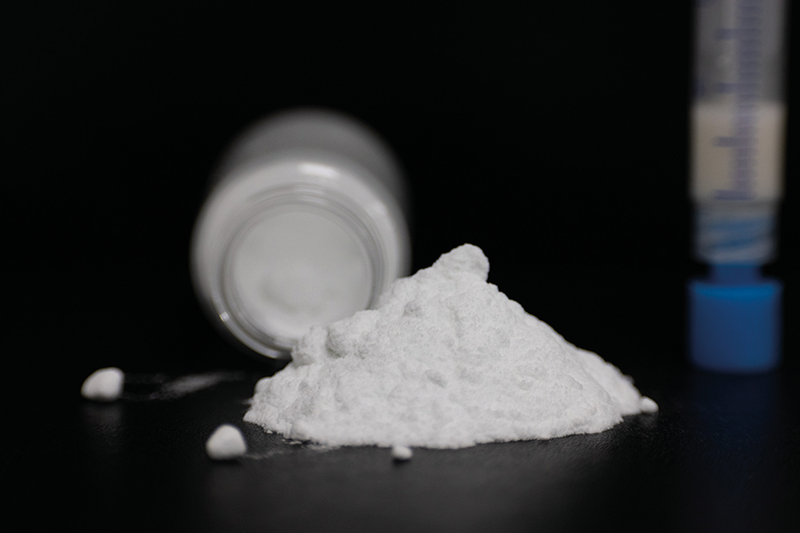
Glass frits – crushed shards – are dried at 60°C before being powdered in a vertical planetary ball mill. This powder can then be processed into different formats, such as injectable pastes, coatings, scaffolds, or freeze-dried beads.
The research finds that when the glass particles react with water in vivo, they release calcium and phosphate ions, which precipitate to form carbonated hydroxyapatite (CHA) – the mineral in bones.
Adhesive proteins and bone cells attach to the CHA layer and produce new bone, forming a strong bone-implant interface, the scientists reveal. The material then degrades over several months alongside structural bone formation, while released gallium ions selectively target residual cancer cells and suppress osteoclast activity.
'Because bone cancer cells overexpress transferrin receptors to fuel their rapid growth, they absorb four to eight times more gallium than healthy cells,' explains Souza.
'Once inside the malignant cells, gallium mimics iron but cannot participate in essential redox reactions. This causes immediate iron depletion, overwhelming oxidative stress and a catastrophic cellular crisis that forces the cancer cells down apoptotic and ferroptotic self-destruction pathways.'
In contrast, healthy bone cells easily manage the temporary stress via natural antioxidant mechanisms.
Beyond fighting cancer cells, a 5% gallium glass formulation is reported to completely inhibit growth of the aggressive, gram-negative pathogen Pseudomonas aeruginosa and can protect surgical sites from hospital-acquired infections.
Souza adds, 'We are developing a biodegradable, injectable paste to fill bone voids created by the surgical resection of bone tumours…to promote fast bone healing and prevent tumour reoccurrence and implant failure.'
The glass powder may also be incorporated into electrospun scaffolds to produce membranes to seal bone voids, used to coat metallic endoprostheses for skeletal reconstruction, or as part of 3D-printed composites.
The Midlands SPARK programme is helping to commercialise the paste product, which is currently at in vivo preclinical testing stage and plans to reach clinical trials by 2030. The team expects it to benefit surgical treatment of any kind of bone tumour, where complete tumour resection is not possible.