Ceramic coating self-repairs cracks at high temperatures
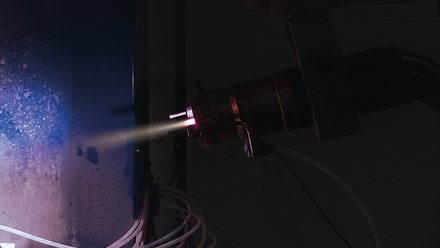
A layered glaze coating produced using controlled suspension plasma spraying (SPS) could prolong the lives of gas turbines.
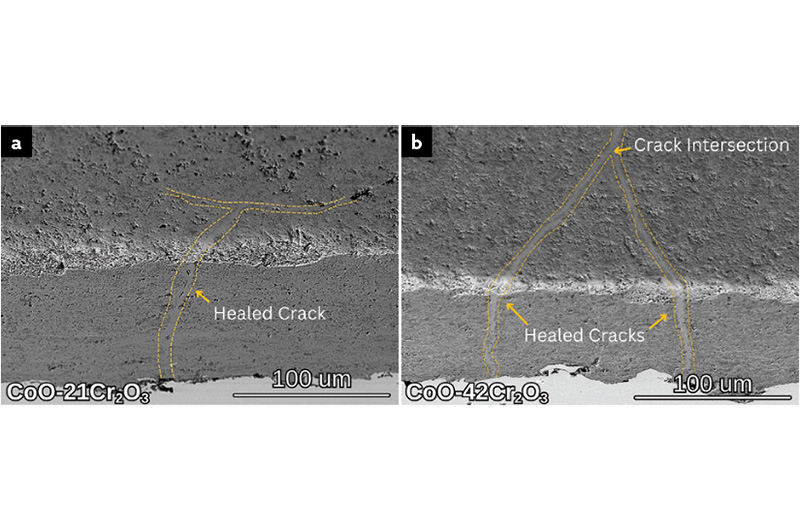
Micrographs showing damaged coatings (a) CoO-21Cr2O3 and (b) CoO-42Cr2O3 successfully repairing their own cracks after exposure to extreme heat at 800°C
© Mayer, A.R., Zouina, O., Chandross, M. et al. Glaze-enabled self-healing ceramic coatings for extreme environments. Commun Mater (2026). https://doi.org/10.1038/s43246-026-01212-y http://creativecommons.org/licenses/by-nc-nd/4.0/An international collaboration led by Concordia University, Canada, describes how the cobalt (II) oxide and chromium (III) oxide layers protect industrial surfaces from high temperatures. The coating is said to self-heal thermally induced cracks and defects, strengthening mechanical and thermal resistance.
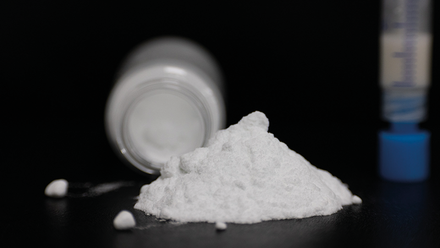
Andre Mayer, a PhD student at the university and an author on Glaze-enabled self-healing ceramic coatings for extreme environments, explains how they prepared a liquid feedstock for the SPS process, mixing very fine cobalt oxide (CoO) and chromium oxide (Cr2O3) powders with ethanol.
This enables the ceramic particles to be sprayed and fed uniformly. The flammable liquid evaporates once injected as part of the suspension feedstock into a high-temperature plasma jet, using argon gas. When the remaining mixture is heated, the jet fires molten particles, which strike the substrate surface, flatten rapidly and solidify into thin, individual layers, eventually creating a dense coating.
'When using only Cr, the coating is too brittle and fails due to cracking propagation, spalling from the surface…whereas solely CoO gets relatively soft depending on the temperature, leading to wear of the coating,' Mayer explains. 'Cr2O3 provides overall hardness improvement, while CoO provides lubricity and acts as the mobile phase, responsible for filling cracks.'
However, even tiny changes in processing parameters can impair performance and quality. 'If the plasma temperature was too high, the fine Cr2O3 particles could oxidise further into chromium trioxide (CrO3), which has a much lower boiling point and would evaporate before reaching the surface, resulting in no deposition,' Mayer reports. 'If the temperature was too low, the particles would not melt, also resulting in no deposition. We had to balance the parameters to find a sweet spot.'
To better understand how these parameters influence coating formation and inform the final deposition process, the researchers undertook a separate Surface and Coatings Technology study on a Co-based superalloy at 800°C to compare coatings.
The aforementioned Nature paper explains, 'Tribological tests…were run in angular oscillation mode at 1Hz, with 10mm track diameter and 30° reciprocating angle, under a 5N normal load, at 600°C and 800°C in air.' The testing parameters were selected based on preliminary trials conducted on the Co-based superalloy, in which a natural glaze layer formed.
Instrumented scratch tests using a 200µm diameter diamond tip created repeatable scratches over the coating surface. When heated at 800°C for up to eight hours, the damaged coatings resisted further damage and recovered its surface integrity.
Evaluating the response to two defects – internal cracks formed during processing/heating and external defects intentionally introduced – Mayer concludes that temperature was the 'driving force' to activate self-healing.
'In coatings without...CoO, which acts as the mobile phase in the healing mechanism, these cracks could lead to coating failure and complete spallation. However, when CoO was mixed with Cr2O3, we observed that some surface defects gradually recovered during high-temperature exposure.'
There remain other considerations, including manufacturing costs, scaleability, compatibility with complex geometries, long-term durability and integration into industrial processes.