Composite secures good vibrations for satellites
A new fibre-reinforced composite structure could help prevent the impact of satellite launch vibrations on sensitive equipment, without adding significant weight.
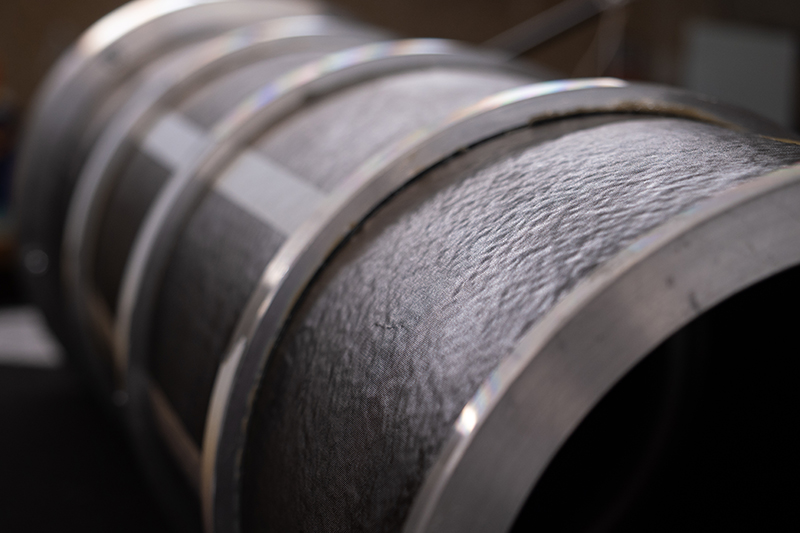
The fibre-reinforced composite structure is designed to reduce launch vibrations before they reach the satellite
© EmpaSome of the strongest shocks can occur during the staged separations, when parts of the launch vehicle are jettisoned.
Researchers at Empa in Switzerland collaborated with Swiss space company Beyond Gravity to develop the structure, which is designed to connect a satellite to its launch vehicle. Known as a payload adapter system, it uses phononic band gaps to reduce the amount of vibration transmitted from the launcher to the satellite. These are frequency ranges in which mechanical waves are reflected rather than transmitted.
Payload adapters are typically made from fibre-reinforced polymer and combine low weight with high stiffness. However, Dr Andrea Bergamini at Empa explains that these materials are poor at damping or isolating vibration.
'Most of the energy coming in from the launcher passes straight through to the payload,' he says. ‘Some is reflected at the interfaces, while the rest reaches the payload, where it can damage sensitive equipment or components.'
Conventional solutions include damping layers, dampers and vibration absorbers, but 'they all add mass without adding stiffness, which is the opposite of what you want in an aerospace structure'.
Rather than dissipating vibration energy, the team took a different approach. ‘We don’t try to dissipate the energy once it’s inside. We try to stop it getting in,’ Bergamini explains.
In a phononic crystal, vibration waves are scattered by a repeating pattern of masses. At certain frequencies, these waves interfere in a way that sends them back rather than travelling through the structure, creating what are known as band gaps.
However, producing band gaps at low frequencies usually requires either heavy masses or very soft connections, neither of which suits a lightweight and stiff aerospace structure.
In earlier work, the researchers designed mass elements that convert some of the vibration travelling along the adapter into a twisting motion. The resulting rotational inertia blocks the vibration without requiring heavier components, but the geometry is difficult to manufacture.
In the new design, aluminium rings are connected by carbon-fibre-reinforced plastic, with the composite itself providing the coupling between axial and rotational movement. The fibres are laid at an angle to the adapter’s main axis, so axial loading naturally produces a twisting motion.
‘We don’t use separate angled connectors between the rings – we use the composite material itself,’ Bergamini notes. ‘The result is lighter than an equivalent aluminium design, and it can be made with standard composite lay-up instead of additive manufacturing or complex machining.’
Computer models were used to simulate how different fibre orientations would affect the adapter’s behaviour. The models show that angling the fibres produces the required axial-rotational coupling, with strong reductions in vibration within the resulting band gaps in both a small prototype and a larger-scale design.
The team then built physical prototypes. ‘The measurements matched the simulations very closely, so the design behaves the way we said it would,’ Bergamini adds.
The research is currently around Technology Readiness Level (TRL) 4, meaning it has so far been demonstrated under laboratory conditions. The next stage will involve testing the scaled demonstrator under more realistic conditions, including random vibrations similar to those experienced during a launch.
‘If that goes well, we would be at about TRL 5,’ adds Bergamini. ‘Those tests will also tell us more about strength and structural requirements, which will guide the next round of design.’
Bergamini notes that the team have considered manufacturability and industry requirements from the start, using materials, processes and interface solutions already established in aerospace to make future qualification and adoption easier.
He says the same principle could also have applications for other lightweight structures that need vibration isolation without extra mass or reduced stiffness.
More like this...