Surface gains for 3D-printed polymers
A coating method could make 3D-printed plastics more durable, while avoiding some of the hazardous chemicals used in conventional metal-coating processes.
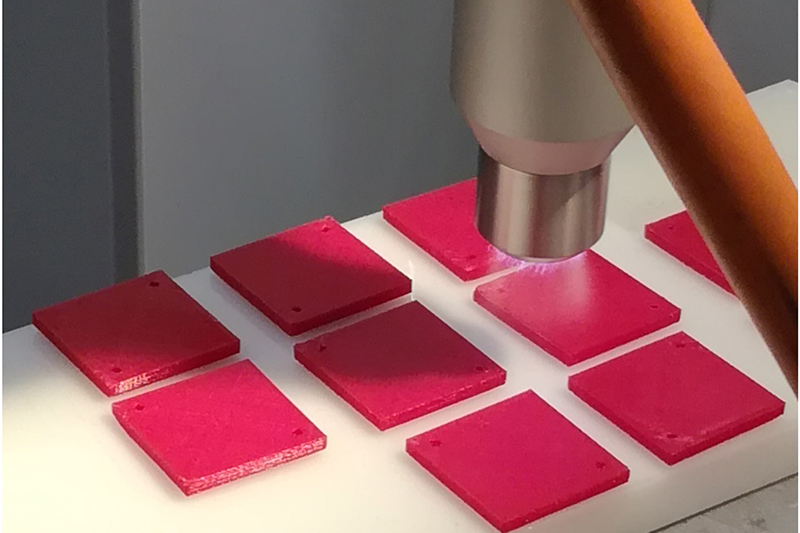
Plasma cleaning of the polymer specimens
© Kimmo LaitinenIn the study Enhancing surface properties of 3D printed polymers by metal and ceramic multilayer coatings, published in Results in Surfaces and Interfaces, researchers in Finland investigated coating techniques on polyurethane (PUR), polypropylene (PP) and polyamide (PA).
These widely used engineering polymers that have been studied less extensively than acrylonitrile butadiene styrene and polylactic acid.
Lead author Kimmo Laitinen, from the University of Eastern Finland, says 3D-printed polymer parts can come off the printer with rough surfaces, visible layer lines or damage from removing support structures. They may also lack wear resistance, conductivity, or other surface properties needed for more demanding applications, meaning further finishing is required.
Coatings can give the polymer these surface properties, but getting metal or ceramic layers to bond properly to plastic can be difficult. Conventional methods also involve several preparation steps using chemicals such as chromic acid and palladium. Laitinen explains that the team wanted to find simpler ways of building up these coatings without relying on those conventional pre-treatments.
‘The most novel aspect was the use of simplified and environmentally friendlier multilayer coating routes.’
The coatings are built up in several layers. For the ceramic systems, the polymer is plasma-cleaned and primed before enamel paint or spray is applied. For the metallic systems, the researchers first add a conductive layer – either brushed-on silver, or thin titanium and nickel films deposited using ultra-short pulsed laser deposition (USPLD). They then add electroplated copper and nickel, with chromium also added in the USPLD route.
Laitinen says this is the first time USPLD has been used in this way to add a conductive layer directly to an insulating polymer before electroplating. The layer makes electroplating possible and also helps the metal coating stick to the plastic underneath. He adds, ‘USPLD is especially interesting because it can deposit virtually any solid material, even alloys, giving much greater freedom in material selection than most polymer metallisation methods.’
The researchers have tested how well the coatings resist scratching, how strongly they stick to the polymer and how quickly they wear away. The best coatings reach pull-off adhesion strengths of around 8-15MPa, while some withstand scratch loads above 100N before failing completely.
‘Most metallic coatings survived the entire 377m wear test without wearing through,’ Laitinen notes. The ceramic coatings gave more mixed results, with enamel paint generally performing better than enamel spray.
One unexpected result is that ‘3D-printed surfaces sometimes outperform smooth sheet materials because their inherent surface texture can improve mechanical interlocking’, says Laitinen.
Performance also varies by test. The PUR did particularly well in scratch resistance, while PA generally gave the strongest pull-off adhesion. For 3D-printed PA, USPLD was the only method that produced a well-adhering metal coating.
‘Overall, these approaches allow manufacturers to combine the design flexibility and lightweight nature of 3D-printed polymers with the functional advantages of metal or ceramic surfaces,’ says Laitinen, adding that larger studies with more specimens will be needed to improve confidence in the results and better establish their industrial potential.
The silver-brush route should be easier to scale using basic equipment and conventional electroplating. The USPLD technique is more challenging. ‘Equipment costs are relatively high, processing is limited mainly to line-of-sight surfaces and vacuum compatibility of some polymers may present challenges,’ Laitinen notes.
‘USPLD is most suitable for high-value, technically demanding components rather than high-volume commodity products’. Potential uses include conductive electronic housings, sensors, customised medical devices, and lightweight aerospace or automotive parts.
Future work could test USPLD with alloys, oxides, nitrides, carbides and composite coatings. Laitinen adds, ‘A central future goal is to build on the demonstrated concept and create coating systems that are both environmentally sustainable and robust enough for demanding real-world engineering applications.’
More like this...