Study finds industrial-scale mining in Africa leads to 'unprecedented deforestation'
For every hectare of active mine site, an additional 34 hectares of forest are lost to supporting infrastructure, according to the University of Sheffield, UK-led research.
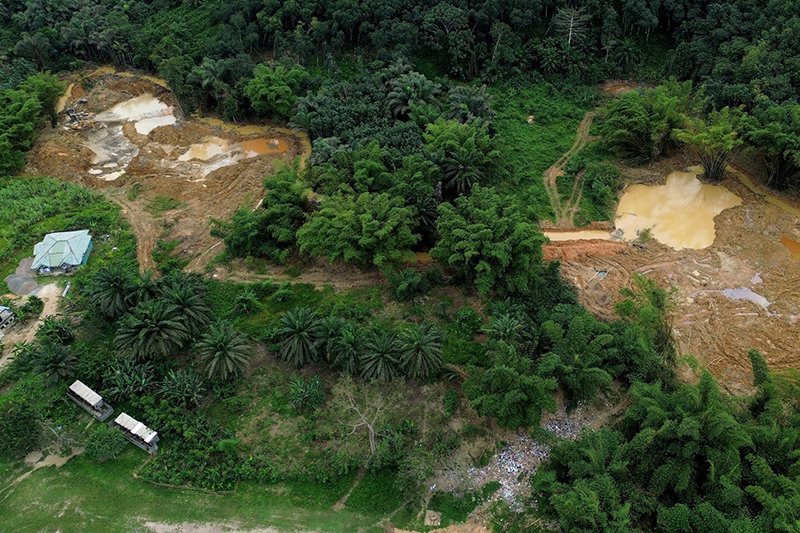
This is reported as the first large-scale study of mining-triggered deforestation across Africa. It compares deforestation rates in mined areas to geographically similar non-mined areas.
Using satellite imagery and statistical modelling, the researchers found that vast swathes of forest are being lost to make way for the infrastructure supporting mines, such as roads, housing settlements and agricultural land to feed workers.
It is reported that, between 2001 and 2020, 187,000ha of forest were lost to mining activity in Africa - an area roughly equivalent in size to the country of Mauritius.
The researchers studied over 16,000 mines, from large-scale mines operated by multinational corporations to ‘artisanal’ mines, often operated by individuals, families or local cooperatives.
Co-lead author Dr Oscar Morton, from the university's School of Biosciences, says, 'The actual mines themselves are just the tip of the iceberg. It’s the extent of additional deforestation triggered by mining that is far greater, with new settlements, agriculture and transport routes posing a serious threat to vital forests across the continent.
'As demand for minerals continues to rapidly grow, it’s crucial that robust measures are put in place to limit the extra deforestation caused by mining and its supply chains.'
The scale of mining operations across Africa is a direct result of increased global demand, with the extraction of metal ores quadrupling in the continent since 1970. As the global appetite for key minerals underpinning the transition to green energy technologies continues to grow, demand is expected to increase 40-fold by 2040.
For more like this...