New money in antimony?
Why antimony is so vital to the world’s economy.
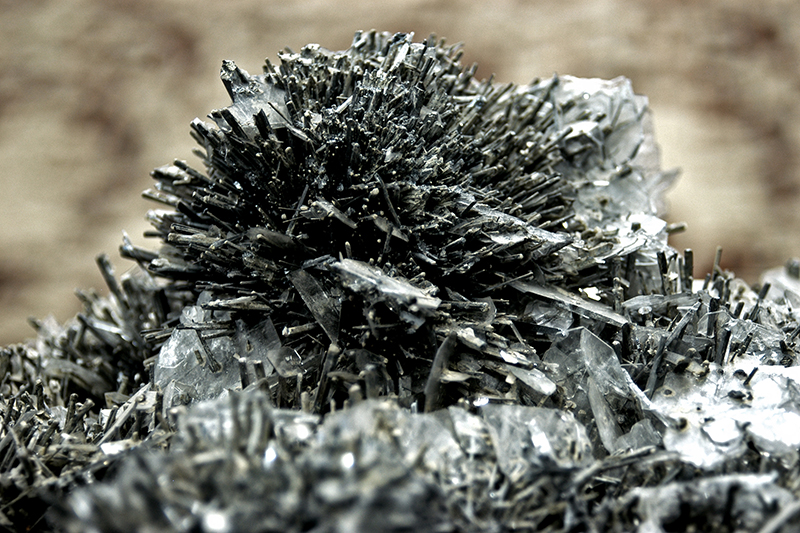
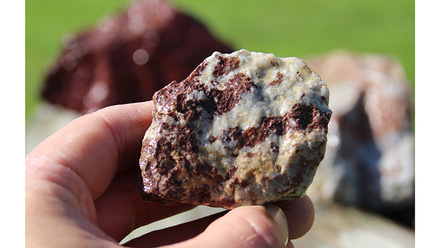
Antimony’s mineral source stibnite
© ShutterstockAntimony is listed as a critical mineral by governments and regions worldwide, including the US, EU, UK, Australia, Japan and New Zealand. This is due to high reliance on China as a supplier and its 'essential function in the manufacture of products which are key to regional economy and/or national security', explains the International Antimony Association.
Applications for antimony are many and include:
- Improving the effectiveness of solders, bullets and plain bearings, with antimony used as an alloying element with lead and tin
- Enhancing the rigidity of lead-alloy plates in lead-acid batteries for energy storage
- Boosting the efficiency and thermal stability of solar panels
- An additive for flame retardants in the form of antimony trioxide for children’s clothing and military uniforms
- A dopant to alter the positive or negative conductivity of semiconductors
- Antimony salts in glass-making, medicine, rubber and textiles
- To harden lead in ammunition and armour-piercing rounds
- In electro-optics in the form of indium antimonide for night vision devices and high-performance military sensors
Found as a lustrous grey metal, its usual source is stibnite – the sulphide mineral Sb2S3 – which is 72% antimony and 28% sulphur.
Aside from China, other supply sources include countries such as Tajikistan and Russia. In the US, Canada and Australia, antimony is produced as a by-product of smelting other metal ores, mainly gold, copper and silver. Numerous stibnite deposits occur in Idaho, Montana and Nevada, while recycling of old lead-acid batteries also contributes to US antimony production.
As confirmation of the rising importance of antimony, Fortune Business Insights valued the global antimony market at US$1.22bln in 2026 and this is projected to reach US$2.01bln by 2034, growing at a compound annual growth rate of 5.8%. The U.S. Geological Survey estimated the value of secondary antimony produced in 2024 at around US$73mln.
Boosting supplies
Two companies operating in Australia and Europe are seeking to further boost alternative supplies. Alkane Resources operates mines in both Sweden and Australia and is based in Perth. Its operations include Tomingley gold mine in Central West New South Wales, the Costerfield gold and antimony mining operation in central Victoria, and the Björkdal gold mine in Sweden.
The miner also owns the Boda-Kaiser Project – a bulk-tonnage, gold-copper development in Central West New South Wales. It merged with Canadian-based Mandalay Resources in August 2025.
Nic Earner, Alkane Resources MD and CEO, spoke about the antimony ore at Costerfield. 'The economic ore at Costerfield Operations tends to be either a ‘typical’ gold-bearing quartz and carbonate with massive stibnite, or gold-only quartz and carbonate veining. The best grades in gold-only veins are often associated with antimony-bearing sulphonates such as tetrahedrite, ournonite and boulangerite.'
Meanwhile, Southern Cross Gold Consolidated explores for gold and antimony in Australia’s Victorian Goldfields. It is the 100% owner of its flagship project Sunday Creek. Current drilling results demonstrate wide zones of gold and antimony over an 11km mineralisation. Earlier this year, the company reported composite intersections of 85 or more at 100g/t and 74 composite intersections showing 50-100g/t. Southern Cross Gold reports 104 separate intersections that indicate 10% antimony, which are obtainable by applying a 1m (down-hole length) at 5g/t gold-equivalent lower cut.
Michael Hudson, President, MD and CEO of Southern Cross Gold Consolidated explains, 'Sunday Creek is a gold-antimony system, with gold being the primary economic metal alongside antimony. The mineralisation occurs in stibnite (antimony sulphide) veins that also carry gold, hosted in a structurally controlled orogenic setting in the Melbourne Zone of central Victoria, approximately 60km north of Melbourne.
'No mining studies have yet been completed. However, the mineralisation is currently being accessed via an underground decline. The orebody is a series of steeply dipping vein sets that are well suited to selective underground extraction rather than open pit.'
He continues, 'Processing routes are being defined through current study work. The intention is to produce a refined antimony product domestically rather than exporting raw concentrate, but the specific metallurgical flowsheet (hydro or pyro) is still under study and we would not want to pre-empt those results.'
Meanwhile the mill feed at Alkane Resources’ site 'is produced from three different mining methods – full-face jumbo development, long-hole cemented rockfill stoping and half upper stoping', shares Earner. 'All mined ore material is hauled from the underground working areas to the Brunswick Processing Plant. This treats an antimony- and gold-rich sulphide ore through a conventional comminution and flotation style concentrator.
'The flotation concentrate is dewatered through thickeners and with filtration to produce a final antimony-gold concentrate product that is bagged, packed into shipping containers and shipped to customers overseas.
'Costerfield produces a concentrate that’s 35-45% antimony and is one of the cleanest stibnite/gold concentrates in the world. It has low concentrations of contaminants, such as iron, lead and arsenic.'
Secure supply
But where will this antimony end up? For Southern Cross Gold Consolidated, 'The antimony strategy is oriented toward supplying Western allied supply chains, with significant interest from partners in the US, Japan and France', says Hudson. 'The split between domestic and export use is still being determined as offtake and processing arrangements are finalised, therefore we are not in a position to give a fixed percentage at this stage.
'[It] depends on production scale and timing as the project advances, and we would prefer not to put a figure on global market share at this stage of study. Suffice to say that Sunday Creek has the potential to become one of the largest Western antimony projects.'
'Costerfield produces around 2% of the world’s antimony,' Earner highlights. 'The antimony-gold concentrate is discharged directly into 1.5t capacity bulk bags ready for transportation by road train to the Port of Melbourne for shipping to overseas markets. The concentrate is sold directly to smelters capable of recovering both the gold and antimony from the concentrates.'
He acknowledges, 'These smelters are predominantly in China and have been long-term reliable partners. Our concentrate is sold on a spot basis and is available for purchase by other smelters, should they be established.'
Hudson elaborates on the importance of reducing the dependence on China. 'Antimony is a designated critical mineral with both defence and civilian applications, including flame retardants, lead-acid batteries, and a growing role in energy storage and other advanced technologies. Its strategic importance to allied supply chains is a central part of the project’s rationale.'
He expands, 'Recent export restrictions have underlined the vulnerability of Western supply chains. Establishing a reliable, allied source of antimony production is a core strategic objective for the project, framed around supply chain resilience and sovereignty for allied nations.'
There is also the possibility of recycling antimony. Hudson says, 'Antimony is recyclable, particularly from lead-acid batteries, and a circular approach to critical minerals is consistent with the project’s strategic positioning. Primary production and recycling are complementary parts of a resilient supply chain.'
Earner emphasises antimony’s criticality lies in its strategic importance in electronics, energy storage and defence applications. Traditional antimony applications in flame retardants and ceramics are believed to be in decline as a result. In fact, as antimony becomes more strategic, its pricing and availability change and therefore reports of thrifting and substitution are emerging.
More like this...