Smoothing the transition
How the global energy system is undergoing its most profound transformation in a century.
This article was written by members of the IOM3 Energy Transition Group
As Chair of the IOM3 Energy Transition Group, I believe it is important that we present a balanced view of how hydrocarbons continue to contribute within a rapidly evolving, increasingly complex and decarbonising energy system. This article reflects the divergent perspectives of members of the Energy Transition Group Leadership Team, set against the backdrop of a sector that, as noted, is undergoing its most profound transformation in a century.
Tony Palmer FIMMM
The prevailing narrative often frames the energy transition as a linear replacement of fossil fuels with renewables. Global data tells a more complex story. Oil and gas continue to supply more than half of global energy, and natural gas demand is still rising in Asia, Africa and the Middle East. Non-energy uses of petroleum products, such as plastics, chemicals, fertilisers, pharmaceuticals and composites, are expanding rapidly, but do not dominate total consumption.
The Energy Institute and the International Energy Agency (IEA) estimate that 83-88% of global oil is combusted for energy, primarily in transport, with the remainder used for non-energy industrial applications.
So, while climate change, geopolitical instability, rapid digitalisation and shifting industrial strategies are reshaping how nations produce, transport and consume energy, fossil fuels still supply 86% of global primary energy, according to the Energy Institute’s Statistical Review of World Energy 2026. A proportion that has barely changed in three decades.
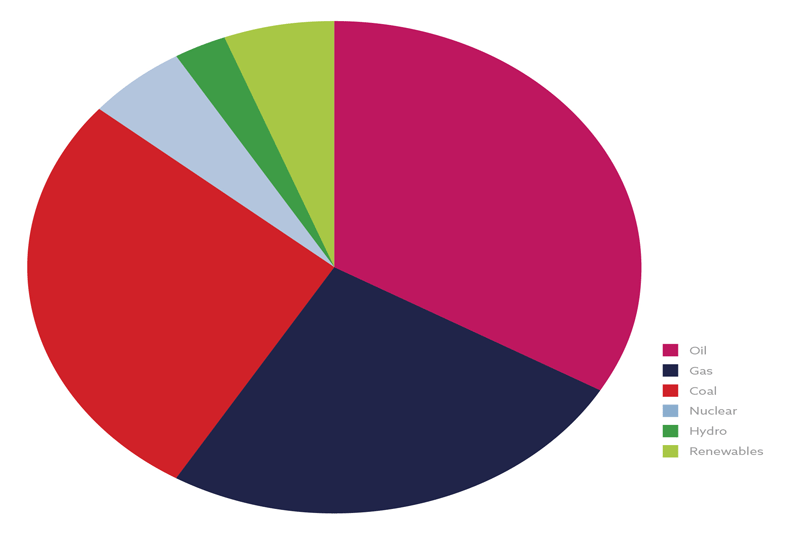
Similarly, in the current trajectory scenario in bp’s Energy Outlook 2025, oil and gas will remain essential through to mid-century, particularly for transport, industrial heat and non-combustion uses. Even in the sub-2°C scenario, there is still a role for hydrocarbons to play in primary energy generation.
Meanwhile, the IEA’s World Energy Outlook 2024 warned that electricity demand is rising faster than anticipated, driven by electrification, industrial reshoring and the explosive growth of artificial intelligence (AI) data centres. The IEA estimates that data centres alone could consume up to 6% of global electricity by 2030.
The Energy Security Strategy from the UK Department for Energy Security and Net Zero emphasises that reliability and affordability must sit alongside decarbonisation. The UK faces these pressures acutely as domestic hydrocarbon production is declining, electricity demand is increasing and geopolitical shocks have exposed the vulnerabilities of import dependence. So, how should we be viewing the role of hydrocarbons as part of the UK’s energy transition pathway?
The authors believe the UK’s future energy system will not be defined by a binary shift from hydrocarbons to renewables. Instead, it will be shaped by energy addition, that is expanding low-carbon supply while retaining strategically important hydrocarbons, supported by new technologies, skills and materials solutions.
The UK should be maximising domestic production, especially for gas. This will have the multi-faceted benefit of reducing reliance on imported gas – albeit at a small scale – helping the balance of trade deficit, providing tax income that can be redirected to subsidise renewable infrastructure build, and easing the transition of skills from the oil and gas sector to the low-carbon sector.
Keeping the lights on
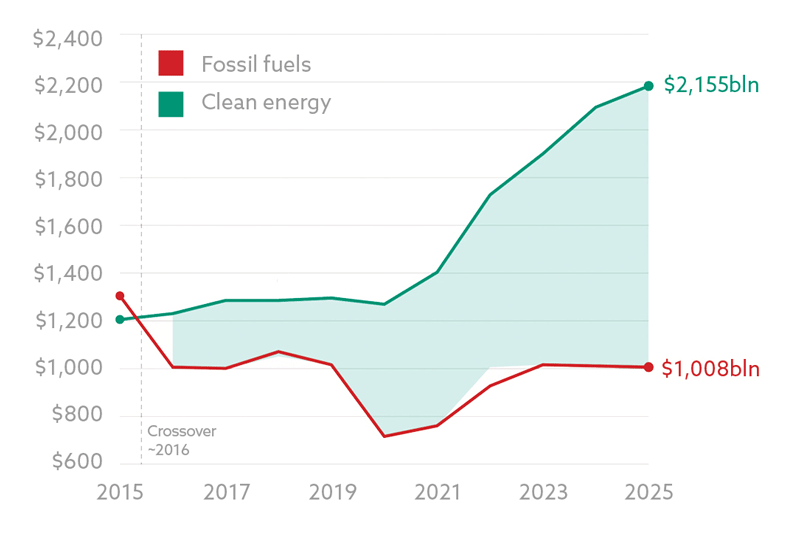
Renewables are growing at record pace. The IEA’s World Energy Investment 2025 publication shows that, since 2016, investment in clean energy has outstripped fossil fuels, with the difference between them on an increasing trajectory.
Jan Rosenow, Professor of Energy and Climate Policy at Oxford University, UK, wrote in his energy transition newsletter, Bright Spots, how 90% of new global electricity capacity is renewable, and that 692GW of renewable power capacity was added last year.
He also noted uneven global growth in renewables capacity and that the data hides some considerable individual country achievements. For example, in 2025, Pakistan imported more Chinese solar panels than any other country for national use, driven by local and individual demand due to high electricity prices, rather than subsidies.
However, intermittency, storage constraints and the pace of grid infrastructure build-out limit the ability of renewables to fully displace hydrocarbons.
In the UK, for example, curtailment of electricity supply from renewables to the grid was 10TWh, as outlined in Montel Energy’s report – Curtailed Renewables in GB and Ireland in 2025. That is 3.4% of the UK’s annual electricity consumption and is increasing each year as grid expansion fails to keep pace.
While the UK is undoubtedly at the forefront of renewables, it is increasingly under pressure to balance security of supply and affordability concerns with the pace of renewables development.
The IEA believes that clean energy can only meet most of the global demand growth if investment triples and permitting accelerates dramatically.
Total energy demand is not falling, it is shifting and expanding. For many countries, including China, India, Nigeria and Indonesia, the emerging reality is energy addition – hybrid systems that combine renewables with natural gas, supported by carbon capture and storage (CCS), hydrogen and nuclear.
Moreover, projections to 2060, such as in the DNV Global Energy Transition Outlook 2025, show that global energy demand is set to peak in the 2030s, when the energy transition is in an ‘addition’ phase.
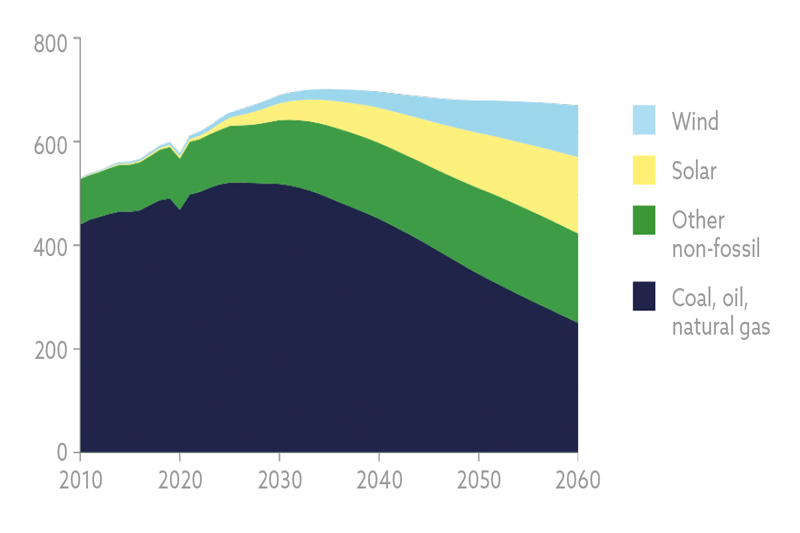
Global energy demand then effectively remains constant and energy efficiency becomes an increasingly important component of energy demand management. This then moves the energy transition into a replacement of hydrocarbon phase, albeit with hydrocarbons still representing ~40% of energy supply.
Balance in mind
As modern energy systems increase the percentage of renewable generation, typically where electricity demand has plateaued, the role of hydrocarbons in power generation will move from baseload generation to one of flexible supply and system management when renewables and storage are unable to meet demand. However, this comes at an increase in the overall system costs. Where energy systems demand growth and renewables are in an additive mode, then the modus operandi will largely be unchanged.
Their high energy density, flexible generation capability and ability to provide firm capacity during periods of low wind and solar output make them indispensable. Natural gas has become the world’s ‘shock absorber’, providing resilience during supply disruptions and seasonal variability.
The UK’s North Sea basin, though mature, remains strategically important. Domestic production reduces import dependence and supports system flexibility as renewables scale up. It also provides tax income that can be used to support a move to a lower-carbon energy system.
However, over-taxation can potentially lead to choking off investment and reducing future optionality to use this income to support the energy transition. The North Sea basin also provides a highly skilled workforce capable of transitioning into new low-carbon sectors. The Energy Outlook 2025 from bp shows that even in net-zero pathways, gas with CCS remains essential for the long term.
Non-energy petroleum demand is also rising. Petrochemicals are the fastest-growing segment of oil demand globally. As economies expand and populations grow, demand for fertilisers, pharmaceuticals, polymers, composites, solvents, resins and engineered materials increases. These materials are central to wind turbine blades, solar panel films, electric vehicle components, hydrogen pipelines, battery casings, medical devices and construction products. Hydrocarbons, in one sense, can be seen to enable, rather than hinder, the energy transition.
Recent geopolitical events have exposed vulnerabilities in global energy supply. The Russia-Ukraine conflict disrupted gas pipelines, instability in the Strait of Hormuz threatens a fifth of global oil and liquefied natural gas (LNG) flows, and sabotage risks to African and Middle Eastern pipelines continue to grow. Volatility in LNG markets has further highlighted the fragility of international supply chains.
Affordability remains a central concern. The UK’s 2022-23 energy price shock demonstrated how import dependence translates directly into consumer bills. The Energy Institute notes that countries with higher domestic production experienced lower price volatility.
Similarly, the UK experienced a lower impact in the current crisis in the Middle East versus that of the Ukraine crisis, as the UK now has a larger share of renewables priced using the less volatile Contracts for Difference mechanism. This highlights the need to accelerate the more than 400GW of renewable and storage projects that are currently queued for UK grid connection.
The UK is making strong progress towards a balanced energy system that combines renewables, nuclear power – including both large-scale and small modular reactors – and CCS. However, this progress appears to be coming at the expense of, rather than in balance with, domestic oil and gas supply, which supports a range of uses beyond power generation.
Strategic choices
The UK’s official pathway is energy transition – replacing fossil fuels while keeping total energy demand broadly stable. Emerging realities point towards energy addition. Electricity demand is expected to rise by 50-100TWh by 2035. Data centres, ports and gigafactories are expanding. Transport and heat are electrifying. The UK Government’s Modern Industrial Strategy increasingly demands abundant reliable power.
The UK’s gas supply and demand trajectory, illustrates the growing gap between domestic production and consumption, and highlights the increasing reliance on imports, as well as the associated risks.
The government’s Digest of UK Energy Statistics from 1998-2025 finds that in 2025 demand was down 1% but near lows seen since the early 1990s. Production is down 3.4% at the lowest output since 1973, while net imports are only down 1.3%, but exports and imports have increased.
A secure, affordable, low-carbon UK system will require a combination of nuclear, gas with CCS, large-scale offshore wind, solar and onshore wind where acceptable, long-duration storage, hydrogen production and networks, and significant grid reinforcement and digitalisation.
West of Shetland and other deepwater developments, despite challenging conditions, offer domestic supply, CCS and hydrogen storage potential. They also offer opportunities for UK engineering innovation, high-value employment, and pathways for subsea processing and electrification.
Technology pathways
The IEA forecasts that CCS will abate around 6% of global emissions by 2050. The UK’s East Coast Cluster and HyNet clusters are central to this strategy, enabling decarbonised gas generation, industrial emissions reduction, hydrogen production and repurposing of North Sea infrastructure.
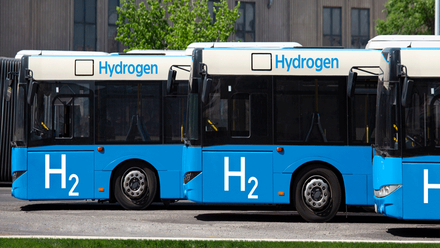
Hydrogen could play a critical role in decarbonising steel, chemicals, cement, heavy transport, maritime and aviation, and providing seasonal storage. Natural gas remains the cheapest feedstock for low-carbon hydrogen with CCS. The IEA expects hydrogen demand to reach 165Mt by 2050. Whether this is achievable will depend highly on the cost of hydrogen supply falling drastically.
Artificial intelligence is transforming operations across the energy sector. Unmanned hydrocarbon production platforms, remote operations centres, predictive maintenance, emissions monitoring, and optimisation of drilling and production are becoming standard. However, AI also increases electricity demand, reinforcing the need for reliable low-carbon power.
Storage and flexibility are essential. Battery deployment is accelerating, but long-duration storage – such as pumped hydro, compressed air and hydrogen storage – will be required to balance renewables effectively.
Globally, considerable investment, R&D and testing has gone into nuclear fusion, but commercial operations are not yet visible. The International Atomic Energy Agency expects the DEMO prototype to be built by 2040, with commercial reactors potentially in operation by 2050.
A new tool bag
It’s worth noting that the UK must double its renewable and low-carbon workforce by 2030. The oil and gas sector provides a highly skilled talent pool with transferable expertise in subsea engineering, geoscience, process engineering, digital operations, project management and safety. A structured skills transition is essential. This includes retooling existing personnel, developing new integrated energy systems curricula, expanding apprenticeships and mid-career conversion programmes, as well as strengthening collaboration between industry, academia and professional bodies.
The Net Zero Technology Centre in Aberdeen is well positioned to lead this transformation, working with universities and organisations like IOM3 to develop fit-for-purpose training and research programmes.
Materials science sits at the heart of the energy transition. Advanced alloys support turbines and reactors, composites enable wind turbine blades and hydrogen tanks (Type IV), ceramics and membranes underpin electrolysers, catalysts drive hydrogen and CCS processes, polymers form the backbone of electric vehicles and solar panels, and insulation and thermal materials improve efficiency across the system.
The Institute can play a pivotal role by shaping professional standards, supporting workforce transition, guiding materials innovation, informing policy with evidence-based analysis, and convening industry, academia and government to jointly work together. This is a pivotal moment for the materials community to lead.
The UK’s energy future will not be defined by abandoning hydrocarbons, nor by relying solely on renewables. It will be shaped by a pragmatic combination.
The next five years will determine whether the UK builds this system domestically or imports it at a premium. The opportunity is clear. The challenge is urgent. The materials community, through IOM3, has a central role to play in shaping a future that is cleaner and more secure.
Also see a Materials World article on AI data centre and energy consumption.
More like this...