Stable storage for hydrogen
High-entropy alloys for hydrogen storage.
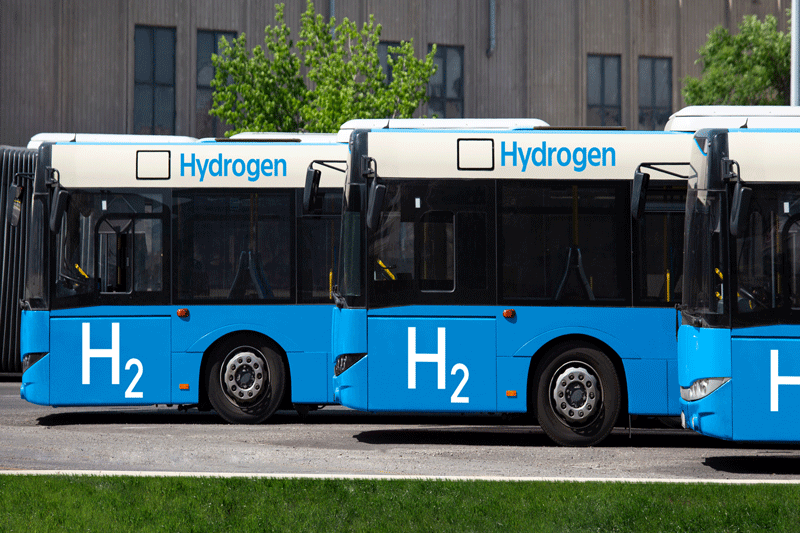
Hydrogen has enormous potential as a clean energy carrier for various industries, but cost-effective storage remains a significant challenge. Existing methods, such as pressure-vessel and cryogenic liquefaction, often face issues related to material durability, safety, transportation, or energy density.
This necessitates a thorough and consistent investigation for the development of hydrogen storage solutions. Advancements in materials science, particularly in high-entropy alloys (HEAs), can provide a robust direction for enhancing these capabilities.
Did you know?
Pressure-vessel suppression generally refers to active explosion suppression, or pressure suppression systems used to quench, inert, or contain rapid pressure spikes inside industrial vessels.
Cryogenic liquefaction is an industrial process that cools gases to extreme temperatures below −150°C (−238°F) to turn them into liquids.
The introduction of HEAs could significantly impact design and transportation. Traditional alloys consist of a principal element, whereas HEAs are composed of five or more elements in nearly equal atomic percentages. Their unique compositional complexity offers remarkable strength, enhanced corrosion resistance and potentially improved hydrogen-absorption capabilities. The distinctive properties have therefore attracted considerable attention across various fields.
For hydrogen storage, the stable microstructure of HEAs enables the alloys to potentially withstand repetitive hydrogen cycles without experiencing substantial deterioration due to their high configurational entropy. The presence of numerous active sites and lattice distortion in HEAs can also accelerate hydrogen uptake and release processes, enhancing hydrogen absorption kinetics.
Furthermore, these alloys can be modified to fundamental compositional tolerances to optimise thermodynamic constraints, including hydrogen binding energy. This would help achieve the desired storage capacities and operational conditions.
Currently, the development of HEA-based hydrogen storage is in a premature stage and requires more experimental and simulation work.
Finding the right combination
Numerous HEA compositions have been considered so far for hydrogen-absorption capabilities, kinetics and cyclic stability (see the diagram far right), involving metal hydrides with rare-earth elements and more common elements like iron, chromium and manganese.
A study on High-entropy alloys for solid hydrogen storage: A review has identified a combination of various alloying elements in HEAs that have higher hydrogen storage compared to conventional magnesium or lanthanum pentanickel (LaNi5) materials.
Published in the International Journal of Hydrogen Energy, the paper confirms how transition metals assist in the kinetics of hydrogen diffusion and absorption in HEAs. However, it explains that not all HEAs possess these characteristics. Instead, some maintain modest or no hydrogen uptake due to their composition.
To achieve a deeper understanding, computational modelling and sophisticated categorisation procedures are being employed
by researchers to uncover the mechanisms behind hydrogen interaction in these complex alloys. Recent developments are primarily focused on microstructure and performance optimisation by fine-tuning HEA composition for a significant enhancement in hydrogen affinity.
A paper on Challenges and potential future trends on high entropy alloy for solid hydrogen storage: Systematic review, in the Journal of Power Sources, shows that the complex microstructure and presence of various alloying elements cause higher resistance to corrosion, cracking and degradation under working conditions.
Indeed, HEAs have been shown to demonstrate excellent corrosion resistance and mechanical strength under such conditions in papers on Corrosion and oxidation behavior of high entropy alloys in extreme and harsh environments: A perspective on steam corrosion in the Journal of Applied Physics, and the Synergistic strengthened mechanical properties and corrosion resistance of CoCrFeNiMnNb0.1 high-entropy alloy by cold rolling + annealing treatment in the Journal of Alloys and Compounds.
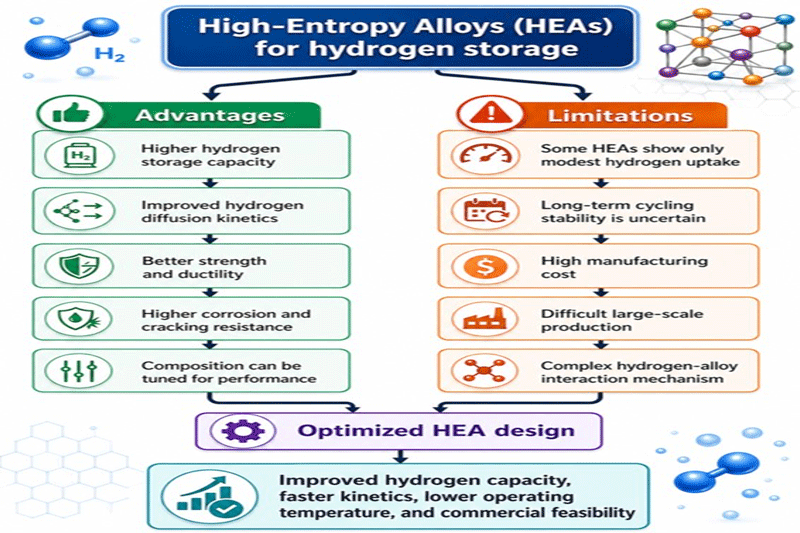
Meanwhile, research on Designing ductile refractory high-entropy alloys, in Nature Reviews Materials, explores how HEAs show improved strength and ductility compared to conventional materials used for hydrogen storage. This is crucial during cycles of hydrogen absorption and desorption.
These characterisations are appropriate and necessary for real-world application. However, many obstacles remain to be addressed, including long-term stability under working conditions, developing a viable storage system and scaling up synthesis.
Due to high-entropy stabilisation, HEAs show much better initial stability compared to conventional alloys under the cycling process, which prevents phase separation. However, grain growth and phase changes have been observed, which indicates that the microstructural change required for long-term cycling has a serious impact on HEA performance across various hydrogenation/dehydrogenation cycles.
The reasonably rapid kinetics of metal hydrides at near-ambient temperature, such as LaNi5 and titanium iron – with their high volumetric dimensions – make them appropriate candidates for hydrogen storage.
In contrast magnesium hydride (MgH2), despite a high gravimetric capacity of approximately 7.6wt.%, exhibits comparatively slow kinetics and has a high desorption temperature – close to 300°C – reports a paper on Enhancing hydrogen storage
performance of MgH2 through the addition of BaMnO3 synthesized via solid-state method in the International Journal of Hydrogen Energy.
Improved kinetics and absorption capabilities of 2-3wt.% have been verified in various compositions of HEAs at much lower temperatures of 100-200°C. However, they are challenged by degradation due to volumetric expansion in the working conditions.
Further work is needed to help understand and reduce microstructural modifications like grain boundary evolution and phase transition, as well as degradation mechanisms that develop with time.
Understanding the complicated interaction between HEA and hydrogen during absorption and desorption necessitates extensive atomistic modelling and experimental investigation. This includes a detailed understanding of diffusion paths, the function of numerous crystallographic planes and the accommodation of hydrogen atoms in the HEA lattice during storage.
Computational investigations employing molecular dynamics simulations and density functional theory can report how hydrogen reacts with the various element sites, which have a strong impact on the binding energies and diffusion paths. And more experimental observations would help design the best possible HEAs with the maximum hydrogen storage capacity using atom probe tomography as well as neutron scattering measurements.
Manufacturing of HEAs is also costly compared to other alloys due to the intricate alloying process. Metal hydrides also frequently comprise expensive rare-earth metals, which makes them expensive for the end user. Scaling up for commercial and large-scale practice is therefore still an immense challenge. Researchers need to develop suitable manufacturing methods that are more economical.
A fuller picture
Along with renewable energy resources, the hydrogen economy is particularly dependent on materials that can store hydrogen efficiently. In recent years, hydrogen has been generated through fossil fuels, which causes high greenhouse gas emissions. Dissociating the formation of hydrogen from fossil fuels necessitates storage opportunities, predominantly made of maintainable materials.
High-entropy alloys can be a great option for hydrogen storage and transportation from renewable energy sources if they are economically feasible and environmentally friendly. To develop a thorough hydrogen economy policy, infrastructure development and greenhouse gases produced due to fossil fuel use must be carefully analysed according to future requirements. While a comprehensive Life Cycle Assessment would enable a comparison of HEAs with conventional materials.
Recyclability of HEAs is vital for long-term sustainability, and policies supporting closed-loop systems for material recovery and reuse are essential.
This work emphasises the development of hydrogen storage capacity and the potential of HEAs due to their excellent corrosion and degradation resistance, adjustable microstructures, and enhanced structural stability under working conditions. A better understanding and advancements in atomic-scale hydrogen interactions with active sites and lattice distortion are promising, even though HEAs face challenges in bulk manufacturing, thermodynamics and optimising capacity.
The numerous advances in computer modelling must be used to anticipate and optimise the composition of HEAs, to make hydrogen storage commercially practicable. Future investigations should focus on the lifespan of HEAs under working conditions that typically cause material degradation in hydrogen storage and transport.
More like this...