Driven by data
How the growth in data centres drives an insatiable demand for energy.

In September 2024, the then UK Technology Secretary Peter Kyle MP announced that the government now classes data centres as Critical National Infrastructure (CNI) in recognition of their contribution to economic growth.
This was the first CNI announcement since the space and defence sectors gained such status in 2015. This designation means data centres now have an equal footing with emergency services, energy and water when it comes to government support, including when anticipating and recovering from critical incidents.
However, the anticipated data centre expansion in the UK as part of AI Growth Zones could actually put two other CNIs – energy and water services – under pressure, due to the sector’s growing consumption of both resources. In the former’s case, this refers to electricity use from a broad range of energy sources, typically via the grid.
The House of Commons briefing document on Data Centres: Planning Policy, Sustainability and Resilience reports that current operational facilities consume around 2.5% of the UK’s total electricity. Future usage will grow given competing consumer and industrial demands.
Dr Alejandro Gallego Schmid from the Tyndall Centre for Climate Change Research at the University of Manchester, UK, warns that data centre electricity consumption – currently around 7-10TWh in the UK – could potentially reach tens of TWh by 2035.
Consumption is surging faster than energy efficiency improvements can offset. He submitted written evidence to this effect in July this year to UK Parliament’s Environment Audit Committee.
He outlined a series of resulting risks – notably grid congestion, rising carbon emissions (both from electricity use and embodied in hardware), growing reliance on imported critical materials, and rapid accumulation of electronic waste.
Schmid told Materials World that there are, speculatively, around 140 data centres in the pipeline. The UK’s energy regulator Ofgem has identified that around 70 have a financial commitment. However, there is a risk that they will rely on natural gas for their power.
'Two of the UK’s largest proposed data centres plan to rely on dedicated onsite gas generation,' flags Schmid. 'Quest Park in Bedfordshire plans to use gas until its grid connection becomes available in 2034, while Wapseys Wood in Buckinghamshire is not currently proposing a grid connection and plans to rely on onsite gas generation, at least in its initial phases.'
Meanwhile, Professor Chris Preist, who works with Isambard-AI, billed as the UK’s most powerful artificial intelligence (AI) supercomputer, suggests energy efficiency improvements could actually increase the amount of power drawn. More efficient hardware will allow and encourage users to undertake even more AI tasks.
Global growth
The picture fills in further when looking at the international landscape. According to the International Data Center Authority (IDCA)’s Global Data Center Report (2026), the global footprint of data centres is currently 67.7GW, a growth of 36% in the past two years. This translates as 2% of the world’s entire electricity usage, up from 1.7% in 2024.
The UK ranks fourth in the IDCA’s global data centre table. Of the top five, the US is a clear frontrunner. Its expanding market accounts for 43% of all global data centre electricity consumption.
But what is behind the sector’s insatiable hunger for energy? Goldman Sachs Research attributes it to the 'AI revolution', which is poised to drive a 160% increase in data centre power demand by 2030. The paradox is clear – the very solutions that are billed to improve productivity and efficiency are also ramping up energy consumption. Goldman Sachs reports that the average ChatGPT query eats up nearly 10 times as much electricity as a Google search.
A report from the United Nations University Institute for Water, Environment and Health, Canada, contextualises this further. The publication on the Environmental Cost of AI’s Energy Use: Carbon, Water and Land Footprints reveals that when OpenAI released ChatGPT in 2022, it surpassed one million users in five days, reaching 100 million in under two months. By mid-2025, around 700 million people were using ChatGPT, sending about 18 billion queries each week.
'Artificial intelligence is the fastest-ever rolled-out technology in the history of humanity, because the internet allows it to penetrate so quickly [and]… that’s one of the explanations for why you need large data centres,' Preist told a Westminster Energy, Environment and Transport Forum on ‘Next steps for AI and the energy sector’.
The Korea Advanced Institute of Science and Technology says AI agents can consume up to 136.5 times more energy per query than conventional generative AI. The researchers claim to have undertaken the first quantitative analysis of AI agents’ computational costs, response latency, energy consumption and data-centre-scale power demand.
However, Allianz Research’s report on Code, Carbon, Kilowatts: AI’s Hidden Toll and the Race to Green the Grid argues that most AI analyses only focus on operational electricity use. Allianz’s own research spans across 26 countries and factors in lifecycle emissions, water usage and AI’s growing resource demand. This analysis notes how identical workloads can generate up to 24 times more carbon emissions depending on the emissions intensity of the electricity grid.
Put simply, data centre location is as important as demand growth, it finds. For example, in fossil-dependent grids in Indonesia, India and Malaysia, emissions exceed 600gCO2/kWh, compared with under 30gCO2/kWh in Norway and Sweden.
For context, Goldman Sachs Research predicts that around 60% of new data centre demand could rely on fossil fuels, adding around 220Mt of CO2 globally. Allianz Research concludes the sector’s global carbon footprint is in fact 57% greater than the International Energy Agency (IEA) estimates – accounting for 286MtCO2 in 2025.
In orbit?

Space-based infrastructure could be a highly ambitious solution for meeting the insatiable demand for AI computing. Wood Mackenzie explores the potential. Its report shares how technology firms SpaceX and xAI have announced plans to put 100GW of orbital computing capacity into space annually, while terrestrial data centres are hampered by accelerating power demands, land constraints, permitting and grid capacity.
However, the exorbitant cost of taking data centres into space remains one of the main barriers. Wood Mackenzie also points to a host of technical hurdles, such as operating advanced computer hardware in a hostile space environment.
Asia’s influence
According to Goldman Sachs Research, demand for data centres in China is anticipated to grow at a 20% compound annual growth rate between 2025-28. Moreover, the broader Asian expansion and the global sector’s reliance on this region will leave a seismic environmental footprint.
The UK’s Carbon Trust explains that global generative AI demand relies on semiconductor manufacturers, who are predominantly based in East Asia, to make the microchips that power AI and data centres. These manufacturers are investing in new fossil fuel capacity to drive their plants.
'Many of the countries in which semiconductor [factories] are located rely on very fossil-based electrical grids, so a fabrication that is running 24/7 will use a significant amount of energy to power all the different steps within the manufacturing process, with highly energy-intensive machines,' explains Andrew Yague, a Carbon Trust Consultant advising semiconductor companies.
Yague says the semiconductor industry’s decarbonisation success is highly dependent on a small number of East Asian countries decarbonising their grids, in particular Taiwan.
Prannoy Chowdhury, Associate Director at the Carbon Trust in Singapore, adds that many leading semiconductor manufacturers are committed to net-zero and have set decarbonisation targets. However, their challenge is the availability of renewables sources at the right price and being able to draw on them 24/7.
The other challenge, Yague adds, is the ever-growing demand for microchips internationally. 'No matter how much you decarbonise the intensity of your plant, if the demand is growing twofold every five years, you have little chance of reducing your overall emissions compared to what they were 10 years ago,' he warns.
China outperforms its Asian neighbours on renewables deployment, Yague observes, but the growth in manufacturing demand is so high that 'the growth in renewables is more or less capturing the growth in demand rather than offsetting any of the existing fossil-fuel demand.'
The global superpower is also massively influential in rewriting mineral demand, with an extensive list of metals critical for making AI chips, server boards and circuity, cooling and heat sinks, and storage and magnets. Raul Munoz, Managing Director and North American industry leader for mining and natural resources at Marsh, explains how copper tops the list.
'If you think about the requirements for a data centre, the extensive power requirements, it requires a lot of copper, not just from the transformers to transmission lines, but also within the data centre framework. Then, when you combine those high-intensity demands and that explosion in growth in infrastructure to the supply of copper… all the analysts or analysis suggest there is going to be a significant gap between what we’re producing today and what those requirements will be.'
Reducing the load
There is research underway to reduce the energy demand of data centres.
A team at the University of Massachusetts Amherst, USA, propose that next-generation AI can learn continuously while consuming a fraction of the computing energy required by current systems.
They claim to have developed AI that more closely resembles key aspects of how the human brain works. They explain that the brain operates efficiently because it functions asynchronously. Only small subsets of the neurons fire when participating in a particular task, or when ‘updating’ themselves. This allows complex behaviour to emerge with remarkably low energy consumption.
'[While] today’s deep-network AI systems, including ChatGPT and Claude, rely on highly synchronised computations across millions or billions of artificial neurons. Updates occur simultaneously and are governed by a global clock, regardless of the underlying task. Today’s networks have to perform substantial computation, requiring intensive energy usage, merely to maintain synchronised operation.'
Professor Hava Siegelmann at Massachusetts University adds, 'This synchronised approach worked well when neural networks were relatively small. But as AI systems have grown to billions and even trillions of parameters, the energy requirements have become increasingly costly, environmentally significant and impractical for autonomous systems such as robots.
'Researchers have previously explored asynchronous spiking neural networks as a route to energy efficiency', she continues, 'but they have found significant obstacles to learning and adaptation, because training procedures that work for spiking architectures are far inferior to gradient-based training methods, including back-propagation, that have made modern deep neural networks so successful.'
Siegelmann’s research team sought to combine the advantages of both approaches.
The researchers claim that their Asynchronous Neural Turing networks model removes the need for global synchronisation, while preserving the differentiable neural properties that make deep neural networks highly trainable.
This would enable AI systems to learn continuously in real time rather than only during a fixed training phase, and dramatically reduce the energy required for intelligent computation.
Two MIT studies similarly consider options to better manage energy demands.
A joint project with Microsoft, for example, revolves around a system that streamlines the design of AI-powered software systems to tackle complicated tasks and automatically optimises how these agentic workflows are implemented. Under test conditions, they claim it can significantly cut energy requirements and costs without hampering performance.
The second project examines how energy use is structured in three US regions where around 82% of the country’s data centre expansion is proposed by 2030.
The engineers conclude that average energy costs could be lowered if the data centres move more than 20% of their energy consumption to non-peak hours. However, the type of energy consumed differs by location, with some seeing a greater buildout of renewables and others having a relative increase in fossil fuel use.
Switzerland, one of the European countries with the highest number of data centres, is also exploring alternatives. The country’s abundance of hydropower means it can draw on renewable sources year-round.
Research undertaken by EPFL proposes that data centre operators across Europe could shift computing workloads so they better align electricity demand with wind and solar-rich periods. The university, which operates three large data centres on its campus, demonstrates how flexible computing can help reduce the renewable curtailment rate from just over 9% to around 6.5%.
'Policies that encourage workload flexibility, grid interaction and waste-heat recovery could help transform data centres from passive electricity consumers into active contributors to a cleaner and more efficient energy system,' says EPFL PhD student Sai Sudharshan Ravi.
The university has launched the collaborative Heating Bits project to develop technologies and methodologies for improving data centre energy management. This involves recovering excess heat from EPFL’s data centres and supplying the local district heating system, in turn, reducing the heat load and increasing the coefficient performance of the heat pumps.
Balancing act
Back in the UK, there are various options being put forward to tackle the challenges of data centre expansion. Edinburgh-based Mocean Energy has unveiled Blue Core – a modular offshore data centre concept designed to power AI server racks using self-generated renewable energy and natural seawater cooling.
Bloomberg touched on the onshore challenges when it reported how Ofgem is considering mandatory power curtailment for data centres during grid stress. This comes at a time when the concentration of data centres in west London and Slough has reached an infrastructure saturation point. The grid overload has reportedly led to connection delays of up to 10 years for critical non-digital projects like housing and hospitals, according to a briefing note by the Digital Innovation & Circular Economy Network+ (see box-out below).
Circular infrastructure
Headed by the University of Exeter, UK, the Digital and Circular Economy (DICE) Network+ has developed a Circular Data Centre Infrastructure Strategic Blueprint.
Recommendations include introducing digital product passports and right-to-repair legislation for data centre hardware to enable information technology asset disposition (ITAD) companies to reuse components, or recover critical raw materials when repair is not viable.
'The UK Government and the data centre industry need to start aligning,' says Dr Diego Bermudez, Research and Impact Fellow at the DICE Network+. 'We engaged with key stakeholders, like the Data Centre Alliance – the trade association that integrates a lot of data centre operators, original equipment manufacturers, regulators and specialists in ITAD. What they see is that for this transformation to happen and to deliver it, the energy grid, data centres and the communications networks must align and collaborate closely. Current planning and permitting are fragmented, there’s no holistic approach. The digital infrastructure needs to include more innovative circular approaches, not only from a materials perspective to secure critical hardware, but also from a heat reuse perspective to benefit local UK communities.'
Dr Alejandro Gallego Schmid, at the Tyndall Centre for Climate Change Research, says the UK’s 2026 Critical Minerals Strategy recognises materials by growth sectors, but data centre infrastructure should be explicitly incorporated into forecasting and planning.
'The key principle is that digital growth, net-zero and national resilience should be planned together,' he says. 'The intention is not to prevent data centre development, but to avoid unmanaged competition for limited materials and excessive dependence on highly concentrated supply chains.'
Paul Stein, CEO at Floral Energy, a business set up to power data centres with off-grid solutions, argues the UK must press ahead with expansion, not least because sovereign AI is critical to the UK’s future.
'There is an economic imperative for a nation which is 80% service based – activities most impacted by AI. But AI is also set to create new discovery pathways in medicine, technology and science, and materials science is seen as one of the most exciting', he says. 'So, it’s vital we find the energy to power AI data centres, or the UK will slip behind in this race to the future of materials and much more.'
Acknowledging the limitations of renewables due to their intermittency, Stein argues that small modular reactors will eventually provide the 24/7 electricity required to support data centre growth, but these will only be available from the 2040s when supply and demand for these complex pieces of kit equalises.
Until then, Floral Energy offers a microgrid solution combining solar and gas (or biogas) power under AI control, with thermal recovery technologies that drive down energy use by recycling otherwise wasted heat.
The business has five patents for a bespoke thermal recovery solution that can recover around 10% of the energy from the data centres’ liquid cooling systems. This may not sound much, he says, but 10% of a 500MW data centre represents a huge reduction in operating costs.
'What we’ve done is bridge the gap between where we are now and nuclear by rolling out gas/biofuel generators coupled to solar and energy storage,' he says. 'Then you bolt on this energy recovery system to reduce costs and emissions, and when nuclear becomes available the system is ready to integrate it.'
From the centre to the edge
Asked for his thoughts on future trends, Preist highlights advances in AI capabilities for laptops. 'The question is, what impact will that have on data centres?' he poses. 'If we don’t need as much sophisticated reasoning, then it may mean that we don’t need as many data centres as we thought we would. We may find a significant part of AI moves into edge devices.
'You can imagine a world in which most AI lives on our laptops and just questions out to data centres when it’s beyond what it’s capable of doing itself,' he adds.
'That has advantages with regards to data privacy and data security…but what that will mean is that our laptops will become more power hungry. If it’s doing AI, it will be more like a gamer’s laptop than a standard work laptop, and if you’re running it all the time, that could be significant. It could double your household electricity bills if you’re running 200-300W constantly.'
Competition for water
The spotlight has also fallen on the water usage of data centres. Advisory groups like the UK Government’s Digital Sustainability Alliance highlight the substantial volume needed to cool systems. Liquid cooling in data centres uses specialised fluids to absorb and remove heat from high-density server hardware.
This is set against a backdrop of projections from the Environment Agency (EA) of a national and regional deficit in water supply across England. “By 2050, a shortfall of nearly five billion litres of water per day is anticipated, which is equivalent to over a third of the current public water supply,” outlines a report from the Digital Sustainability Alliance on Water Use in AI and Data Centres.
The publication continues, 'This impending water deficit is not uniform across the country. Some regions are projected to experience less future rainfall, possess smaller water storage capacities and face larger population or resource demands, leading to localised areas of acute water stress.'
Water UK has also commissioned analysis and concludes that England will increasingly be unable to supply new businesses and homes with the water needed, partly due to data centres, which are currently excluded from the EA’s National Framework for Water Resources.
The picture is complicated by the fact that England’s data centres do not have mandatory water-use reporting, according to the Greening AI Data Centres Coalition. This is a global initiative launched earlier this year that brings together nine of the world’s leading built environment and sustainable finance organisations.
However, unlike energy demand, which he sees as an 'exceptional-sized problem', Professor Chris Preist at the University of Bristol views water usage as a 'normal-sized problem', and one where some have miscalculated the impact. The use of old data partially explains the concerns.
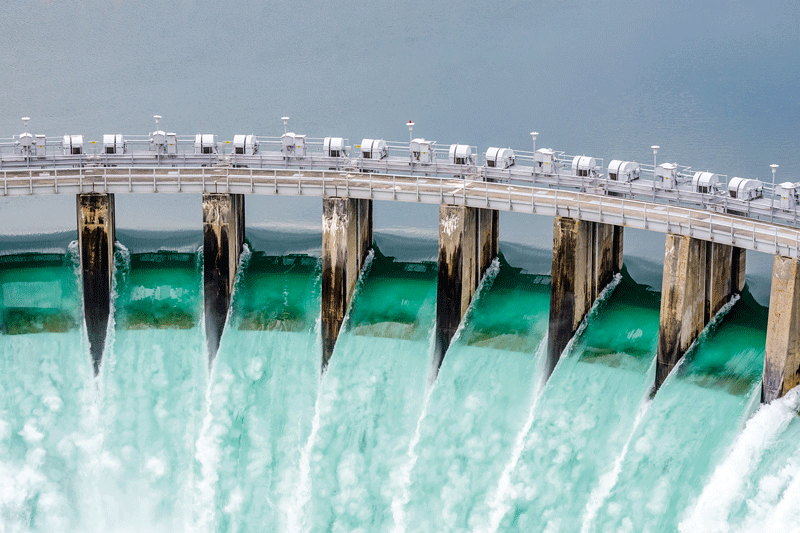
'When they say a data centre is using so much water, they’re combining both the water it uses to cool it and also the water that is used somewhere else, maybe in a hydroelectric dam, to generate the electricity,' he explains. 'They use an average mix of electricity – they don’t look at what the data centre is using.'
More like this...