Resolved to solve
2026 Armourers & Brasiers’ Materials Venture Prize winner, Professor Chun Ann Huang, talks about commercialising a solvent-free, dry electrode battery coating.
What is dry electrode processing in battery manufacturing?
Traditionally, battery electrodes are made with wet slurry coating, where the active material is mixed with a solvent and coated onto a metal foil. This coating is around 100µm thick and typically the foil is many hundreds of metres long. The solvent is then evaporated in large drying ovens up to 100m long, which is an expensive and energy-intensive process.
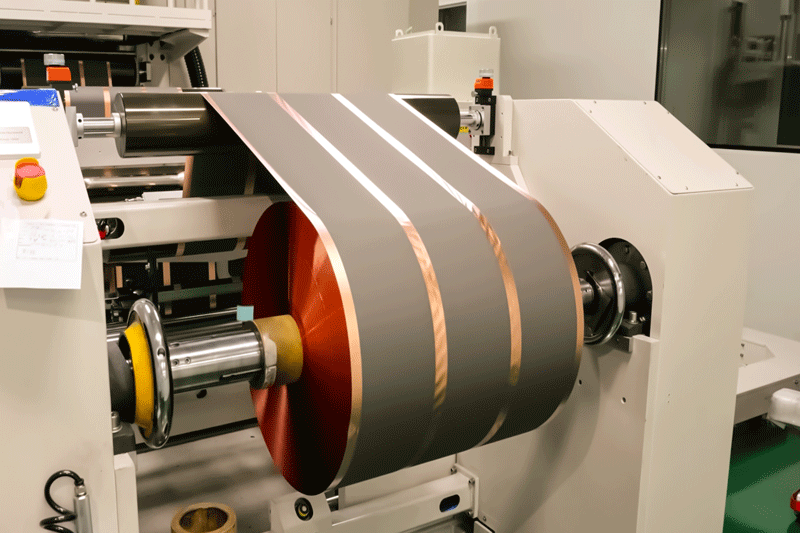
In dry coating, powder is coated directly onto the foil, with no solvent. This eliminates the expensive solvent-evaporation and recovery process. When the large drying equipment is removed from factories, manufacturers can more than double their output in the same space, significantly reducing cost.
The mainstream approach to dry coating in industry has been fibrillation. Extremely high shear causes polytetrafluoroethylene binder to unwind from micelles, creating a fibrous mesh network that mechanically entangles and binds the active material and conductive additive together. The shear is applied through both mixing and rolling.
Demand for dry coating is expanding rapidly, but the complexity of this multi-parameter process means many cell manufacturers have faced considerable challenges when scaling up to high-speed gigafactory production lines, including:
- Delamination – the coating can peel away from the foil, either in manufacture or during use, leading to poor conductivity or failure.
- Inhomogeneity – evenly distributing particles in the coating is essential for battery electrodes, but is more challenging with dry material than with wet slurry. Uneven distribution of the active material and binder can lead to poor conductivity through the electrode and lower performance.
- Fragility – inhomogeneous mixing can also cause cracking, which can lead to failure or poor performance. This can be exacerbated when making electrodes at high speed on factory lines. Efficient production lines can run at around 80m per minute, which can put considerable strain on the foil and active materials.
Tell us about the technology you are proposing.
I have been fortunate to work with many industry experts over more than 16 years of researching and developing battery electrode manufacturing techniques at both Oxford University and Imperial College London, UK. The processes and pain points for electrode manufacturers have always driven my research – how can we fix real-world manufacturing problems in ways that industry can easily adopt?
The Advanced B-Solv Technology (B-Solv) seeks to improve the structural integrity and performance of dry-coated electrodes. The technology supports the scale-up of fibrillation dry coating by engineering the electrode’s microstructure to improve robustness, processability and conductivity, leading to higher yields and performance.
It’s also important to me that my work has a positive impact on the planet. Enabling dry coating dramatically reduces energy consumption in this enormous and fast-growing industry, and removing toxic solvents and unnecessary equipment further benefits the environment. So, developing effective dry coating techniques is naturally something I was drawn towards.
Dry coating is a transformational technology. It should enable electrode manufacturers to increase production while reducing energy costs and equipment costs. However:
- Coating is part of a high-speed, high-yield manufacturing line, so solutions need to be reliable at high speed without disrupting existing processes.
- Manufacturers’ active material formulations are core to their business. They are constantly being improved and usually secret, so they will be cautious about approaches that alter these formulae or depend on a fixed chemistry.
This led me to seek a solution that works for any material and can also drop seamlessly into standard gigafactory manufacturing lines.
How does it work?
Our technology is about microstructure. We use coating and rolling techniques to rearrange the materials in the electrode.
Using familiar electrode-manufacturing equipment, we engineer the dry-coated electrode microstructure, making it stronger and more robust.
Calendaring is key to our process – using large precision rollers to compress the electrode at speed. We also precision distribute the materials throughout the electrode. This combination provides the structural and conductive integrity that can be so challenging to achieve with dry coating.
And it is designed to be a drop-in process for manufacturers, so that it has no complex additional steps that could disrupt overall factory design.
As we move into production, our aim is to make it easy for manufacturers to commit to dry coating, and remove expensive and environmentally detrimental solvents and drying ovens.
Which solvents are problematic?
N-Methyl-2-pyrrolidone is used to produce battery cathodes (the positive electrode) and is classified as a reproductive toxicant under EU REACH regulations. In the EU, there are strict rules around workplace exposure limits to this solvent, and so we believe its removal from battery manufacture would be very positive for the industry. Anodes (negative electrode) are typically made from graphite and can use more manageable water-based solvents.
What are the cost and energy savings of your approach?
Cost savings can vary significantly across regions and manufacturers, but there is no doubt that they are substantial. This explains the cell manufacturers’ pursuit of dry coating, including Tesla’s US$218mln purchase of Maxwell Technologies.
The drying ovens from wet slurry coating can be as long as 100m and consume the vast majority of electricity in electrode production, or 50% of electricity in overall cell production. Estimates vary, but a good ballpark is 50GWh of electricity needed annually to make 1GWh of wet-coated battery cells. At €0.15 per kWh, switching to dry coating could save €375mln annually in electricity costs for a 100GWh plant.
But this is only a portion of the cost saving for a cell manufacturer. Removing solvent recovery and drying ovens can reduce factory floor space by as much as 80%, allowing the manufacturer to double or triple cell production in the same space.
Machine CapEx is also substantial – a solvent recovery system alone in a 100GWh factory could cost €24mln, and drying ovens significantly more.
The environmental benefits are huge. Enabling dry coating can reduce annual electricity consumption by an astonishing 2.5TWh per 100GWh factory – perhaps 300,000t of CO2 per year. This is on top of the carbon footprint saved by reduced equipment manufacture, and the benefits of removing toxic solvent production and disposal.
Have you seen improved performance in batteries produced using your process?
Cells made with our process versus wet coating improve on both their charging speed and the amount of energy they can store. The dry-coated electrodes increase volumetric energy density by ~35%, compared with conventional electrodes made by slurry coating. The battery capacity increases by 15-30% at increasing charge and discharge C rates from 0.1-2C. The dry-coated electrodes also exhibit competitive long-term cycling versus conventional slurry-coated electrodes over hundreds of charge and discharge cycles.
How will you scale up the invention?
We started in the lab at Imperial and are now developing our second-generation coating machine, supported by the Faraday Institution, Imperial College’s Deep Tech Prime Fund and the Armourers and Brasiers Venture Prize. They have all recognised the value of our technology to improve both UK and international battery manufacturing. We are working with a cathode material manufacturer to optimise the B-Solv process for different formulations.
The third-generation coating machine will be a full pilot line machine, to enable customers to test their proprietary powders and optimise the machine for their specific processes before scaling up to gigafactory production. We are keen to hear from cell and equipment manufacturers who would like to accelerate their switch to dry coating or improve their dry coating yield.
More like this...