Waste not, watt not
The potential of waste cardboard as an indigenous UK fuel for bioenergy.
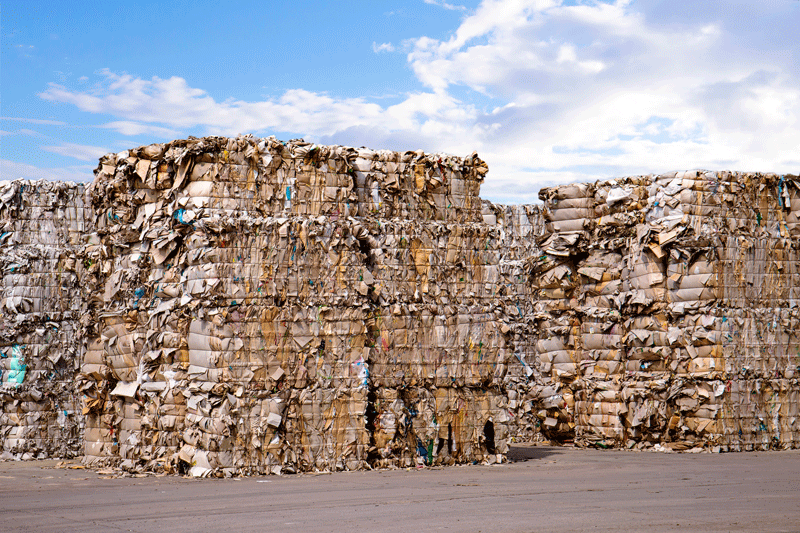
Cardboard is one of the most ubiquitous packaging materials, with 72Mt of cardboard produced annually.
It is an umbrella term with no fixed definition, and applies to almost any thick, stiff, paper-based sheet that is thicker than ordinary writing paper. It is often made from pressed wood pulp or recycled paper fibres and is generally classified as paperboard (cereal boxes) or corrugated fibreboard (shipping boxes), with subcategories and grades for each.
From food packaging, delivery boxes, packaging for furniture, to anything that needs transporting between a manufacturer and the consumer, cardboard is used. Last year, the global corrugated carton market size was valued at ~US$180bln by Fortune Business Insights, while the UK cardboard industry was found to be worth £6.2bln by BDO.
The UK Department for Environment, Food and Rural Affairs reported that 5.48Mt of cardboard and paper waste was produced in 2024, with 74.3% recycled. However, while the material can typically be recycled five-to-seven times, after that wood fibres become too short and weak to maintain structural integrity. The material is then downcycled to low-strength products, such as egg boxes, or composted, landfilled, or used as fuel for energy.
In composting or landfill, the short fibres break down anaerobically, generating methane gas. The International Energy Agency reports that methane gas has a 100-year global warming potential that is 28-30 times greater than carbon dioxide, meaning that improper disposal can significantly multiply cardboard’s overall climate footprint.
A recent development that could advance the potential of cardboard for bioenergy are the UK’s Simpler Recycling and Extended Producer Responsibility (EPR) regulations. These regulations have standardised what materials get recycled in the UK and make packaging producers pay the full cost of managing waste. EPR also makes non-recyclable or mixed-material packaging more expensive to use.
Did you know?
A 2022 study in Economics Letters – Is online shopping packaging waste a threat to the environment? – found that online shopping generates 4.8 times more packaging waste than offline shopping. When cardboard breaks down in compost or landfill the fibres produce methane. The International Energy Agency reports that the global warming potential of methane gas is 28-30 times greater than carbon dioxide over 100 years, meaning that improper disposal of cardboard can significantly multiply its climate footprint.
A burning question
The UK power sector has completely transformed over the past 30 years. Privatisation in the early 1990s led to the introduction of more varied coal supplies. This was subsequently followed by the introduction of co-firing of biomass in major power plants in the early 2000s, and the complete conversion of coal-fired power plants to biomass in the 2010s.
The 2025 iteration of the Digest of UK Energy Statistics, from the Department for Energy Security and Net Zero, states that ~14% of the UK’s electricity production came from bioenergy that year. And a 2022 Chatham House report on Greenhouse Gas Emissions from Burning US-sourced Woody Biomass in the EU and UK found that ~8.Mt of biomass are used annually for pulverised fuel combustion in the UK, accounting for 21% of the entire wood pellet market.
In the UK, this is dominated by wood pellets and wood chips, followed by recycled and waste wood. Other types of biomasses such as cardboard make up only around 1% of the total, yet there is limited capacity for the UK to produce its own woody biomass pellets, shared the study Increasing biomass resource availability through supply chain analysis in Biomass and Bioenergy.
Furthermore, the use of wood pellets has been increasingly scrutinised due to concerns over lifecycle greenhouse gas emissions and reliance on imported feedstocks. Wood pellet supplies are further limited since Russian wood pellets have been banned in the UK and Europe due to the Ukraine war.
Currently, biomass electricity generation is subsidised in the UK via the Renewable Obligation Certificates and Contract for Difference, based on the amount of wood burnt to generate electricity.
However, future support is uncertain as the schemes end in 2027, with a four-year extension of transitional support, creating pressure to reduce costs and improve sustainability. This has increased interest in alternative biomass sources with lower costs, securer supply chains and potentially lower environmental impacts.
Through Engineering Doctorates, and the Resilient Decarbonised Fuel Energy Systems Centre for Doctoral Training, based at the University of Nottingham, UK, researchers have helped several power generators to explore novel fuels and address the challenges of these fuels in real bioenergy systems.
These EngDs are industry-sponsored four-year PhDs with projects focusing on global energy and decarbonisation challenges.
Cardboard is one of these novel fuels. The team at Nottingham has provided the first comprehensive characterisation of cardboard as a potential indigenous fuel source for power generation, with a focus on its suitability for pulverised fuel and stoker furnace systems.
Igniting potential
It is worth noting that cardboard is already commonly used in combustion to generate electricity in energy from waste (EfW) plants, but as part of mixed materials. The UK Government and the Environment Agency categorise UK EfW fuel into two distinct carbon fractions:
- The biogenic fraction (~50%) – biomass material like wood, paper, natural cloth and food scraps. This is classified as a partially renewable energy source.
- The fossil fraction (~50%) – oil-derived products, predominantly unrecyclable plastics. The high plastic content means UK incinerators have faced increasing scrutiny for their carbon footprint.
These EfW plants use moving grate boilers, a type of stoker furnace. Stoker furnaces are also common within processing industries to produce steam for breaking down materials such as sugar beet and sugar cane in mills all over the world. They operate at lower temperatures of 900°C, but require a much longer residence time of around 45-60 minutes, compared to larger-scale pulverised fuel boilers. These operate at more than 1,300°C with residence times of only 1-5s.
The combustion of large-scale, high-temperature, short-residence time pulverised fuel boilers can be simulated experimentally in a drop tube furnace.
Stoker furnaces can also be simulated at laboratory scale using a muffle furnace. Testing of cardboard in these furnaces showed favourable combustion characteristics for both, indicating that cardboard can rapidly combust under both short and long residence time conditions. This makes it a potential viable candidate for co-firing in large-scale pulverised fuel furnaces, or for dedicated use in stoker and fluidised bed systems.
From boxes to bioenergy
Biomass has a low density, so it needs to be pelletised to increase its density and reduce transport costs. A key challenge in assessing the potential of any new fuel for bioenergy is therefore understanding how best to break it down to the target size for burning and determining its combustion performance.
Large power stations of 500MW or more burn fuels as a fine powder. Exactly how fine depends on the fuel. Biomass power stations typically require particle sizes of less than 1mm, while coal needs to be ground to less than 300µm. Stoker furnaces are smaller boilers (typically under 50MW) that use what is known as lump material – typically 6-30mm in size.
Mills that use shear fracture mechanics to break down materials are better suited to biomass-based materials such as cardboard.
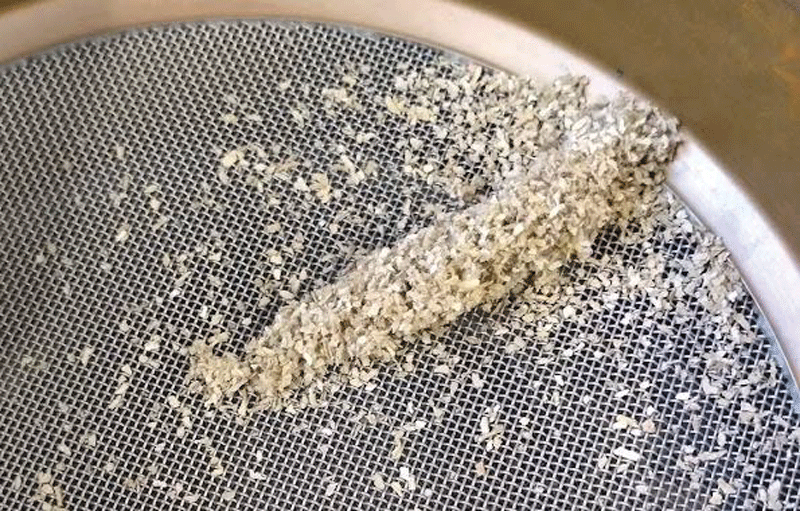
When milling the cardboard samples in the knife mill compared to conventional biomass, it was found that the particles have a strong tendency to form large mats or clumps, known as fluffy agglomerates. These typically consist of a wide range of particle sizes and have very low bulk densities. This phenomenon will likely cause severe handling issues if cardboard is used as a fuel for power generation.
Known issues include quality degradation, longer processing time, potential fire hazards and trapped materials in reaction vessels. Next steps would be to conduct controlled trials to explore its handleability in the different systems used in power generation.
Furthermore, biomass is generally made of three components – hemicellulose, cellulose and lignin. Cardboard has no hemicellulose component, which was expected as the processes used to make cardboard result in a cellulose-rich pulp.
The team at Nottingham has developed fingerprint characterisation tests using thermogravimetric analysis (TGA), which over many years of testing, have proven to be unique for every biomass. They have found that cardboard’s thermal fingerprint includes a feature at around 600°C that is not normally seen in biomass. This is due to the presence of calcium carbonate, a common filler in cardboard manufacture.
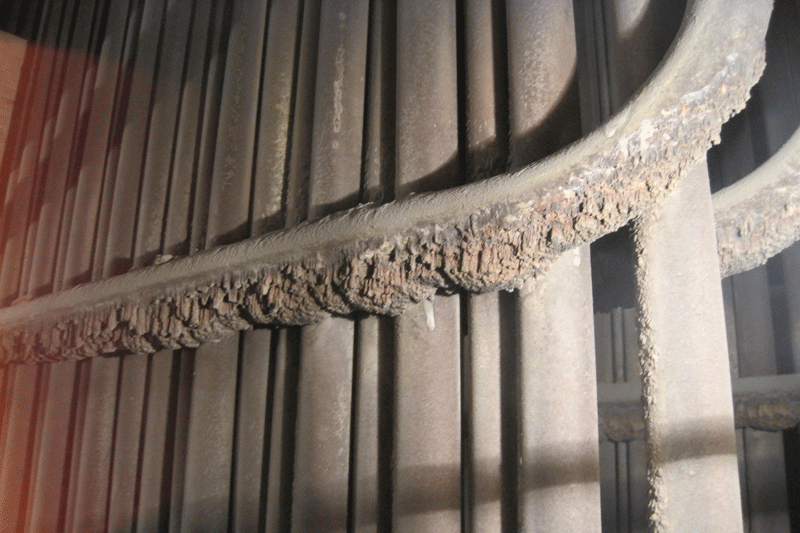
Calcium carbonate is added to cardboard to improve its optical properties and stiffness, but forms ash during combustion that can reduce a boiler’s performance. Cardboard ash content is close to the 10% biofuel limit according to ISO 17225-2.
Previous research at Nottingham shows how minerals such as calcium carbonate reduce ash fusion temperatures while increasing slagging risk. This means it’s easier for slag to form inside the boiler to reduce performance. So, the scientists at Nottingham developed a TGA test to estimate the calcium carbonate content of cardboards based on small sample sizes.
The TGA heats a small amount of the cardboard at a specified ramp rate in a nitrogen atmosphere up to 900°C. The TGA measures the weight loss as the furnace heats up, and using these weight loss profiles, the calcium content of the cardboard can be estimated.
The printed cardboard has higher calcium carbonate contents at 10.4-12.2 % compared to the unprinted samples at 5.5%. This is an expected result as it is known that one of the main uses of fillers (predominantly CaCO3) is to improve printability. It means that unprinted cardboard, which is used as packaging materials for transport, is likely to be a better candidate than printed boxes used for consumer packaging.
A balancing act
The arguments for using cardboard as an indigenous fuel source for bioenergy ultimately depend on balancing the different lifecycle options for cardboard waste. One of the key unanswered questions from a carbon balance perspective is whether it is better to landfill cardboard at the end-of-life, or to combust it for heat or electricity production.
Both end-of-life scenarios release greenhouse gas emissions. Life Cycle Assessment studies would be the next step to evaluate options if cardboard waste is to be used as a low-carbon fuel source.
Using cardboard waste in controlled combustion systems can offer a route to neutral or negative carbon emissions through carbon capture and storage. For example, Veolia recently announced the first trial of next-generation, non-amine carbon capture at the Sheffield Energy Recovery Facility. This trial will aim to remove one tonne of carbon dioxide per day from the site and demonstrate the role that carbon capture technologies can play in decarbonising hard-to-abate emissions.
It is also worth noting that coal provides the most energy when burned, with a Higher Heating Value of 25-30MJ/kg, so less material is needed to produce the same amount of heat. Biomass is lower at 18-21 MJ/kg, and cardboard is lower still at ~16MJ/kg.
However, more than 8Mt of wood pellets come from the US and Canada for UK power stations, which involves a significant amount of energy to process and transport. Cardboard waste is an indigenous resource which could be diverted for bioenergy use to replace a significant portion of these wood pellets.
The EPR legislation could make reutilisation of cardboard waste more feasible, as packaging becomes simpler and more standardised, potentially making cardboard easier to process and use as a consistent bioenergy feedstock.
Ultimately, the potential update of cardboard waste as a fuel is dependent on the value proposition for waste management companies and energy producers. Techno-economic analysis can identify the potential of the different lifecycle journeys and highlight additional sources of valorisation, such as using the waste ash from combustion for building materials.
Cardboard waste offers a unique opportunity for the UK to source nearly 4Mt of biomass fuel indigenously, which is not possible for any other biomass resource in the UK.
This low-cost source of fuel offers energy security in an increasingly unpredictable world with rapidly changing supply chains. Such resources could help stabilise the energy market and minimise the impact of price shocks from international events with global impacts.
To achieve this, several technical challenges in material handling, logistics and combustion performance will need to be overcome. However, simplifying recycling supply chains through EPR and the move to secure energy sources are positive drivers for cardboard waste usage for bioenergy beyond EfW.
More like this...