Winding up to circularity
Advancing a circular economy for composites from wind energy.
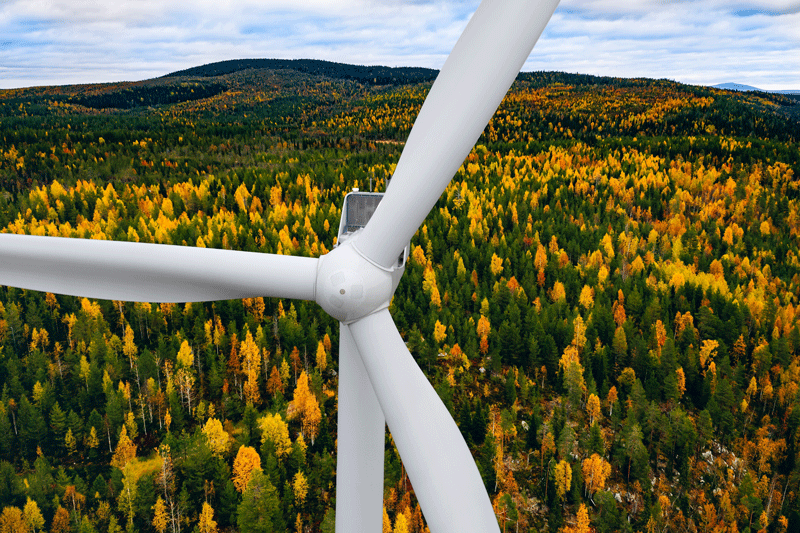
Wind energy is central to the UK’s energy transition, accounting for 30% (87.1TWh) of UK electricity generation in 2025 and making it the country’s second-largest source of electricity. This role is set to grow substantially, with the UK Government’s Clean Power 2030 pathway calling for 70-79GW of wind capacity by 2030.
However, among the many influencing factors are the materials used to build turbines and their management at end-of-life.
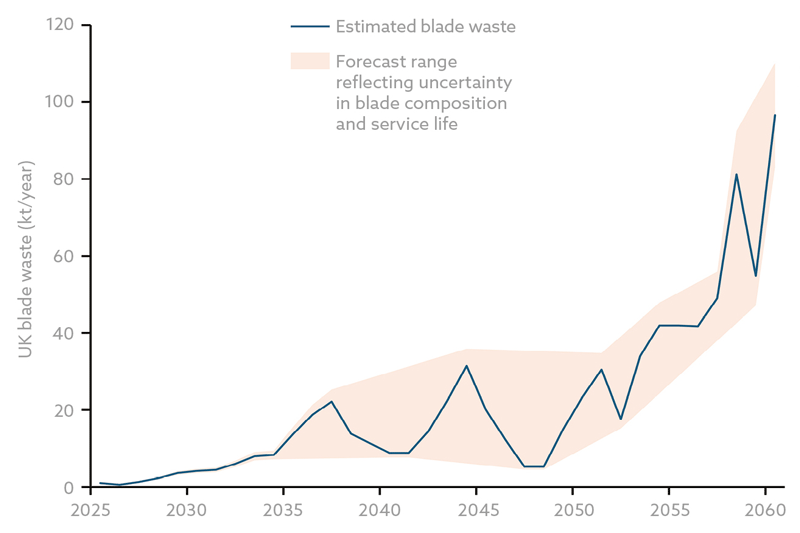
Thousands of UK wind turbine blades will reach the end of their operational lives over the next two decades, part of a challenge growing across Europe and globally. As the graph (below) shows, UK blade waste is expected to increase rapidly over the coming decades, dominated by composites, which typically account for 75-85% of blade mass.
Blade circularity
Wind turbine blades are manufactured from complex combinations of glass fibre and, in modern blades, carbon-fibre reinforced thermoset composites, adhesives and lightweight structural core materials. Unlike metals, these materials cannot simply be melted down and recycled, making it technically and commercially challenging to recover materials with sufficient quality and performance for use beyond lower-performance applications.
Having said that, blade recycling technologies have advanced significantly, with several routes now commercially available. However, moving from early commercial activity to widespread adoption requires more than recycling technology alone.
Exploring this challenge was a key focus of SusWIND in 2025. SusWind is the NCC’s flagship joint industry programme for wind turbine blade sustainability, delivered with the Offshore Renewable Energy Catapult.
Now in its sixth year, SusWIND aims to establish a viable market for circular composite materials in wind energy. In 2025, the programme brought together partners spanning the wind energy value chain to identify the commercial, regulatory and material challenges that must be overcome to enable blade recycling at scale in the UK.
The findings suggest that many of the technologies required already exist, but further advances are needed to increase material recovery and resource efficiency. Widespread adoption also depends on robust markets, mature supply chains, supportive regulation and long-term investment.
Creating a circular supply chain depends on four interconnected factors – a credible business case for recycling, sustained demand for recovered materials, regulation that enables rather than restricts circularity and continued innovation in the materials used to manufacture future blades.
Finding the value proposition
Viability depends on balancing the cost of processing end-of-life blades against the value of recovered materials. With the technical barriers reducing, commercial success increasingly relies on confidence in future blade volumes, feedstock availability, market demand and regulation.
Although the environmental and resource benefits of recycling are increasingly recognised across the wind sector, recycling remains difficult to justify where end-of-life decisions are driven primarily by cost. Blade recycling gate fees are not widely published and remain uncertain, with reported estimates ranging from £200-1,500/t. This compares with a median UK energy-from-waste gate fee of £121/t and a median landfill cost of £152/t, including landfill tax, according to the NGO WRAP’s Gate Fees Report 2024/25.
So, while many turbine owners have committed to avoiding landfill, energy-from-waste remains the UK’s lowest-cost disposal route and therefore the principal commercial competitor to recycling.
On the other hand, SusWIND’s Life Cycle Assessment (LCA) finds energy-from-waste to have a comparatively high climate impact among the end-of-life routes assessed.
To investigate blade recycling viability, SusWIND has developed dynamic techno-economic models for hypothetical mechanical and pyrolysis recycling facilities. The analysis indicates that both routes could become commercially viable within the next five years under a private-public investment model.
At commercial scale, each facility could contribute almost £6mln in annual gross value added while supporting 30-50 skilled jobs. The benefits extend beyond economics. Lifetime greenhouse gas emissions savings could exceed 200ktCO2e by retaining valuable materials within the economy and displacing virgin production.
Commercial success therefore depends on two external factors. First is feedstock security. Forecast blade volumes suggest that facilities may initially run below operating capacity, but this could be mitigated by accepting composite waste from other sectors.
Second, market demand. Recycling facilities need reliable markets for recovered materials that meet end-user technical and quality requirements at commercially viable prices. Otherwise, there is no viable recycling business.
This principle is reflected in Article 6 of the EU Waste Framework Directive, which requires recovered materials to have a defined use, meet technical performance requirements, satisfy market demand, and pose no adverse environmental or health risks before they can achieve end-of-waste status.
SusWIND has assessed the commercial opportunities for the principal outputs from blade recycling, including mechanically recycled products, reclaimed glass and carbon fibres, and polymer-derived feedstocks. Across all material streams, recyclers must balance performance, cost and sustainability against existing alternatives. While recovered products may not compete on all three, they need a compelling overall value proposition to secure long-term demand.
Did you know?
According to NCC, UK blade waste is expected to increase rapidly over the coming decades, dominated by composites, which typically account for 75-85% of blade mass.
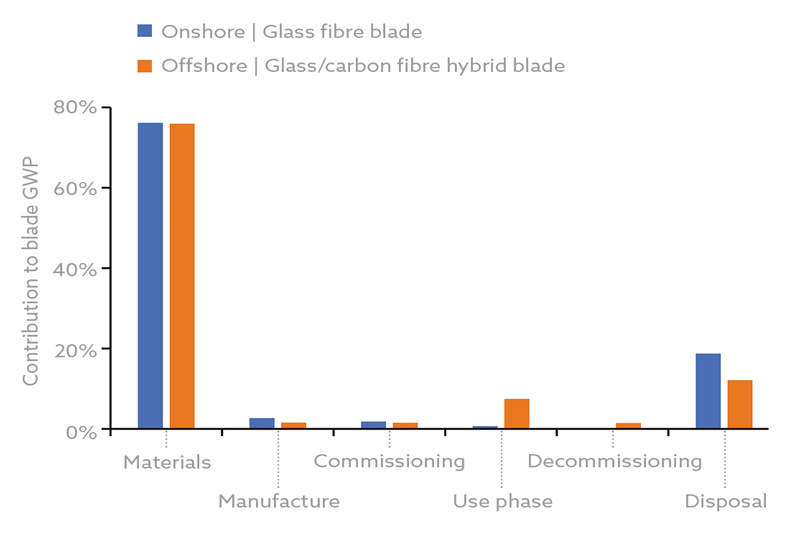
Composite materials account for around 75% of a blade’s lifecycle global warming potential (GWP) and almost 90% of the turbine’s unrecyclable content, making them the greatest opportunity for improving the sustainability of future blades.
SusWIND’s Lifecycle Assessment has identified carbon fibre as the largest material contributor to a blade’s carbon footprint, accounting for around 50% of its lifetime GWP.
Supporting the market
Several commercially mature routes are available for managing end-of-life blades, including mechanical recycling and cement kiln co-processing.
For mechanical recycling, products such as reinforced plastic lumber for decking, fencing and other construction applications demonstrate that markets are already available and sufficiently large to absorb expected recycling volumes. However, these applications generally represent open-loop recycling, with recovered materials used outside the wind sector. Although they provide an effective route for diverting blades from landfill and energy-from-waste, they do not create demand for recycled materials from turbine manufacturers themselves.
More advanced material reclamation of fibres and polymer-derived feedstocks has been achieved through chemical recycling technologies such as pyrolysis and solvolysis, which could potentially enable these materials to be reintroduced into future blade materials. While these technologies are established for recycling other waste streams, their application to wind turbine blades is not yet commercially mature. This creates the opportunity for demand to originate within the wind supply chain rather than relying solely on external markets.
Market size is unlikely to limit deployment, with required market shares below 1% for all major material streams. The greater challenge is producing recovered materials of consistent quality at prices competitive with virgin alternatives, for reclaimed glass fibres and polymer-derived feedstocks in particular. Demonstrating a compelling value proposition therefore remains essential to secure long-term market demand.
Going full circle
As recycling technologies mature, regulation is increasingly important for deployment at scale. Frameworks must evolve to reduce investment barriers and build confidence in recycled materials.
In agreement with the RESCUE project, WindEurope and the European Composites Industry Association, SusWIND’s review has identified three key regulatory areas – waste classification, cross-border movement of materials and market incentives.
Composite structures are currently classified under various waste codes, creating inconsistency across the supply chain. A dedicated composite waste code would simplify classification, improve data collection and provide greater certainty for recyclers and regulators.
Composites materials can be transported internationally. In response to calls from the composites industry, as well as the wind and marine sectors, the European Commission has recently proposed an amendment to the EU Waste Shipments Regulation, which intends to remove the barriers to cross-border shipments of fibre-reinforced composites. This is a welcome development, as recycling capacity is unlikely to exist in every country, more efficient movement of composite waste will be essential if future facilities are to achieve the economies of scale needed for commercial viability.
Removing barriers to recycling is important, but regulation that creates demand for recycled materials is likely to have the greatest long-term impact.
One approach already emerging in other sectors is the introduction of recycled content requirements. Recently adopted EU legislation introduces recycled content requirements in the automotive sector that will create demand for recycled materials from within the same sector that generates the waste. A similar approach in wind energy could stimulate investment in blade recycling, while encouraging original equipment manufacturers, material suppliers and recyclers to develop future blade materials and recycling technologies in parallel.
Such measures should be introduced gradually as recycling technologies and material qualification mature.
Existing mechanisms, such as the UK’s Contracts for Difference Clean Industry Bonus, could incentivise circularity alongside current supply chain and decarbonisation criteria. This points towards incentives ahead of disposal bans, allowing recycling capacity and markets to develop first.
Combined with standards and digital product passports, recycled content requirements could provide the long-term market confidence needed to accelerate investment in circular composite materials.
Materials innovation to capture value
Beyond recycling today’s blades, the greater opportunity is designing the next generation for circularity. However, this does not mean applying the same strategy to every material. Future blades must balance material reclamation, recycled content and decarbonisation alongside performance, manufacturability and cost.
Composite materials account for around 75% of a blade’s lifecycle global warming potential (GWP) and almost 90% of the turbine’s unrecyclable content, making them the greatest opportunity for improving the sustainability of future blades. However, different constituent materials require different strategies, with legacy glassmfibre and modern glass/carbon fibre hybrid blade designs to consider.
Glass fibre
Across both legacy and modern blade designs, glass fibre typically accounts for 40-50% of total blade mass, making it the single largest opportunity for increasing recycled content.
Direct reuse of reclaimed glass fibre in composites is possible in lower-value applications, but its discontinuous format and reduced mechanical performance limit its usefulness in new structural blades. A potentially higher-value route is to remelt the reclaimed glass as a feedstock for new, virgin-quality, continuous glass fibre.
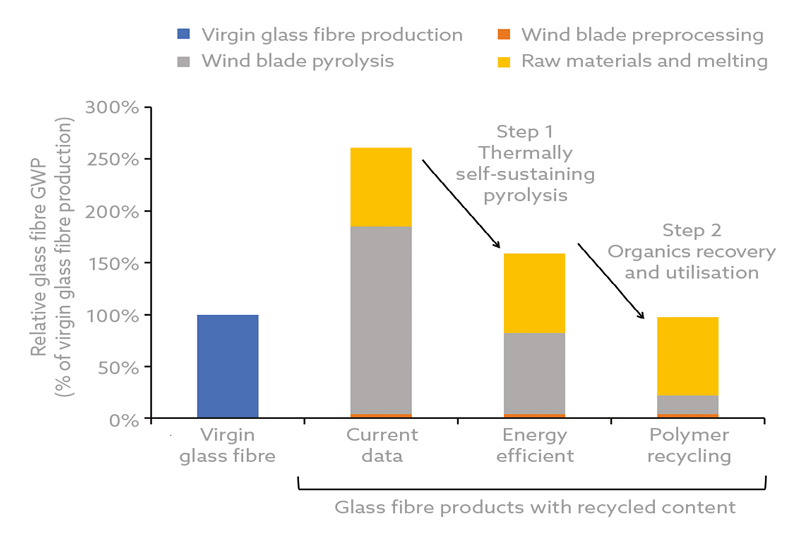
SusWIND analysis reveals that remelted glass fibre containing material from wind turbines could achieve a GWP comparable to virgin fibre, provided recycling advances towards low-energy processes and polymer recovery rather than combustion (see graph below). This is because remelting remains highly energy intensive, while the recycled route also carries the additional impact of recovering glass from blade waste.
The challenge is translating this potential into an industrially viable closed-loop process. Glass remelting is already being explored using well-controlled production waste, but end-of-life blades introduce greater variability in glass composition and potential contamination from manufacture, service and recycling. SusWIND’s Greener Glass Fibre 2025 white paper explores these challenges and sets out a potential pathway for incorporating recovered blade glass into new glass fibre production.
Polymers
Polymers make up over 35wt.% of wind blades and present the second major opportunity for increasing circularity. SusWIND LCA of blade recycling technologies has identified polymer combustion as the largest source of GHG emissions associated with blade recycling. This includes direct combustion during thermal recycling and downstream combustion as fuels, or incineration where the recovered polymer products are treated as hazardous waste. Avoiding or minimising polymer combustion, and instead recovering these materials as useful chemical feedstocks, is therefore critical to reducing the GWP of blade recycling.
Pyrolysis and solvolysis can recover oils and chemical intermediates with the potential to be refined and reintroduced into resin manufacture. Solvent-based recycling has also demonstrated recovery of valuable molecular building blocks from epoxy resins, and new recyclable resin systems are being developed specifically to simplify future material recovery.
Working with recyclable polymer suppliers, SusWIND has assessed the environmental impact of secondary polymer recovery and reuse, identifying high-impact processes where further improvements could maximise the benefits of closed-loop recycling.
Attention is now turning towards economically viable routes to refine recovered products into feedstocks that can compete with virgin materials.
Carbon fibre
Unlike glass fibre, carbon fibre cannot be remelted and recycling typically alters its format, limiting reuse in primary structural applications. Reintroducing recycled carbon fibre into blades therefore remains a challenging proposition, although sectors such as automotive are exploring recycled content and could provide circular markets for carbon fibre recovered from wind.
SusWIND LCA has identified carbon fibre as the largest material contributor to a blade’s carbon footprint, accounting for around 50% of its lifetime GWP, meaning the greatest opportunity currently lies in reducing the impact of virgin fibre production.
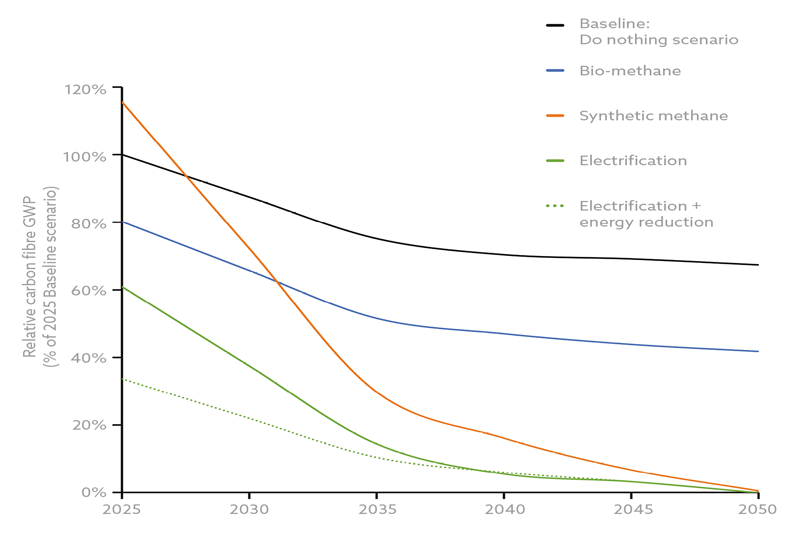
SusWIND analysis and net-zero roadmapping has identified opportunities for decarbonisation in lower-carbon precursors, renewable electricity and renewable thermal energy to displace natural gas (such as biomethane and synthetic methane from green hydrogen). The graph above illustrates the potential reductions achievable through electrification and improved energy efficiency.
The sustainability strategy for future blades is therefore material dependent – glass fibre presents the greatest opportunity for circularity, polymers for chemical feedstock recovery and carbon fibre for decarbonisation. Together, these developments point towards blades designed for structural performance, material reclamation and long-term circularity.
Wrapping up
The technologies needed to improve blade circularity are increasingly available. The challenge now is creating the commercial, regulatory and supply-chain conditions needed for widespread adoption. This requires markets for recovered materials, confidence in their quality and performance, and incentives that enable investment while encouraging circularity to be considered from the outset of blade design.
Instead of recycling being an end-of-life challenge, future blades should be designed with material reclamation considered alongside performance, manufacturability and cost. This needs coordinated action across original equipment manufacturers, material suppliers, recyclers and policymakers, supported by standards and regulation that create demand for circular materials.
SusWIND will continue working with organisations across the wind and composites value chains to help establish these conditions, independently benchmarking emerging technologies, generating environmental and economic evidence for scale-up and investment, and facilitating collaboration and the sharing of data, experience and best practice.
The opportunity also extends beyond wind. WindEurope found that turbine blades account for only around 10% of Europe’s thermoset composite waste in its 2020 report, Accelerating Wind Turbine Blade Circularity. Applying the technologies and lessons developed for blades across larger waste streams from construction, transport and marine could accelerate composite circularity more broadly, while providing recyclers with more secure and diverse feedstock. It is clear that connection and collaboration is essential to build the confidence needed for widespread commercial adoption.
More like this...