Intelligent artificial muscle integrates sensing and actuation
An artificial muscle mimics biological muscle by simultaneously processing motor and sensory signals.
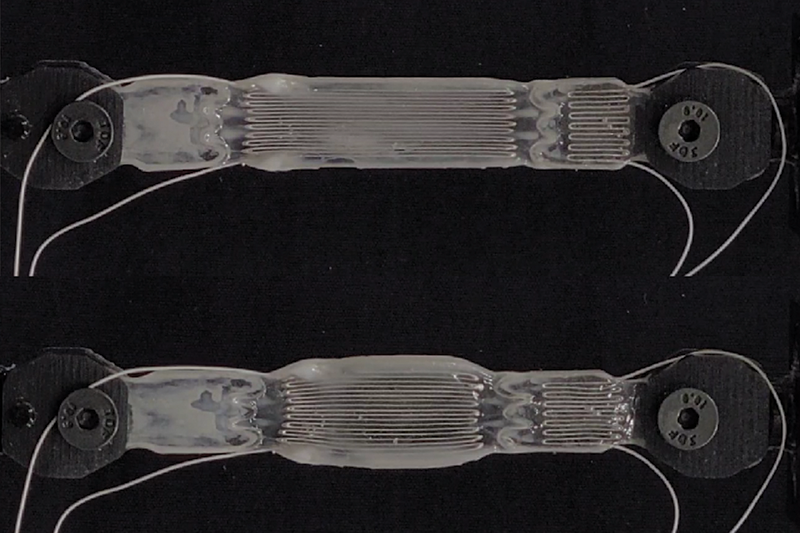
Isometric contraction of the artificial muscle
© Soft Robotics & Bionics Lab, Seoul National UniversityThe inventors in South Korea believe this offers a strong grip on progressing humanoid robotic applications.
Inspired by biological muscle-tendon complexes, researchers at Seoul National University have embedded liquid metal channels within a liquid crystal elastomer (LCE). The ‘muscle’ can reportedly contract in response to electrical stimulation, and measure internal force and length in real time.
Professor Yong-Lae Park at the university says the work seeks to find a solution for artificial muscles made from soft polymeric materials, where non-linear and hysteretic behaviour makes them difficult to control.
'What struck me is that our own biological muscles are also highly non-linear, yet we control them effortlessly,' he explains. 'When I looked into why, I kept coming back to proprioception – our muscles have sensing organs embedded inside them. The muscle spindle reports length, and the Golgi tendon organ, sitting at the muscle-tendon junction, reports tension. Together, they continuously tell the nervous system the mechanical state of the muscle, which is what makes smooth control possible.'
Drawing on Park’s research, the team looked at giving the material 'a sense of itself' using LCEs while also adding the tendon-like component.
This approach differentiates from earlier studies that rely on the liquid metal as just a heater or a sensor 'limited to simple on-off triggering'. Others only capture the kinematic data for measuring length, but this is problematic – the same length can correspond to very different internal forces, Park adds.
'Our muscle senses force and length simultaneously and in a decoupled way, and it does so from within a single, monolithic structure that also does the actuating – true afferent and efferent signalling in one body, with no bolted-on sensors,' he explains.
'On top of that, we arrange two muscles as an antagonistic pair, like a flexor and extensor, which gives us much better control during the slow cooling phase. That combination is what lets us close the loop reliably on both force and position.'
Building the muscle-tendon complex requires two versions of the same LCE chemistry, albeit tuned for opposite functions.
For the contractile 'muscle', they make a polydomain nematic material. This is synthesised through a thiol-acrylate reaction, by first stretching it to align the mesogens and then locking them in with a second photopolymerisation to create a monodomain nematic LCE.
Deploying an isotropic LCE for the 'tendon', they deliberately reduce the reactive mesogen content, add a diacrylate spacer to quench the nematic order and run the reaction above the nematic-to-isotropic temperature. Keeping the material permanently isotropic at room temperature gives it a rubber-elastic quality. It also produces a fast-recovering material that barely responds to heat, perfect for sensing tension.
'Because both are the same base chemistry, we can chemically crosslink them into one continuous specimen, which mimics the connective tissue at the real muscle-tendon junction,' Park continues.
Next, the team pattern serpentine liquid-metal channels into each LCE region using direct ink writing, with the nematic LCE channel acting as a heater and stretch sensor, and the isotropic LCE channel sensing both stretch and tension.
They have developed a custom sensing-and-driving circuit that handles sensing and heating on the same metal channel.
The two muscles are paired antagonistically to 'track square, sinusoidal and ramp trajectories in both stretch and force' and were tested for stiffness and size in a finger and gripper.
Further work is required before use in humanoid robotic applications. 'Right now, the muscle relaxes by passive convection, which is the slowest part of the cycle, so faster or active cooling is a clear direction for improving response time,' Park says. The other priority is scaleability across different sizes and geometries.