Lab combines artificial intelligence and robotics to automate tasks
The self-driving lab could improve experimental consistency, support reproducible research and provide higher-throughput materials development.
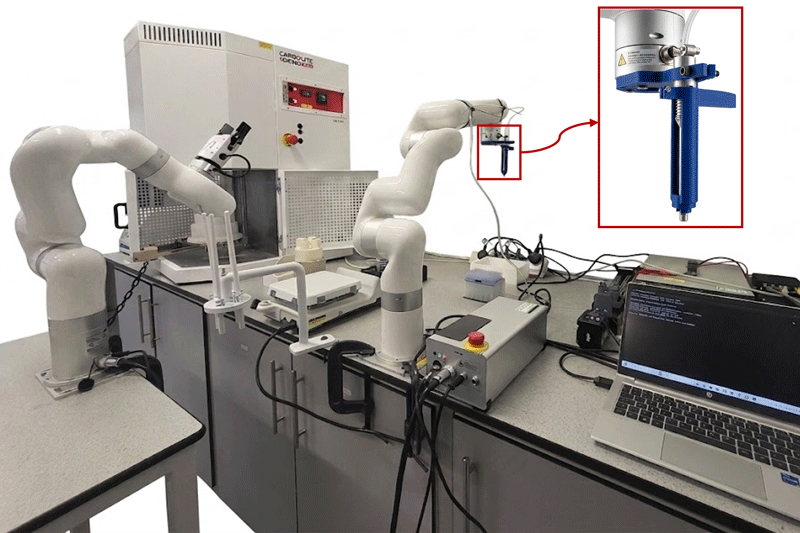
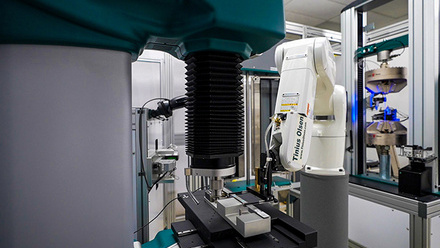
The coordinated automated system at the University of Nottingham, UK, uses two robotic arms, a specially designed liquid-dispensing tool, laboratory equipment and purpose-built software.
An artificial intelligence (AI)-based approach known as active learning uses information from previous experiments to identify material compositions worth investigating.
The team at the Centre of Excellence in Coating and Surface Engineering (CE-CSE), University of Nottingham, UK, has integrated different processing stages into a single system and calibration experiments to demonstrate accurate liquid dispensing using different liquids.
The team then demonstrated that the lab could automatically prepare a precursor solution, transfer the material for furnace processing, manage controlled cooling and retrieve the processed sample.
‘A key challenge is enabling laboratory robots to work reliably across different stages of an experiment, particularly when liquid handling must be combined with high-temperature processing,’ says Tanvir Hussain, Professor of Coatings and Surface Engineering at the university.
‘Our work addresses an important part of that challenge and creates opportunities for further integration with intelligent experimental planning and optimisation.’
More like this...