Taking flight
Early-career professionals in the defence sector share their industry journeys.

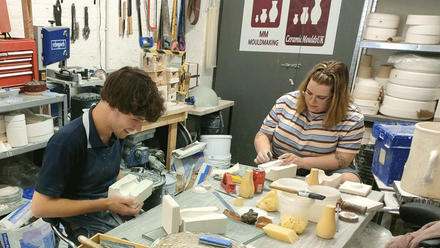
Ethan (left) and George (right) share their experiences working in the defence sector alongside other early-career professionals
Annie, MSci AIMMM, Materials and Analytical Science Graduate, AWE
Time at company: 2 years
Who or what inspired you to do engineering and science?
My parents (now retired) were both automotive engineers throughout my childhood and their entire careers. By their very nature, I grew up surrounded by and with a passion for real-world engineering and science. My interest started when I was quite young, although I didn’t realise at the time – I fondly remember finding my parents’ M. C. Escher graphic illustrations book when I was in primary school, and being totally entranced by the calculated geometrical patterns in works such as Relativity or Spirals. Another early memory includes watching the TV series How It’s Made after school with my dad. I think the culmination of science, engineering and art to design and manufacture something new is so interesting. This type of work really stole my attention and heart.
What education pathway did you take and why?
At school, I loved my resistant materials and core science classes. However, as I got to A-Levels, my school didn’t have the resources to run a materials-based course. I was sad I couldn’t follow the path I originally wanted to, but instead focused on the main sciences – Chemistry, Physics, Maths and Further Maths. I then applied for a mixture of degree courses and discovered a Natural Sciences degree that had Materials Science listed as one of the pathway options. I was so excited to be accepted onto the course, and it wasn’t surprising that I majored in Materials Science over the four years.
I developed a particular interest in materials characterisation – my favourite techniques being electron microscopy and X-Ray diffraction. Improving awareness of Materials Science as a viable STEM career pathway at schools, as well as boosting resources for continued materials education, is so important for our future generations.
How important are early careers entry routes to your organisation?
AWE offers many early-career pathways into the business – Level 3-6 apprenticeships, the Defence STEM Undergraduate Sponsorship (DSUS) Scheme, the undergraduate year in industry, summer students and the Evolve Graduate scheme. All undergraduate pathways open a route onto the graduate scheme, or to come back as a direct hire.
Early-careers schemes play a highly important role in growing the next generation of cross-disciplinary employees and preparing them to meet national defence needs. Personally, I think these pathways allow great connections to be built, both within the graduate intakes and throughout the science, engineering and quality functions. This is so important for company-wide knowledge sharing and maintaining strong foundations for the future.
What advice would you give to any new starters into your industry?
Defence businesses and teams differ massively in terms of diversity and background, as well as opportunities offered to new starters. It is so important to believe in your technical ability and decision-making, but also to ask for support and feedback when required. Be confident and resilient, but also humble in your work. Colleagues will respond positively to a proactive and supportive attitude, often opening doors for you.
Connor, Student IOM3 Member, Materials Engineer, Dstl
Time at company: 7 years
What education pathway did you take and why?
I joined Dstl after sixth form on a Level 3 Mechanical Engineering apprenticeship, going on to complete a Higher National Certicate in Manufacturing Engineering as part of the programme. The opportunity to work on real-world challenges, contribute to national security and be involved in R&D made the defence sector an attractive option for me.
Following my apprenticeship, I secured a full-time role within Dstl as a Personal Protective Equipment Scientist, where I was encouraged to further my education. I started a Degree Apprenticeship in Materials Science Technology. Part of the way through, I moved to my current role as a Materials Engineer, and I am due to graduate in November 2026. Although I was previously offered a place at university, I felt I was better suited to the apprenticeship route. The course has allowed me to gain practical experience while continuing my education and getting paid.
What degree, apprenticeship or other entry routes are available in your place of work?
Dstl offers apprenticeships from Levels 3-7 and accepts early-careers cohorts across a range of disciplines (engineering, electronics, ordnance, munitions and explosives, quality). Dstl also supports further education through Master’s degrees and PhDs.
Working in a niche area, the ability to upskill staff while they work is extremely valuable to the business, helping to ensure they have the knowledge and skills needed to meet defence requirements.
Which materials or characterisation techniques particularly interest you, and why?
Titanium. Having had the opportunity to become a visiting researcher working on recycled titanium, it has been a particularly rewarding experience. Titanium is an incredibly versatile material due to its combination of high strength, low weight and excellent corrosion resistance. Its importance across defence and aerospace applications makes it an exciting area to work in, and being involved in research to develop more efficient and sustainable manufacturing routes has further increased my interest in the material.
In terms of characterisation techniques, I would choose microscopy, it allows you to see materials at a level that is not normally visible and to better understand the relationships between material structure, properties and performance.
Microscopy can often provide immediate insight into why a material has behaved in a certain way. It is an invaluable tool for investigating component failures, or evaluating the success of new materials and manufacturing processes.
What do you think is the greatest challenge facing the defence/materials sector in the next 10 years?
Securing resilient supplies of critical materials and increasing sovereign manufacturing capability will be significant challenges to overcome in the next decade. Ensuring reliable access to strategic materials, all while maintaining technological competitiveness, will be critical for meeting future defence needs. To do this, I believe adopting a fail-fast approach will enable defence organisations to stay innovative while managing risk and cost.
Testing ideas early through small-scale trials and demonstrator projects allows organisations to identify what works and what does not before significant investment is made.
Ethan, Student IOM3 Member, Degree Apprentice, Lucideon
Time at company: 3 years
What education pathway did you take and why?
I first studied Mechanical and Electrical Engineering at college while working as a Maintenance Engineer. Shortly after, I pursued a Higher National Certificate to develop my credentials further.
I followed a general engineering and science education route, but delayed going to university as I wanted to have a visible impact in the real-world quickly. I started a degree apprenticeship with Lucideon, and met many colleagues who could not hide their excitement for Materials Science. I have carried their passion into my work and intend to inspire others in return.
From my experience, I believe my degree apprenticeship gave me the chance to prove myself in a commercial R&D environment, and push and refine my technical skills to a level that would never be achieved at university alone. This option enabled me to work towards a degree, all while developing new materials and having the impact I craved.
What attracted you to a career in the defence sector?
At the beginning of my apprenticeship, I asked to be part of a ‘cool project’ and was introduced to the development of a new composite material for the defence sector. It was one of the most intricate and complex material systems I had ever seen.
This gave me my first taste of the types of advanced materials being designed to evolve national defence systems. For example, advanced ceramics are incredible and used in some of the harshest environments we know. As a result, my interest is mainly in composite materials, such as ceramic-matrix composites (CMCs) and MAX phases, which aim to fundamentally change and control ceramic failure mechanisms.
What do you think is the greatest challenge facing the defence/materials sector in the next 10 years?
In R&D for defence-related materials, the biggest challenge will be the ability to maintain sovereign procurement of materials from which to manufacture our systems. As technologies become more advanced, the use of complex precursor materials without established local supply chains will result in greater dependence on other nations. Innovation in the defence sector will come from reducing the cost of existing materials procurement and manufacturing processes, rather than creating new ones. This type of research will maintain system advancement while naturally keeping risk and cost low, due to the abundance of existing knowledge and expertise.
What advice would you give to any new starters into your industry?
For anyone looking to begin their career in the defence industry, I would encourage you to see the bigger picture in your day-to-day role. Many scientists solve problems with their formulations or forming processes, but only great scientists and engineers consistently look at the problem from a broader perspective. Understand where the problem is coming from, where improvements in the supply chain can be made, and anticipate and address challenges before they become larger problems.
It’s easy to lose motivation if you are not ready for a few failures on your way to success. I wish I started with the mindset of not wanting to win, but wanting to learn from every mistake.
George, MEng MIMMM, EngD Researcher, Bristol Composites Institute, NCC
Time at company: 3 years
Who or what inspired you to do engineering or science in the first place?
At school in years 8 and 9, my science classes began exploring more complex underlying topics such as elements and atoms. I noticed I was quite interested in these subjects, and for the first time got excited about these areas.
I was lucky enough to have the freedom to do my own independent learning outside of school, which made it easy to improve and engage with science and engineering further. I spent hours after school working on my design and technology projects – it was so fun and rewarding to see them progress further.
Later in life, I took A-levels in Maths, Physics and Chemistry, going on to study a degree in Mechanical and Electrical Engineering. In my third year of university, I took a year in industry in an engineering-related organisation, which I really enjoyed. This inspired me to pursue a Doctorate in Engineering (EngD), which I am currently undertaking.
What attracted you to a career in the defence sector?
I have a particular interest in ceramic composites to achieve multifunctional, high-specific strength and thermal resistance. When applying for engineering doctorates, defence projects stuck out as the most appealing as they involved highly specialised composite testing with interesting applications and requirements. Specifically, high-temperature thermal resistance testing is of particular interest to me, and it has been great to work with NCC on this during my EngD.
It is very interesting how the experimentation and analysis of severe material damage can unveil surprising physical phenomena in materials.
What do you think is the greatest challenge facing the materials/defence sector in the next 10 years?
As drones rapidly become a prime asset in modern conflict, being able to support their performance and development with scaleable material and manufacturing techniques is critical. This includes ensuring supply chains are secure.
Additionally, other countries are innovating and developing technologies at great pace. Some nations are even able to export highly relevant technologies at scale, developed through primarily fail-fast methods. These principles should be applied nationwide to enable effective peacetime innovation. As successful innovation is highly dependent on the relevance and viability of projects, it is important ample time is given to the identification and scoping of projects before greenlighting.
Anything you wish you’d known before starting a career in defence?
I wish I knew more about the range of companies (i.e. start-ups, SMEs, national labs and the large primes) and career routes within the defence sector earlier on in my career. Each pathway offers various attributes that cater to personal preferences, and I’m still learning about them now.
The defence sector is a large and sometimes nebulous place, which can be quite daunting. But its breadth means there are vast career opportunities, with the potential to cater well to almost anyone. Be patient and thorough in your search through this sector and don’t be afraid to reach out to people for specific guidance or advice
More like this...