Energy-harvesting performance boost for carbon nanotube yarns
An electrolyte system uses heavy water to increase the energy output of electricity-generating twistrons.
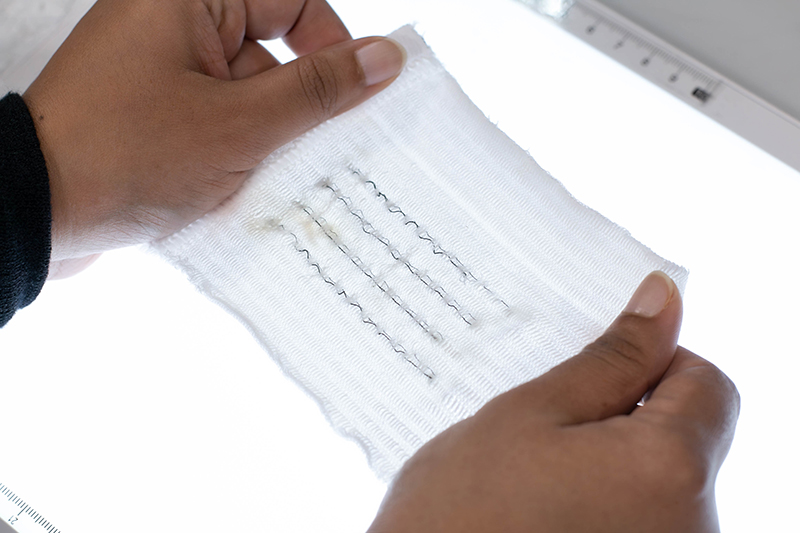
To demonstrate practical use for their technology, the University of Texas at Dallas researchers embedded a twistron yarn array covered in a solid electrolyte gel into a commercial textile and stretched the material to simulate energy harvesting from human motion. The captured energy successfully powered wearable electronic devices
© University of Texas at DallasUS researchers say they have successfully powered wearable electronic devices using energy harvested in carbon nanotube yarns that had been covered in a non-corrosive, heavy water-based electrolyte solution and repeatedly stretched.
Rather than use conventional water, the University of Texas at Dallas team turned to heavy water, which replaces hydrogen with deuterium, and contains an added neutron in its nucleus.
‘Using heavy water slows the movement of charged molecules and reduces or minimises the self-discharging rate, so we can keep more charges on the carbon nanotubes. For energy harvesting, that’s a big benefit – more charges lead to better harvesting performance,’ explains Ishara Ekanayake, the study’s co-first author.
After bathing the twistrons (spun yarns made from carbon nanotubes), the team say the solution delivers up to 2.5 times higher peak electrical power and 1.8 times more energy per stretching cycle at low frequencies, between 0.01 hertz (cycles per second) and 2 hertz.
The energy conversion efficiency reportedly reaches 9.5%, which, they claim, is higher than any other previously reported twistron harvester operating in neutral electrolytes.
In a second demonstration, electrolyte-coated twistron yarns are coupled with a polymer-based artificial muscle. When the muscle was heated, it contracted and stretched the twistron yarn to produce electricity. The team says this shows the technology’s potential for use in temperature-change applications.