Riding the tube
The latest developments in the market for carbon nanotubes.

After decades of anticipation and setbacks, nanocarbons are finally gaining meaningful market traction and experiencing notable growth. Once confined to niche uses, carbon nanotubes (CNTs) are now positioned for strong expansion over the next decade, largely due to rising demand in the energy storage sector. According to IDTechEx, the CNT market is expected to surpass US$1.25bln by 2035.
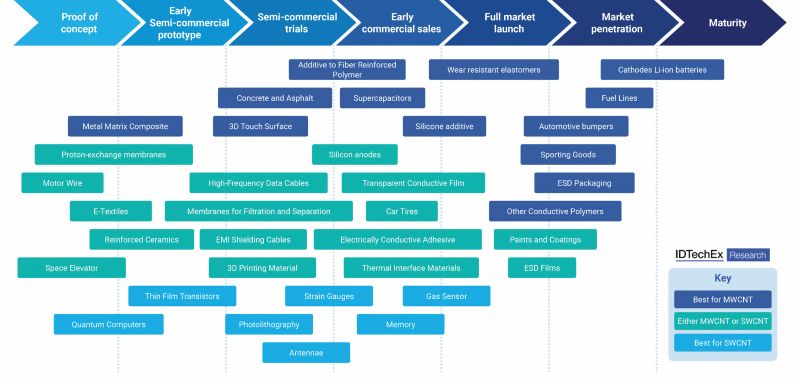
Multi-walled carbon nanotubes (MWCNTs) are being adopted across diverse sectors, such as thermal interface materials, polymers and coatings, yet their strongest growth area is in energy storage.
When used as conductive additives in lithium-ion batteries, even minimal CNT loadings can enhance energy density, while also supporting thicker electrodes, broader operating temperatures and higher-capacity materials.
Data from companies such as Showa Denko (now Resonac) has shown that replacing just 0.5wt.% of carbon black (CB) with CNTs can improve charge capacity at room temperature by 10%.
Their role in supercapacitors is also expanding, underpinned by advances in dispersion techniques, binder compatibility and additive interactions. A number of nanocarbon hybrid products have been developed by companies such as CHASM and Birla. They combine properties from CNTs, graphite and CB to achieve a more homogenous dispersion. This allows interactions with binders and other additives to be selectively tuned.
Multi-walled carbon nanotubes production has been well established for several years, with catalytic chemical vapour deposition (CVD) remaining the primary manufacturing route. As the industry scales, technical and economic improvements, particularly in post-processing, will be essential.
Charged up
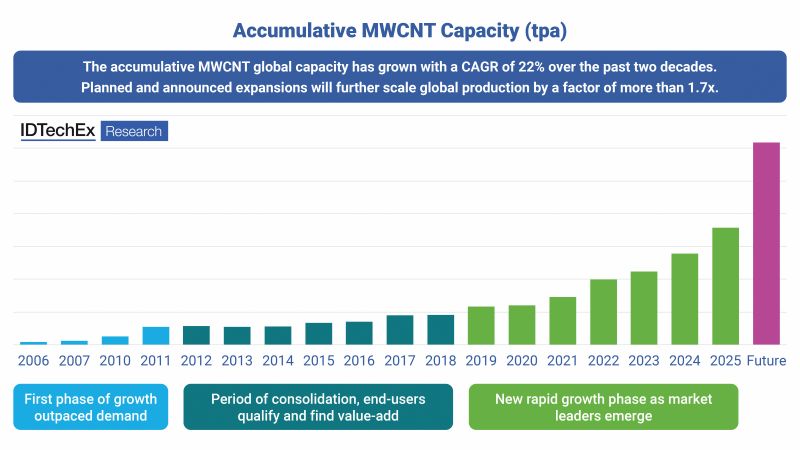
The use of CNTs as conductive additives in lithium-ion batteries presents substantial high-volume potential and so is already reshaping the dynamics of the CNT market. This shift is reflected in the rapid increase in planned production capacity and a trend towards industry consolidation.
The latest IDTechEx report profiles the key producers and upstream supply chain players, underscoring Asia-Pacific’s dominant role in the market both from existing facilities and announced expansions. As of mid-2025, companies based in China, South Korea and Japan account for over 90% of global MWCNT production capacity.
Cnano boasts a wide portfolio of prominent customers, while LG Chem, operating with vertical integration, has pursued aggressive scaling plans. Both companies, along with others such as JEIO and Kumho Petrochemical, have announced significant growth initiatives.
Notably, LG Chem expanded its capacity from 1,700tpa to 2,900tpa in 2023, followed by a further increase to 6,200tpa in 2024. Meanwhile, new entrants like Huntsman and Carbon Corp have revealed ambitious capacity targets. Overall, global CNT capacity is projected to increase by 1.7x based solely on planned and announced expansions.
Leading companies have also strengthened their positions through strategic acquisitions, such as Cabot’s 2021 purchase of SUSN, leveraging expertise from the adjacent CB market.
A direct and measurable outcome of these developments will be downward pressure on material costs, pushing CNTs toward commoditisation and slimmer profit margins. This trajectory closely parallels the CB industry, where margins have historically dropped below US$1/kg, highlighting the challenges and competitive dynamics within the CNT sector.
However, falling prices combined with rising production capacity are also poised to open new opportunities for CNT adoption beyond lithium-ion batteries.
In prospective markets, CNTs will face competition from established nanocarbons, such as CB and graphene. Cost remains a critical determinant, as many industries resist paying a premium for advanced additives. This is particularly evident in reinforced concrete and asphalt, where large-scale volumes and narrow margins leave little room for higher material costs.
The tyre industry illustrates this challenge on an even greater scale. Despite promising research suggesting CNTs could reduce nanoparticulate emissions, CB continues to dominate due to its low cost, reliability and globally entrenched infrastructure.
Against this backdrop, opportunities for MWCNTs will hinge on applications that demand their unique performance advantages. Reinforced composites represent one of the most promising areas, as CNTs deliver both exceptional mechanical strength and high thermal conductivity.
These properties enable advanced solutions, such as integrated de-icing systems in polymer composites. Potential applications include wind turbine blades, aerospace components and other high-performance engineering structures – scenarios where the superior attributes of CNTs outweigh cost concerns and provide clear differentiation from incumbent materials.
Challenges remain
A persistent challenge for nanomaterials, and especially CNTs, concerns regulation and safety. The 2021 review, Assessment of the carcinogenicity of carbon nanotubes in the respiratory system in Cancers, highlighted that “In 2014, the International Agency for Research on Cancer classified the first type of carbon nanotubes as possibly carcinogenic to humans, while in the case of other CNTs, it was not possible to ascertain their toxicity due to lack of evidence”. The specific variant classified, Mitsui-7 (MWCNT-7), consists of long, rigid nanotubes with diameters exceeding 50µm. Other CNT types were deemed unclassifiable with respect to carcinogenic potential, with the review noting that material heterogeneity makes consensus difficult.
In 2024, the European Chemicals Agency (ECHA) proposed amended, harmonised classification and labelling for MWCNTs, basing toxicity regulation solely on fibre size. This approach has drawn significant criticism from industry stakeholders.
Resonac (formerly Showa Denko), for example, conducted a two-year carcinogenicity study on two MWCNT materials of different lengths, concluding that not all materials within the ECHA classification exhibit carcinogenic effects, while some outside of it may still present evidence of carcinogenicity.
Similarly, Zeon has argued that current regulation relies on correlation rather than causation, applying the fibre hypothesis in a way that does not reflect a time-ordered biological response. Instead, they advocate for a dose-dependent framework focused on inflammatory response, which would offer a more accurate, causality-based, regulatory model.
Another key challenge for CNTs lies in translating their much-publicised, exceptional properties into measurable performance at the macroscale.
While CNTs exhibit outstanding attributes, such as tensile strength (~100GPa), thermal conductivity (~3,500W/mK), electrical resistivity (>1μΩ•cm) and charge-carrying capacity (108-109Acm2), they are not a ‘magic powder’ that can simply be blended into a composite to deliver improved results. In practice, incorporation often requires masterbatches for polymers, and energy-storage applications typically rely on conductive slurries combining CNTs with other carbons, such as CB.
Dispersion remains one of the most significant hurdles. Achieving a uniform distribution of nanocarbons within a polymer matrix is highly complex, especially when accounting for processing methods like moulding and forming. Nanocarbon additives can alter flow rates and viscosity in extrusion moulding, while in fibre laminates, their presence may necessitate adjustments to curing cycles.
Since its acquisition by CB producer Birla in 2023, Nanocyl has advanced a hybrid CB-CNT material designed for conductive polymers. This hybrid aims to combine the strengths of both materials, although challenges persist, particularly in dispersion. Whereas CNTs require high shear to disperse, CB disperses under low shear. To simplify processing for end-users, Nanocyl provides masterbatches in polypropylene, polycarbonate and high-impact polystyrene, each containing 30wt.% of the hybrid nanocarbon.
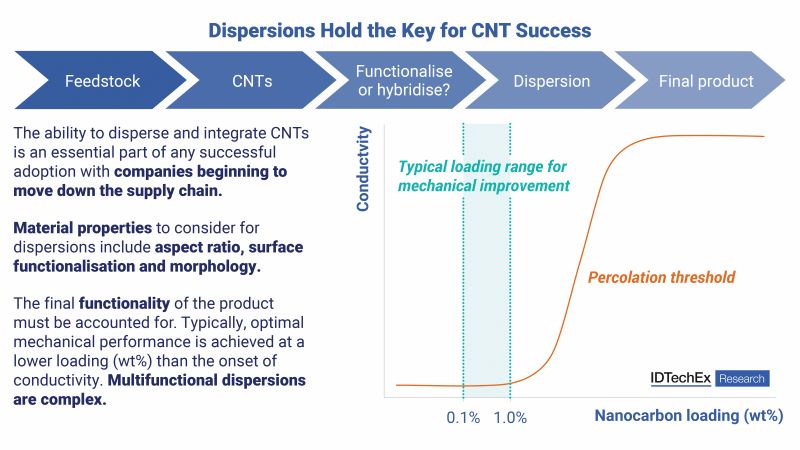
A common misconception in nanocarbon composites is the idea that a single material can enhance all properties across all matrices. In reality, different CNT grades are suited to different applications, and the optimal additive loading varies accordingly.
Mechanical improvements are typically observed at concentrations of 0.1-1wt.% or lower, while conductivity thresholds generally require higher loadings. Balancing multifunctionality across these metrics is therefore difficult, although thermal and electrical conductivity often complement one another.
Lay of the land
The success of CNTs is likely to drive three major shifts in the market:
- Industry consolidation – today’s market remains fragmented, with a high number of suppliers. Consolidation is almost inevitable, echoing the CB industry, where four-to-five dominant players now define the landscape. Clear leaders are emerging in the CNT market through large-scale capacity expansions, with opportunities for early movers to acquire IP and technology to strengthen their positions.
- Entry of multinational corporations – as markets mature, large global players are expected to move in. This trend is already underway in CNTs, with CB leaders such as Orion, Cabot and Birla acquiring CNT companies. A push is also being seen from carbon-capture players, who are seeking to acquire more of the value chain by converting captured flue-gas into CNT feedstock.
- Price and margin pressures – perhaps the most transformative change, and one that will ultimately enable broader adoption beyond energy storage, is a reduction in pricing and profit margins. While not all applications will be equally affected, success in high-volume markets such as composites and concrete, where CNTs will compete directly with nanocarbons such as CB and graphene, will require movement towards commodity-level pricing.
After a decade of intense hype, the nanocarbon market has reached an inflection point, and the coming years are expected to bring substantial growth.
CNTs have found a ‘killer application’ in energy storage, and expanding production capacity is poised to enable adoption in additional sectors. As capacity scales and costs decline, CNTs are well positioned to penetrate high-volume markets, unlocking new opportunities across composites, polymers and other advanced materials. Success will be dependent on overcoming the remaining key challenges, including regulatory and those related to dispersion of CNTs.