UK accelerates fusion research
Fusion Strategy for 2026 announced, as government invests £45mln in an AI supercomputer for the sector.
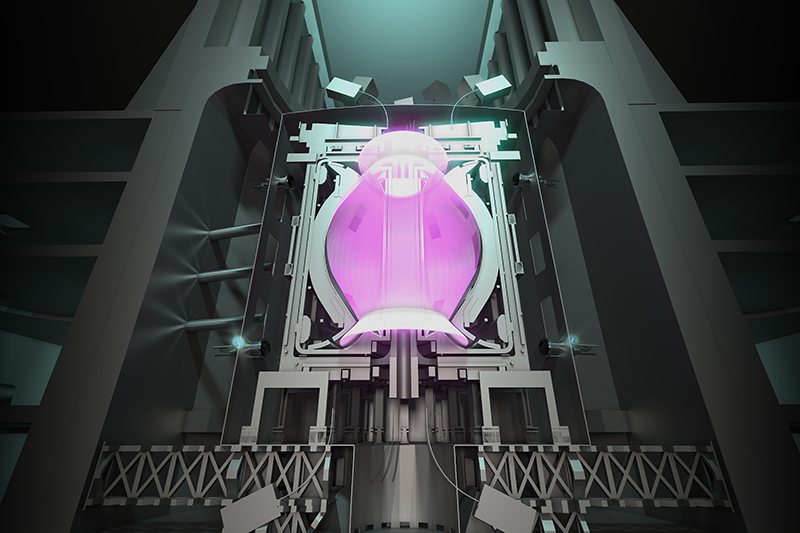
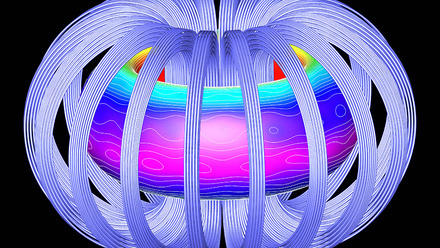
Graphic of a tokamak fusion reactor with burning plasma at the Spherical Tokamak for Energy Production (STEP) Fusion project at the Culham Campus in Oxfordshire
© UK Industrial Fusion Solutions LtdThe UK Government has published ‘a strategy to accelerate growth of the fusion industry, grow supply chains and skills, and position the UK as a global leader in commercial fusion’.
This strategy outlines plans to boost fusion research, technology development and commercialisation, which the government says it will achieve by strengthening supply chains, building the skills needed for the fusion industry and supporting investment.
A new energy revolution: The UK's plan for delivering fusion energy breaks the plan down into the role of the UK Atomic Energy Authority (UKAEA) Group, accelerating R&D, growing investment, supply chains and skills, and policy innovation.
This comes as the government invests £45mln in a 1.4MW, mission-focused, AI supercomputer called ‘Sunrise’.
It says this is a key first step in establishing the country’s first AI Growth Zone at the UKAEA Culham Campus, Oxfordshire.
As outlined in the R&D section of the Fusion Strategy, Sunrise will be dedicated to fusion energy and is targeted to be in operation in June 2026.
Funded by the Department for Energy Security and Net Zero (DESNZ), Sunrise will reportedly tackle key fusion energy challenges, such as in plasma turbulence, materials development and tritium fuel breeding, as well as deliver spillover benefits to other clean energy technologies and the UK’s broader net-zero ambitions.
It will also contribute to the government’s AI Opportunities Action Plan and AI for Science Strategy, bringing together Advanced Micro Devices, DESNZ, the Department for Science, Innovation and Technology, Dell Technologies, Intel, UKAEA, the University of Cambridge and WekaIO.
The supercomputer is planned to deliver up to 6.76 exaflops (6.76 quintillion floating point operations per second) of AI-accelerated modelling to enable high-fidelity simulations and creation of digital twins for complex systems.
Dr Rob Akers, Director for Computing Programmes at UKAEA, says, ‘[We will use] physics-informed AI to develop predictive digital twins that reduce the cost, risk and time of learning that would otherwise require expensive and time-consuming physical testing.’
Sunrise will reportedly contribute to solving challenges for a range of UK fusion programmes and drive critical advancements for the Lithium Breeding Tritium Innovation (LIBRTI) programme, which is developing tritium fuel-cycle technologies for self-sufficiency in future fusion operations.
It will also be used for STEP Fusion, the UK’s flagship initiative to demonstrate fusion energy in the 2040s.