Magnetic coils used to stabilise fusion plasma
Scientists at the UK Atomic Energy Authority (UKAEA) have found 3D magnetic fields can suppress instabilities at the plasma edge.

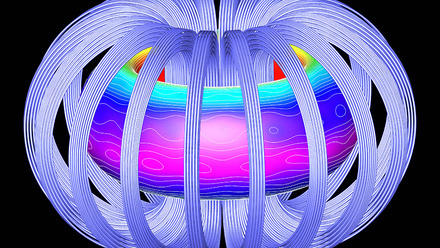
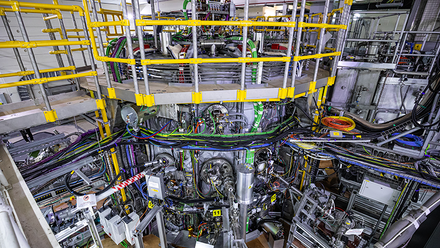
As part of the UK’s Mega Amp Spherical Tokamak (MAST) Upgrade experiment, researchers have used Resonant Magnetic Perturbation (RMP) magnetic coils to stabilise fusion plasma in what is claimed to be a world-first demonstration.
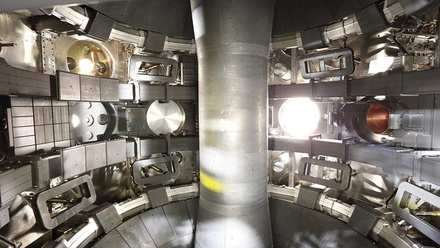
The MAST Upgrade machine is the largest operational spherical tokamak in the world, designed in the shape of a cored apple, in contrast to other ring-shaped tokamaks. This demonstration formed part of its fourth scientific campaign.
The RMP coils apply a small 3D magnetic field at the plasma edge to suppress Edge Localised Mode (ELM) instabilities that arise in a spherical tokamak.
ELM instabilities occur at the edge of a plasma and can pose a serious challenge to the inner components of a future fusion power plant. The UKAEA researchers have demonstrated complete ELM suppression in the MAST Upgrade machine – the first evidence of this in a spherical tokamak.
James Harrison, Head of MAST Upgrade Science at UKAEA, says, ‘Suppressing ELMs in a spherical tokamak is…an important demonstration that advanced control techniques developed for conventional tokamaks can be successfully adapted to compact configurations to develop the scientific basis for future power plants like STEP, the Spherical Tokamak for Energy Production.’
Improving plasma stability is a key challenge in the development of fusion energy, as instabilities can reduce performance or risk damage to tokamak components.
The RMP coil demonstration will inform further work aiming to eliminate ELMs as a barrier to commercial fusion viability and directly inform the ELM control system design for the UK’s STEP Fusion programme.
For more like this...