Quantum battery reveals potential for faster charging
A 'world’s-first' quantum battery could transform how we store and use energy in the future, claim scientists in Australia.
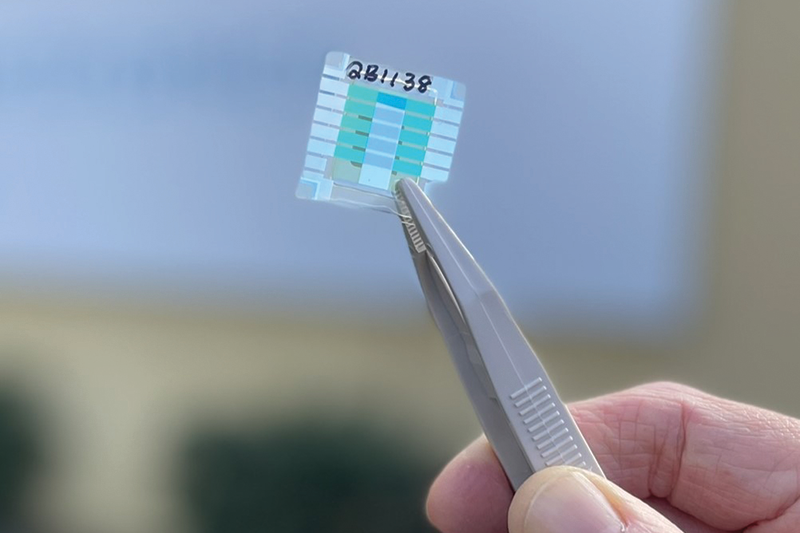
Working prototype of a quantum battery
© CSIRODr James Quach at CSIRO led the team that engineered the prototype. He expects quantum hardware to be the first viable application of these batteries, such as to make quantum computers 'faster, more scaleable and less error-prone'.
'Our findings confirm a fundamental quantum effect that’s completely counterintuitive – quantum batteries charge faster as they get larger. Today’s batteries don’t function like that,' reveals Quach.
The device exploits the quantum effects of superposition, entanglement and collective behaviour.
Quach explains how the storage units behave collectively rather than individually. If a battery has ‘N’ storage units and each takes one second to charge, then when all units are charged at the same time, each one will take 1/√N seconds.
Scientists from CSIRO, the University of Melbourne and RMIT University produced the multi-layer, organic, microcavity device on an indium tin oxide (ITO)-coated, transparent, glass substrate.
The substrate is cleaned with isopropyl alcohol and de-ionised water in an ultrasonic bath. The device is then treated with UV-ozone to create an oxygen-rich ITO surface and increase its work function. Layers are deposited by thermal evaporation under a high vacuum.
The layers include 75nm silver cavity top and bottom mirrors; a 15nm hexaazatriphenylene hexacarbonitrile hole-injection layer; a 15nm copper phthalocyanine (CuPc) light-absorbing active layer; a tuneable C60 fullerene electron-accepting layer; a 15nm bathophenanthroline electron-transport and hole-blocking layer; and a 1nm lithium fluoride electron-injection layer.
The final 0.5x2cm device is encapsulated with cover glass and desiccant, then sealed with UV-curable epoxy resin. It traps light in a particular way and can convert energy into an electrical current.
The central CuPc/C60 heterostructure embedded inside a Fabry-Perot optical microcavity enables strong light-matter coupling. Its donor-acceptor interface supports charge separation, while transport and blocking layers guide charges in the desired direction and suppress recombination. Metallic contacts discharge stored energy as measurable electrical current.
Quach says a challenge is 'balancing optical performance and electrical functionality in the same structure' and integrating 'three things in one platform – super-absorbing light capture, metastable energy storage and electrical discharge'.
This is because the 'cavity had to remain tuned closely to the CuPc transition…but we also needed to introduce donor-acceptor and transport that would allow efficient charge separation and extraction.
'Changing thicknesses or compositions to improve electrical performance can also shift the cavity resonance or alter losses, so the device design required careful optimisation.'
The team used advanced spectroscopy techniques to confirm the prototype’s charging behaviour. It retains stored energy for six orders of magnitude longer than it took to charge.
However, the quantum battery’s capacity remains low at a few billion electron-volts, and they only hold charge for a few nanoseconds. Further work is necessary to allow scaling up and commercialisation.
'We are looking at coupling large numbers of microscopic quantum batteries into an integrated array,' explains Quach. 'This modular, array-based approach is likely to be more practical than scaling a single device, as it aligns with how existing energy and electronic systems are engineered.'
The team is also exploring hybrid quantum-classical designs to extend storage time by combining quantum advantages, such as collective charging and super-extensive scaling, with classical stabilisation mechanisms to mitigate losses and decoherence.
Quach says, 'My ultimate ambition is a future where we can charge electric cars much faster than fuel petrol cars, or charge devices over long distances wirelessly.'