Flexible and transparent glass for adaptive optics
A silicon-selenium chalcogenide glass could overcome the trade-off between infrared transparency and mechanical flexibility for adaptive optics.
Researchers at Ningbo University, China, have designed the S60Se40 chalcogenide glass with a chain-ring, dual-network architecture that reportedly suppresses multi-phonon absorption, while exhibiting autonomous self-healing and shape-memory behaviour at room temperature.
Infrared (IR)-adaptive optics are critical for defence, space and biomedical applications, says Dr Linling Tan at the university, but 'existing technologies face a fundamental limitation'.
Conventional deformable lenses based on organic materials are typically IR-opaque, absorbing strongly in the IR spectrum. Heavy-element networks can make the glass IR-transparent, but tend to introduce rigidity.
The dual-network chalcogenide glass, described in a paper on An infrared-transparent flexible glass for adaptive optics, is said to overcome this trade-off.
Published in Light: Science & Applications, the research explains how a dynamic covalent network of physical crosslinks are integrated with heavy chalcogen elements sulphur (60mol.%) and selenium (40mol.%) via conventional vacuum melt-quenching.
Meanwhile, 'eight-membered S₈-ᵧSeᵧ rings are interwoven with the chains via physical (non-covalent) crosslinks', explains Tan.
'The covalent [Se,S]n chains composed of heavy chalcogen elements suppress multi-phonon absorption, extending the long-wavelength IR cut-off to ~21μm. The covalent bonding network also pushes the short-wavelength cut-off into the visible range (~625nm)', says Tan – a transmission window of 0.62-21μm.
The rings 'serve as mobile, topological crosslinkers that dissipate stress', because they are only twofold-coordinated and do not covalently bond to the chains, which 'act as the load-bearing skeleton'.
Tan says this allows reversible slippage and dynamic bond exchange, which is the origin of the glass’ polymer-like flexibility.
The glass is reported to have an ultralow Young’s modulus of 0.0037GPa, extreme tensile strain of ~650% and elastic recovery of ~80%.
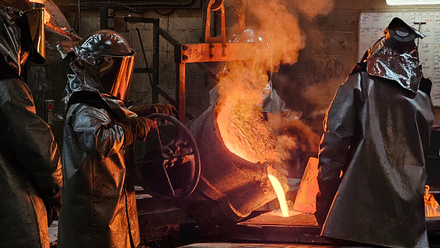
To produce the material, high-purity (99.999%) sulphur and selenium are weighed out in their stoichiometric ratios, loaded into a quartz tube and flame-sealed in a vacuum.
Using heavy chalcogen elements instead of light elements (hydrogen, carbon, oxygen) enables IR transparency.
The sealed tube is heated to around 400°C at 0.8°C/min and held for 48h for homogenisation. Then the melt is water-quenched to form a cylindrical glass ingot, which can be sectioned into wafers and polished to optical quality.
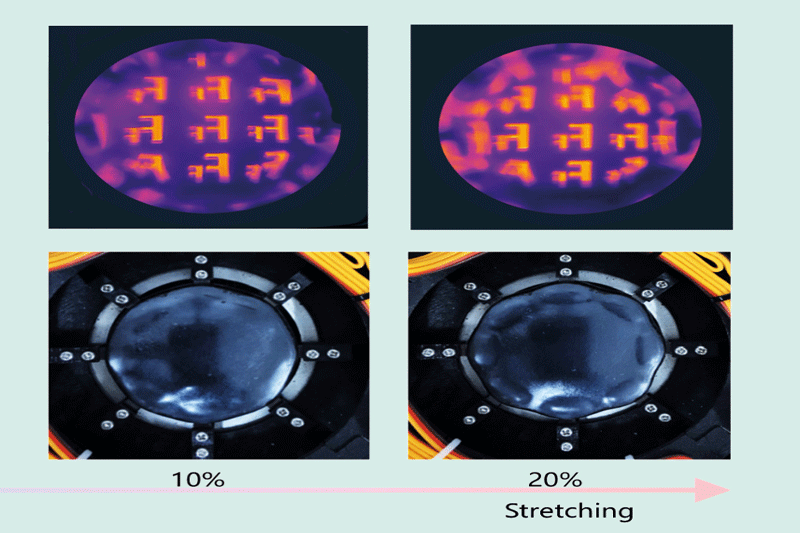
The scientists describe how the wafers can be incorporated into deformable lenses that have a tuneable focal length and real-time aberration correction for applications in adaptive imaging and wavefront control.
Conventional oxide glasses like silica are brittle and opaque beyond ~2.5μm, but the chalcogenide glass reportedly demonstrates both flexibility and transparency.
It is said to operate across near-IR, mid- and low-wave IR bands (0.62-21μm), with a higher refractive index (n≥2.139) than conventional glass and real-time tuneability.
Reversible S-S, Se-Se and Se-S covalent bonds and high molecular mobility of its chain-ring motifs at ambient conditions also give the glass self-healing and shape-memory properties.
Tan reports that the compact, lightweight glass can be integrated directly into imaging systems without folded optical paths, eliminating bulky zoom mechanisms and opening up avenues for soft IR photonics and reconfigurable optical systems.
The team sees their material as useful in IR-adaptive optics for imaging in turbulent or complex thermal environments, with applications in defence and security, space lasers for communication, biomedical imaging and industrial metrology.
The material is suitable because it 'uniquely combines broadband IR transparency, polymer-like flexibility, self-healing and shape-memory behaviour in a single platform', adds Tan.