Record broken for sustained high-temperature superconductivity
Pressure quenching can reportedly ‘lock in’ superconductivity up to -122°C in the mercury-based, copper-oxide ceramic Hg-1223.
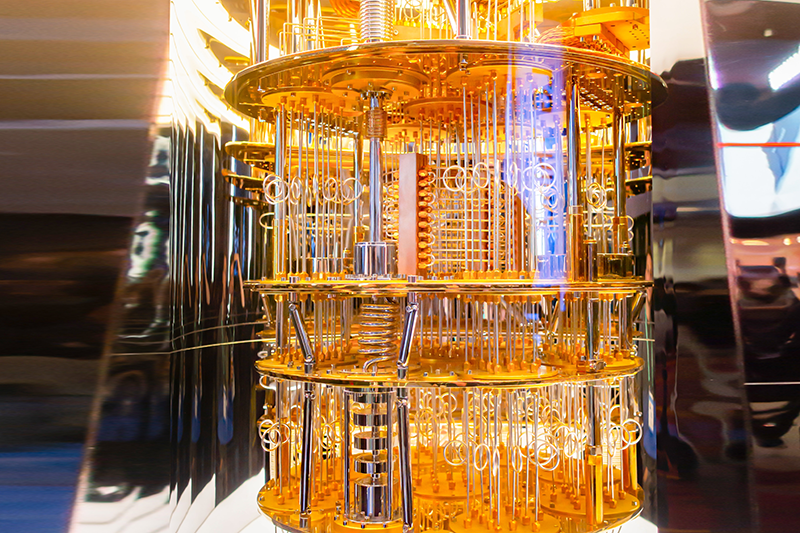
The IBM Q System One Quantum Computer, which could benefit from higher-temperature superconductor materials
© Audio und werbung/ShutterstockResearchers from the University of Houston, Argonne National Laboratory and Intellectual Ventures (IV), USA, placed small pieces of Hg-1223 in a diamond anvil cell and chilled them to near-absolute zero using liquid helium, while applying up to 300,000 times normal air pressure.
They found the material’s critical temperature could remain as high as 151K (-122°C) after removing the pressure and warming, even up to two weeks later.
The team say their method increases the critical temperature for Hg-1223 to show superconducting behaviour under ambient pressure by up to 18°C, and believe further work can increase this even further.
It was first discovered that Hg-1223 could superconduct at up to 133K (-140°C) in 1993.
Other studies had also previously shown the critical temperature of Hg-1223 increases when placed under ultra-high pressure in a diamond anvil cell, up to 164K (-109°C), but were unable to maintain the behaviour after the pressure was released.
Rohit Prasankumar, a physicist with IV’s Enterprise Science Fund, says, ‘It was such a strong effect that we repeated the process with five different samples to prove to ourselves that it was real.’
High-temperature superconducting materials are useful in a range of areas, including quantum computing, fusion energy, power transmission and industrial production.
When published, the paper Ambient-pressure 151-K superconductivity in HgBa2Ca2Cu3O8+δ via pressure quench will be available in the Proceedings of the National Academy of Sciences.