Power to the people
Can the promise of a ‘just transition’ become a reality?
In the coal town of Collie, Western Australia, the walls are covered in paintings paying tribute to its workers. For more than a century, the industry was at the heart of the town, providing jobs and supporting the local community. When the state government announced in 2022 that its remaining coal-fired power stations would close by 2029, there was a risk the town would become another story of industrial decline – meeting emissions targets, but leaving the community to bear the cost.
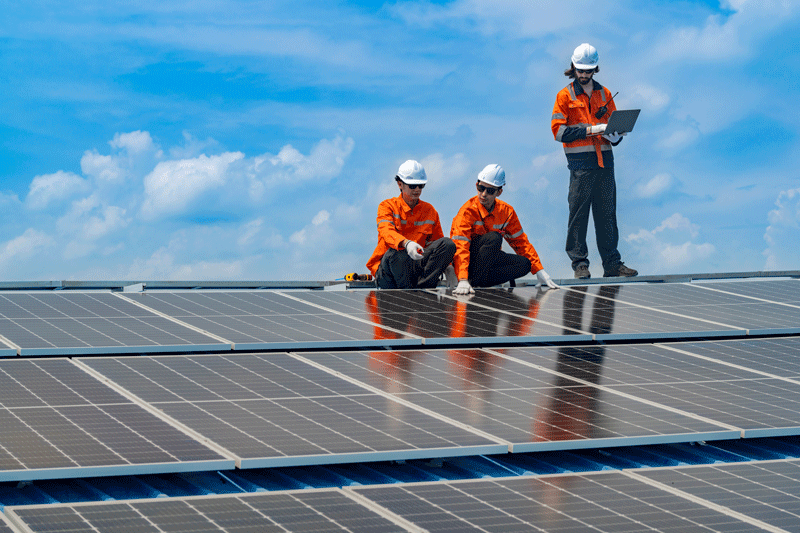
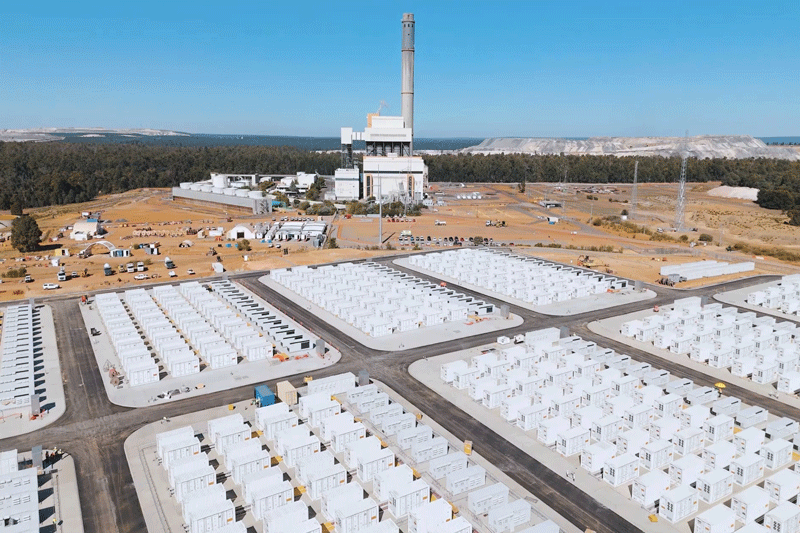
Instead, murals have appeared across the town celebrating its coal workers. A jobs and skills centre opened on the high street. Investment went into mountain bike trails to diversify the local economy, alongside hundreds of millions of dollars for industries including green steel, magnesium refining and battery storage. Workers have started retraining before their jobs disappear.
For Haley St Dennis, Head of Just Transitions at the Institute for Human Rights and Business (IHRB), Collie illustrates why communities need to see realistic alternatives – new jobs, investment and economic opportunities – before they can trust that the transition will not leave them worse off. Rather than being presented with a plan after key decisions had already been made, workers and residents helped shape it. A cross-government working group now oversees the transition, and unions have negotiated improvements in pay and conditions.
Much of this, St Dennis says, comes down to 'very careful sequencing' – creating tangible benefits early enough to build confidence in what remains a long and uncertain process. 'It’s not something that happens overnight,' she says. 'These are very live processes that unfold over many years.'
However, examples like Collie are difficult to find. The IHRB’s JUST Stories initiative was launched in 2025 to document inclusive transitions around the world. It now brings together 60 projects spanning energy, agriculture, finance and the built environment. In compiling them, the IHRB found a wide gap between commitments made and what is happening on the ground.
'Don’t let the wave of public commitments to just transitions fool you,' St Dennis warns. 'The real answer for us is around the agency of affected stakeholders in the design and decision-making. It’s really not about the language and the PR.'
The idea of a ‘just transition’ originated in the North American labour movement during the 1970s and 80s, with the aim of protecting workers and communities affected by industrial change. It has since become a mainstream part of climate policy, appearing in corporate strategies, national plans and international negotiations. According to the World Resources Institute, the number of countries explicitly incorporating just transition concepts into their Nationally Determined Contributions rose from just one in South Africa in 2015 to 66 by April 2025.
It is easy to agree that the transition should be ‘just’. The harder question is what justice actually means when the interests of those affected are different.
Conflicting interests
In wealthy industrial economies, the challenge is relatively clear. When high-carbon industries close or switch to cleaner technologies, jobs can disappear too. Governments are then left to support workers through reskilling and into new employment, while helping local economies adjust.
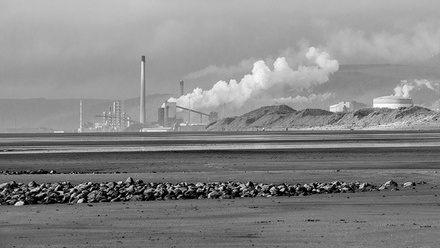
Take Port Talbot in South Wales, UK. Tata Steel’s shift from blast-furnace steelmaking to an electric-arc furnace is intended to reduce emissions, but the shift puts thousands of jobs at risk.
The response has involved substantial support from the UK Government, including a £500mln grant towards the £1.25bln furnace project and a £122mln Transition Board package for affected workers, businesses and communities. In July 2026, the government announced that up to a further £5mln could support employment and skills provision for young people in the area.
But for the workers who left Tata, the issue is less whether Port Talbot still makes steel and more about what came next for them – and whether the alternatives offer the same pay, security and sense of status as the jobs they lost. It is a point the trade union movement has been making internationally.
In a statement ahead of COP30 in Belém, Brazil, in 2025, the International Trade Union Confederation (ITUC)’s General Secretary Luc Triangle warned that 'many of these new jobs do not meet decent work standards'. And while retraining can help employees move into other sectors, there is no guarantee that suitable jobs will be available.
But this is only part of the story. For countries in the Global South, the challenges are very different. It is not about moving away from an established high-carbon energy system, but how to build one in the first place – while industrialising and dealing with a climate crisis they played relatively little part in creating.
Dr Amir Lebdioui, Director of the Technology and Industrialisation for Development (TIDE) Centre at the University of Oxford, UK, argues that the term ‘just transition’ is now used so broadly that its meaning is becoming increasingly unclear.
'It has become more of a mantra than an actual clear concept that can really guide policies,' he says. 'Frankly, I would much rather talk about an effective transition – because if you don’t have a just transition, you can’t really have a sustainable transition in the long term, especially globally.'
For Lebdioui, that means making sure these countries can move towards cleaner energy without sacrificing their own development. 'If you make it so difficult for developing countries to align in the transition with national development, they’re more likely to drop sustainability goals.'
Africa illustrates Lebdioui’s point. According to Wood Mackenzie’s Horizons report – Asset rich, energy poor: maximising Africa’s natural resources to transform the continent – around 600 million people in Africa still lack access to electricity, while four-fifths of the population rely on traditional cooking fuels such as wood, charcoal and biomass.
At the same time, many of the minerals needed for batteries, renewable energy and electrification are mined in Africa, but used to drive the energy transition elsewhere. The challenge is making sure that mining these resources also creates jobs, supports industrial development and improves access to energy.
Critical to whom?
While critical minerals are often presented as a major opportunity for Africa in the green transition, Lebdioui cautions that 'what’s critical today might not be critical tomorrow'.
He argues that, as technologies change and materials are substituted, countries that build their economies around particular commodities risk being caught in repeated boom-and-bust cycles. 'When we think about critical minerals, they’re critical to whom?' Lebdioui asks. The challenge, he argues, is to build economies able to adapt as technologies and demand change.
That requires industrial policy – 'the mother of all policies', Lebdioui calls it – spanning education, skills, innovation, trade and investment.
He argues that market forces alone are unlikely to build the processing and manufacturing industries needed to move African economies beyond raw material extraction. 'There is no business case unless there is industrial policy to make it so,' he insists. 'If you look at who’s capturing the benefits or the lion’s share of value in green technology sectors, it’s the same as usual.'
The aim, he says, is not simply to turn every lithium producer into a battery manufacturer, but to build on existing capabilities and remain flexible as technologies change.
He cites Costa Rica, which used clean electricity to attract new industries, and Malaysia, which built on its electronics sector to move into solar-cell production. 'The key commonality there – in terms of the countries that have done a good job [in] including and adding value to their natural resources – is that level of experimentation,' Lebdioui says. 'Not "copying and pasting" something that works somewhere else, but really thinking about what you have, what you don’t have and how you want to enter those green industries.'
Regional coordination could also make a difference. Lebdioui argues that African countries could combine their minerals, renewable resources, ports, markets and manufacturing capabilities to build stronger regional supply chains and negotiate from a stronger position.
'The future is really coming together, negotiating together and thinking about green development as a collective endeavour,' Lebdioui says. 'Because in the end, what’s really critical is not the mineral or anything that is under the ground, but the policies and the humans that design them.'
Beyond technology

The same challenge can be seen at household level in rural Rwanda. Dr Jonathan Nixon and Dr Alison Halford have been leading a research team testing solar-powered electric cooking with rural households, as part of Coventry University’s Solar Energy Transitions project.
The idea is straightforward – replace carbon-intensive biomass cooking with an induction cooker powered by solar generation and battery storage. But rather than starting with the technology, the project began with the people expected to use it.
'Very often, solutions are engineered and just sort of dropped in,' Nixon explains. 'There’s a lot of evidence that shows that doesn’t work and those technologies don’t get taken up.'
Households took part in repeated workshops before the systems were installed, and their feedback shaped the technology. Initially, the system showed users the battery’s remaining charge as a percentage. But households wanted to know something more practical – was there enough energy left to cook their next meal? The project therefore explored showing the remaining cooking time instead, which was harder to calculate as it depends on factors such as the weather and usage.
'It’s not just about understanding the energy demand,' Nixon says. 'It’s about a co-design revealing those social impacts on the technical decisions behind it.'
Previous research had pointed to local reluctance due to cultural preferences or attachment to traditional methods, but 'our findings completely challenged that', reveals Nixon. 'We had almost all of the households almost immediately – within days – transition to [the induction cooker] becoming their primary cooking need.' Households that did return to biomass did so due to outages, faults, or equipment poorly suited to dusty rural kitchens.
The technology brought further benefits than just changing how people cooked. Some households previously spent around five hours a day, sometimes more, collecting firewood – work that fell largely to women. Solar cooking reduced that workload and even changed who prepared meals, with Nixon’s team seeing more men begin to cook. However, those benefits could quickly disappear if the system failed and households returned to biomass, with women again bearing most of the extra labour and smoke exposure.
Making the technology work at a larger scale brings other challenges. Nixon says households may need a range of financing options, from subsidies and carbon finance to pay-as-you-go schemes. But the system also needs to be easy to maintain. His team sourced components from local markets and trained local technicians, because 'if there is a problem or something breaks, then you’ve got access to that easily'.
In some areas, poor roads made travelling by car slow and expensive, so technicians sometimes used motorbikes instead. 'It’s not just the technology that needs a solution,' Nixon says. 'It’s the entire service that goes along with it. It’s got to all be done together.'
The same problem appears on a much larger scale. According to the International Energy Agency’s report on Clean Cooking in Africa 2026, nearly two billion people worldwide still lack access to clean cooking solutions, half of them in sub-Saharan Africa. Nixon argues that clean cooking should be treated as 'central energy infrastructure, not just purely stove distribution', with finance, energy supply, maintenance and local skills all needed to make it work at scale.
Who owns the benefit?
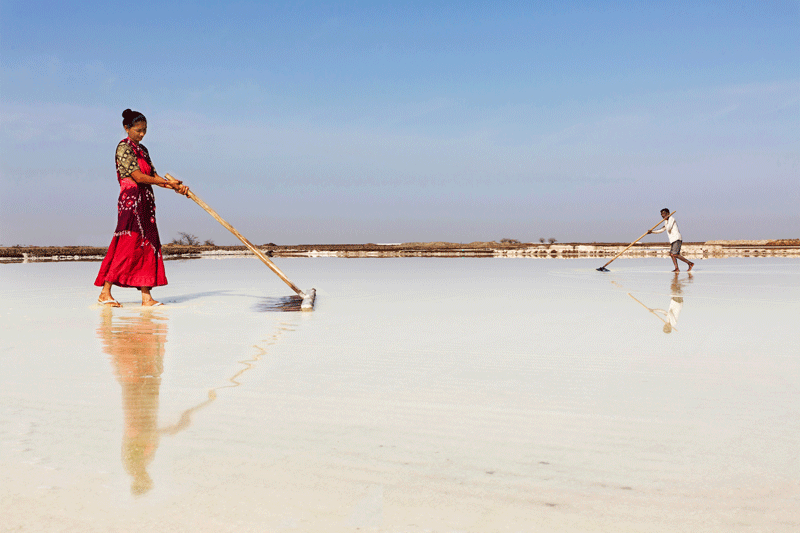
In Gujarat, India, another initiative shows what can happen when locals are proactively involved in the solution. St Dennis points to agarias – informal female salt-workers represented by the Self-Employed Women’s Association.
They historically spent close to 60% of their income on diesel to pump underground brine to the surface. According to the IHRB’s JUST Stories case study, a new solar-pump programme has scaled to around 7,000 systems, raising the women’s income from salt production by around 30%.
Many also earn additional income working as technicians and forming a female-owned seasonal solar park, created by pooling their panels during the off-season to feed electricity into the grid. 'They now own their own energy value chain in a way that has absolutely transformed their lives, but also the production of this commodity,' she explains.
The Gujarat story raises a bigger question – how much of the value created by a transition stays with the community?
St Dennis argues that consulting workers and local people is not enough if the important decisions have already been made. 'The common pattern is consulting communities on a plan that’s already funded and designed,' she says. 'The budget choice has already been made, which really only leaves either objection or acquiescence.' The real question, she argues, is whether the people affected 'were in the room before the budget was fixed'.
Poor community engagement can also carry a direct financial cost. St Dennis cites one renewable energy developer that attributed US$200mln in losses to unmanaged community opposition. 'Treating this kind of co-creation, genuine engagement as PR rather than shared decision-making, will show up on the balance sheet,' she warns.
Who benefits from a transition also depends on how it is financed. Rowan Conway is Executive Director of the Just Transition Finance Lab at the London School of Economics’ Grantham Research Institute, UK. She cautions that 'money flows to bankable assets. Private finance itself won’t necessarily find its way to helping and enabling a transition'.
That can leave things like support for workers, social protection and local economic development struggling to get the funding they need. For some countries, taking on more debt is not necessarily the answer either. 'Are we creating the potential for debt spirals in places where they can’t cope?' Conway asks. 'The answer could be yes, if done badly.'
The ITUC makes a similar argument. Its submission on the Just Transition Mechanism (an emerging framework agreed on at COP30) calls for finance for the Global South that supports social protection, green industrialisation, skills, jobs and energy access without adding to countries’ debt burdens.
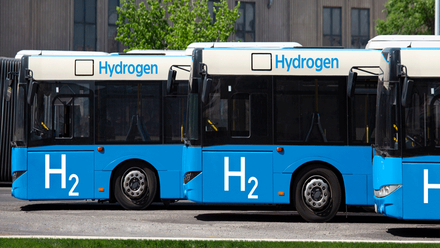
Meanwhile, Lebdioui questions whether African countries with limited public funds should use renewable electricity, water and investment to produce hydrogen mainly for export, when many still need more energy for their own people. In that model, he argues, exporting hydrogen can become 'the commodification of renewable energy' – turning renewable power into an export product rather than using it to improve domestic access and support development.
He adds that for countries that are fiscally constrained or have many competing priorities, 'it perhaps makes more sense to invest in renewable energy access, which has proven to increase economic prosperity, than actually converting that for green hydrogen export'.
From Belém to Antalya
The rise of the just transition
1970s-80s
The idea develops within the North American trade union movement, linking environmental action with protection for workers and livelihoods.
2015
The International Labour Organization adopts its just transition guidelines, with social dialogue at the centre. The Paris Agreement also recognises the importance of a just transition.
2020-23
Dedicated funding and programmes begin to emerge, including the EU Just Transition Mechanism and Just Energy Transition Partnerships with South Africa, Indonesia, Vietnam and Senegal.
2025
At COP30 in Belém, Brazil, countries agree to develop a new international Just Transition Mechanism.
2026
Negotiators begin designing the mechanism ahead of COP31 in Antalya, Turkey, with questions over governance and finance as yet unresolved.
These issues will be high on the agenda at COP31 in Antalya, Turkey, this November. Plans for a Just Transition Mechanism are now being developed as the Belém-to-Antalya Mechanism (BAM), aimed at helping countries cooperate and providing practical support for managing the transition.
For trade unions, a key outcome at Belém was formal recognition of workers and their representatives as part of the process. The question now is how much influence they will actually have.
The ITUC wants BAM to be based on the International Labour Organization’s just transition guidelines, and to give workers and unions a role in shaping and governing the mechanism. It also argues that formal negotiation between governments, employers and workers should remain a core part of the process, alongside wider consultation with communities and other groups.
How much BAM will actually help solve the financing gap remains unclear. Conway thinks that, at least initially, it may be more about bringing countries together, agreeing priorities and identifying what support is needed than providing money directly.
She says BAM has already broadened the discussion around 'what "just" means', but warns that it now needs to 'focus on the practicalities so that it’s not just a symbolic gesture'.
In practice, that means turning broad commitments into projects that can actually be delivered. 'The difference between rhetoric and action is that you have to have a phased process that goes from concept to technical delivery,' she explains.
For St Dennis, BAM will only matter if it leads to 'genuine partnership with affected workers and communities', with benefit sharing and a real stake in decision-making, rather than 'just a consultative seat at the table'.
What that looks like will vary from place to place. But these examples show that technology is only one part of the transition. Just as important is who gets to shape it, who benefits from it and whether the changes work for the wider community.
And the effects can reach far beyond the workers who lose their jobs. 'The locus of pain is actually the community, not the individual,' Conway says. 'Just doing workforce reskilling is a drop in the ocean, especially if you are changing the shape of a place – because the hairdresser closes down if the jobs are not there, [and] the café is closed down.'
That wider impact is clear in India, where transitions are affecting not only miners, but truck drivers, railway workers, suppliers and local businesses. To make sure these groups are not overlooked, a worker support facility is being developed with the Asian Development Bank. This will bring together existing training, employment and social-support programmes, and extend them to people beyond those directly employed by the mines.
Even in Collie, one of the more promising examples, the transition remains a work in progress. St Dennis describes transitions like these as 'building the plane while flying'. 'There’s rarely going to be a perfect win-win in every just transition case,' she says. 'It’s really not about that. It’s about how you navigate the trade-offs in a way that everybody understands what’s at stake, has a say in the process and feels that, at a minimum, the most patent injustices are avoided. Beyond that, everything else is co-negotiated toward this longer-term future.'
Over the coming decades, the energy transition will move enormous amounts of materials and money. Its success will depend not only on how quickly emissions fall, but on how much of the opportunity it creates reaches the workers, communities and countries affected by the change.
More like this...