Floating new ideas
Marie Laure Bertet of BASF talks about a project to improve the performance of floating photovoltaic systems.
What are the advantages and challenges of floating solar energy?
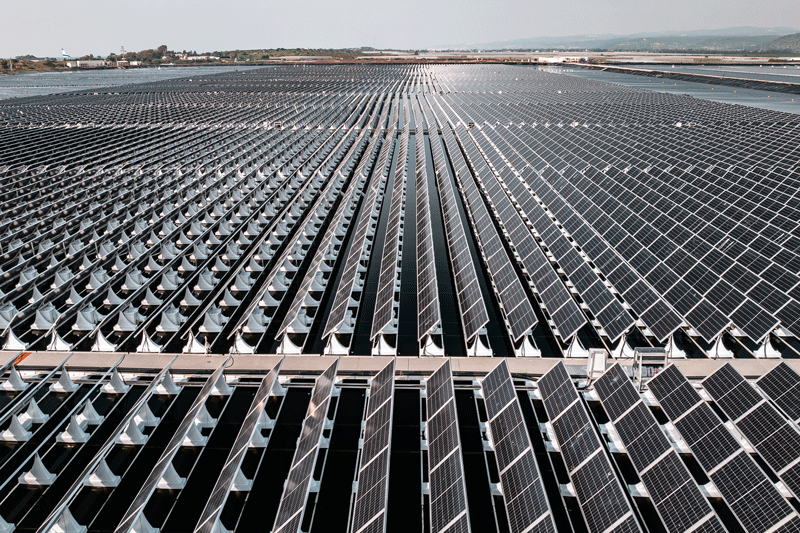
Floating solar, or floating photovoltaics (FPV), uses solar panels mounted on floating platforms installed on bodies of water, such as reservoirs, lakes, ponds and unused quarries.
One of the primary advantages of floating solar is that it enables renewable energy generation in areas where land is limited or better used for housing, agriculture, conservation or commercial development.
In addition, solar panels generally operate more efficiently at lower temperatures. The cooling effect of the surrounding water can improve panel performance, allowing floating systems to generate more electricity than comparable land-based installations. Floating solar systems can also provide environmental benefits by reducing water evaporation through shading, which is particularly valuable in warm and arid regions. Furthermore, the reduced sunlight reaching the water surface may help limit algae growth.
Despite these benefits, floating solar installations present several challenges. Initial installation costs are typically higher due to the need for floating structures, anchoring systems and specialised electrical equipment designed for aquatic environments.
Water bodies can also create harsher operating conditions, as changing water levels, waves, wind and corrosion can place additional stress on the system.
Solar floats are also exposed to long-term UV radiation and thermal stress. The central materials challenge is therefore maintaining buoyancy and structural integrity over many years under combined environmental stress. While maintenance activities such as cleaning, repairs and component replacement are generally more complex and costly because personnel must work overwater.
There are also environmental considerations, particularly when installations are placed on reservoirs intended for drinking water, where potential impacts on water quality and aquatic ecosystems must be carefully evaluated.
Tell us about your collaboration with the firm Xfloat.
Polyethylene-based floats used in FPV systems must perform multiple critical functions simultaneously. They must provide buoyancy, support solar modules, and allow safe access for inspection and maintenance. At the same time, these floats must withstand long-term exposure to harsh environmental conditions. To minimise maintenance costs and maximise system reliability, the floats are expected to have a service life comparable to that of the solar panels themselves.
To address these requirements, BASF and Xfloat have partnered to improve the durability and sustainability of floating solar installations. By combining Xfloat’s proprietary floating solar platform technology with BASF’s light stabiliser, high-density polyethylene (HDPE), floats can maintain their structural integrity and performance in demanding outdoor environments for more than 30 years. This helps reduce maintenance and replacement needs while supporting the long-term performance and cost-effectiveness of FPV installations.
How do you protect HDPE from degradation in this application?
From a polymer-engineering perspective, the decisive factor is not only initial mechanical performance, but the ability to retain key properties over the intended service life of the installation. Polyethylene is widely used because of its favourable processing and mechanical properties and cost effectiveness, but it is not inherently stable against thermal or photo-oxidative degradation.
Prolonged exposure to UV radiation, oxygen and heat can trigger chemical reactions within the polymer that gradually reduce its mechanical integrity. Without an appropriate stabilisation package, the material may lose mechanical performance over time. Stabilisers are therefore introduced to reduce degradation processes and help maintain the polymer’s functional properties during outdoor exposure.
One important class of additives used in polyethylene is UV absorbers. These materials protect the polymer by absorbing harmful UV radiation and dissipating the energy as harmless heat through non-radiative processes.
Ultraviolet absorbers are especially effective in thick polyethylene components because they provide protection throughout the bulk of the material. This makes them well suited for applications such as FPV pontoons, where substantial wall thickness allows efficient absorption of incoming UV light.
However, because UV degradation often initiates at or near the polymer surface, UV absorbers alone may not provide sufficient protection. Ultraviolet exposure can generate free radicals that initiate oxidative chain reactions, leading to embrittlement and loss of performance over time. To address this, polyethylene formulations typically incorporate hindered amine light stabilisers (HALS). These work by scavenging free radicals and interrupting the oxidation cycle before significant polymer damage occurs.
A key advantage of HALS chemistry is its regenerative mode of action. This allows the stabiliser to repeatedly neutralise radicals over extended periods, making it highly effective for long-term outdoor applications.
How were the material properties tested?
Solar radiation varies significantly by geography, and this directly influences polymer degradation rates. A float installed in a moderate UV environment will not experience the same exposure profile as one installed in regions with higher irradiation levels.
BASF has developed a UV-radiation mapping tool, in collaboration with the German Aerospace Centre and NASA Goddard Space Center. The aim is to support location-specific predictions of solar radiation over the lifetime of plastic materials. Such data can be used both for predictive material design and for investigating field performance.
Northern and Central Europe generally experience more moderate UV radiation levels, while regions such as Southern Europe or parts of Asia can subject outdoor plastic applications to higher degradation stress. For floating solar farms in regions such as India, Singapore, Thailand, parts of the US, South America and the Mediterranean, polyethylene floats may need to withstand irradiation levels comparable to demanding outdoor weathering conditions, including those observed in Florida testing environments.
To evaluate long-term weathering performance, the durability of different formulations was compared by measuring how well they retain their mechanical properties after prolonged exposure to simulated outdoor conditions.
In the BASF study, weathering resistance was assessed by monitoring the retention of elongation at break over a period of 20,000 hours, following the test method DIN EN ISO 4892-2, Cycle 1.
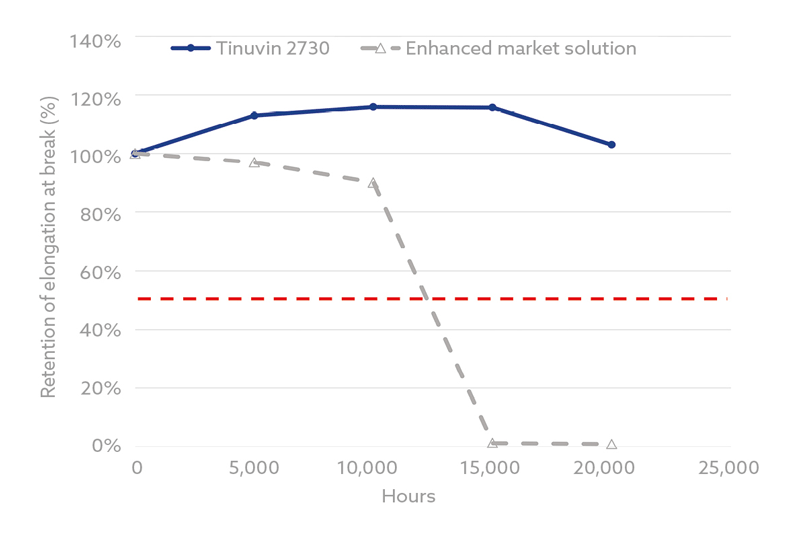
The accelerated weathering tests were conducted in a xenon-arc chamber equipped with Boro S/Boro S filters, which closely reproduce the spectral distribution of natural sunlight. The irradiance was maintained at 60W/m² across the 300-400nm wavelength range, corresponding to 0.51W/m2 at 340nm. Throughout the test, environmental conditions were carefully controlled at 65°C and 50% relative humidity to ensure consistent and reproducible exposure.
To simulate real-world outdoor weathering, the test alternated between two exposure phases – 102 minutes of continuous light exposure, followed by a period of light exposure combined with water spray to mimick the effects of rainfall and moisture. This combination of intense UV radiation, elevated temperature, controlled humidity and periodic water exposure accelerates the degradation processes that materials experience in service.
As a result, the methodology provides a reliable and standardised basis for comparing the long-term durability and weathering performance of different formulations within a significantly shorter testing timeframe than under natural outdoor conditions. This underlines the need to align stabilisation design with realistic regional exposure scenarios.
More like this...