Colour-changing packaging signals food freshness
Anthocyanin – a natural plant pigment – embedded into a metal-organic framework reportedly creates a hydrogel that can indicate when food starts to spoil.
A team at Kyushu University, Japan, embedded this technology into a hydrogel made from cellulose nanofibres (CNFs) and poly(vinyl alcohol) (PVA). They suggest the resulting packaging film could extend the shelf life of food products.
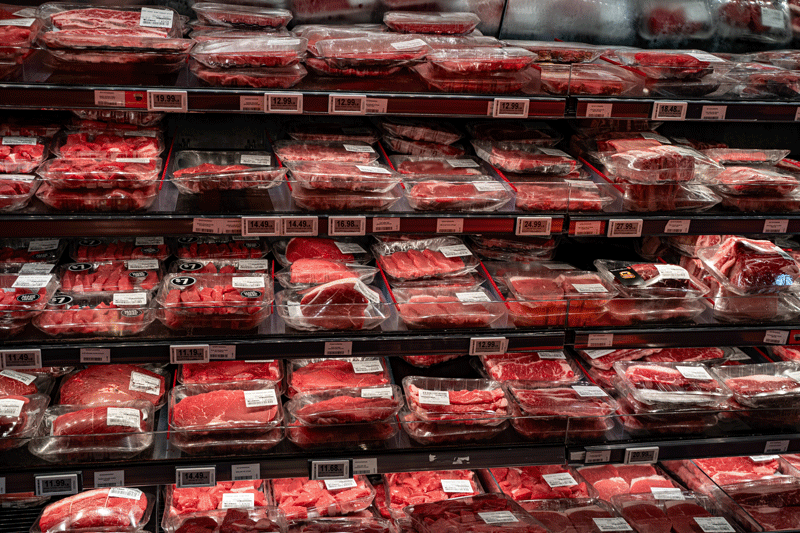
Meat products start off mildly acidic, but as bacteria multiply, they break down proteins. This releases alkaline compounds, causing increased pH before any visible spoilage.
Extracted from purple sweet potatoes, anthocyanin turns from purple-red at low pH to yellow-green at higher pH values, offering a way to visualise increased bacteria.
However, 'free anthocyanins tend to degrade under light, oxygen, humidity and temperature fluctuations, [which lowers] the reliability of freshness indicators', elaborates Professor Fumihiko Tanaka at the university.
To stabilise the anthocyanins and reduce pigment loss, they are immobilised using amine-functionalised, zirconium-based MOF UiO-66-NH2, chosen for its thermal and chemical stability. A solvothermal method creates particles of UiO66-NH2, while anthocyanins are ground and freeze-dried into a powder. The two are combined to produce anthocyanin@UiO66-NH2 particles.
The anthocyanin molecules are adsorbed onto the MOF’s surface and anchored in place through chemical interactions. This shields them from oxygen, light and heat, allowing them to remain sensitive to pH changes.
The CNF and PVA are mixed to form a hydrogel matrix, and borax is added to induce dynamic borate crosslinking. The anthocyanin@UiO66-NH2 particles are dispersed throughout this packaging film. These components are reportedly safe for food contact.
In tests using pork, the protected pigment was said to be consistently responsive, shifting from purple-red to yellow-green and giving a readable signal.
'Immobilisation reduced anthocyanin leaching and improved signal stability compared with systems containing free anthocyanins,' reports Tanaka. The team 'observed clearer colour discrimination during pork spoilage monitoring'.
The scientists report that anthocyanin and MOF components also contribute antioxidant and antimicrobial effects, slowing microbial growth and reducing accumulation of compounds that cause spoilage. This extends the pork’s shelf life by about 12 hours compared to untreated samples.
The material is also self-healing, claims the team. When cut and pressed back together, the damage reportedly becomes nearly invisible within minutes, while almost 99% of the original tensile strength is recovered within two hours.
The reversible bonding behaviour originates from 'dynamic borate-diol bonds between borax and the hydroxyl-rich polymer network', says Tanaka. ''The network reconstructs itself.' This could keep bacteria at bay during shipping, handling and storage.
Tanaka adds that the technology is 'broadly adaptable, but specific sensing systems should be tailored to different foods'.
Spoilage of meat products generates alkaline compounds such as ammonia and biogenic amines, which produce a strong response in anthocyanin indicators. This could also apply to poultry, seafood, fish and other protein-rich foods. However, different targets – such as ethylene production, respiration activity, or moisture changes – might be more relevant for fruits and vegetables.
Tanaka continues, 'We are not only trying to generate a colour response, but also preserve food under realistic conditions where packaging may experience deformation, abrasion, or local damage.'
The team will investigate long-term storage stability, temperature cycling, humidity fluctuations, light exposure and real supply-chain conditions to ensure the signal stays reliable throughout the intended shelf life.
Commercial deployment would need scaleable manufacturing approaches, such as coating, printing, roll-to-roll processing and continuous systems. The team is exploring practical implementation, including the potential for a smartphone app to support customers in reading the packaging’s colour.