Endoscope’s variable stiffness aids low-impact surgery
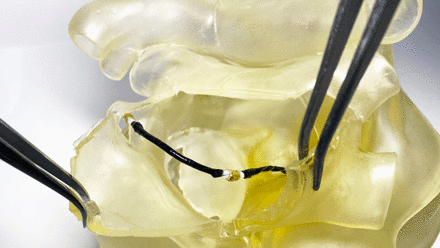
A dexterous endoscope deploys a series of interconnected segments to move freely.
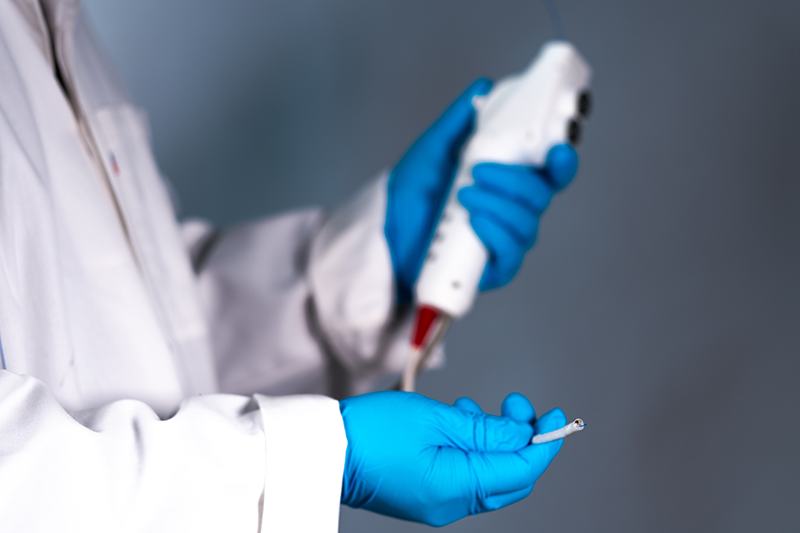
Dexterous Endoscopes' variable-stiffness design for hard-to-reach areas
© School of Engineering/Adrian AlberolaThis could allow medical practitioners to conduct multiple treatments in a single, stable and minimally invasive procedure, with extreme precision.
It is designed to overcome a mechanical trade-off that currently exists, whereby surgeons have to switch between flexible and rigid endoscopes. The new device, using standard materials for this application, would allow them to transition between soft and rigid states on demand.
Switzerland-based designers at Dexterous Endoscopes, a spin-out of EPFL, believe the product could overcome challenges for surgeons undertaking urological, gastrointestinal, and ear, nose and throat (ENT) procedures. The mechanically segmented endoscope would allow them to compress and lock together the device, transforming it from a soft to rigid form so they can operate in confined and hard-to-reach areas.
Dexterous Endoscopes’ CEO Yegor Piskarev explains how the variable-stiffness approach was shaped by the development of a catheter that switches from soft to rigid to improve the treatment of cardiac arrhythmia.
During his PhD, he explored technologies such as low-melting-point alloys and thermally responsive polymers.
'These materials offer a large stiffness change between soft and rigid states, but they come with important drawbacks such as high operating temperatures, slow transition times, potential biocompatibility issues and material fragility,' he explains.
They initially developed a prototype of a fibre-jamming catheter filled with hundreds of ultra-thin fibres that stiffen under vacuum. But the EPFL team identified practical issues with using thermally driven materials. The alternative mechanical, rather than material, approach, applies the same variable-stiffness principles to endoscopes. It is reported to be faster, more reliable and more intuitive for surgeons, Piskarev says.
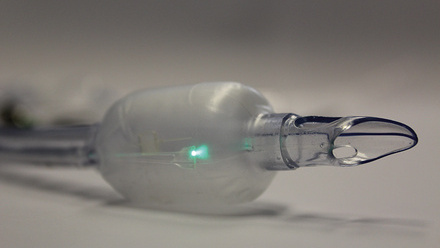
Initially focused on ENT procedures, Dexterous Endoscopes is developing several iterations of the device, which looks like a vertebra where all the components can be rapidly compressed to lock together.
'This means surgeons can safely navigate delicate anatomy in a soft state, then switch to a rigid configuration to perform precise and stable interventions all within a single device,' says Piskarev.
Laboratory bench testing was a critical first step, as it allowed them to evaluate their own device, but also benchmark existing endoscopes and understand the mechanical limitations.
'We focused on key performance metrics, such as bending capability and, importantly, the maximum force that can be transmitted through a medical tool inserted via the working channel, for example, forceps,' Piskarev explains. Under test conditions, the device can reportedly apply at least five times more force compared to existing flexible endoscopes and is still able to navigate safely through complex anatomy.
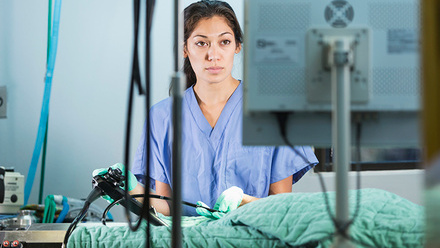
Having developed a prototype, the team has performed preclinical cadaver trials with surgeons in conditions that closely replicate real procedures at hospitals in Lausanne in Switzerland, Munich in Germany and London in the UK.
The results are said to demonstrate that it works for extended periods without failure. They plan to continuously refine the device based on ongoing surgical feedback.
'These trials led to changes across almost every aspect of the device,' Piskarev says. 'We refined the ergonomics, including the position and size of control buttons, adjusted the level of stiffness in both soft and rigid states based on surgeon preference, and improved overall handling.'
The next step is to obtain regulatory clearance from the US Food and Drug Administration (FDA), which Piskarev says could be done without clinical trials.
First though, they have frozen the design and will work with a contracted manufacturer to fabricate the devices according to all relevant ISO standards. The first 500 devices will be used for verification and validation activities, after which they will be ready to submit it via the FDA’s 510k funding pathway.