CBAM for your buck
How the Carbon Border Adjustment Mechanism reshapes materials trade.

A Carbon Border Adjustment Mechanism (CBAM) is a climate policy that aims to ensure that highly traded, carbon-intensive products imported to a country from abroad face a comparable carbon price to that paid by domestic manufacturers. This is intended to remove the financial incentives that drive ‘carbon leakage’, whereby manufacturers relocate their production to countries and regions with less stringent climate policies.
By requiring importers to report and pay for the embedded carbon emissions in certain goods, the CBAM aims to ensure that decarbonisation efforts translate into genuine global emissions reductions rather than simply shifting emissions overseas. Other objectives of the climate policy are to reduce threats to domestic manufacturing industries, encourage companies to invest in decarbonisation innovation and strengthen government control of climate policy.
The mechanism works by applying a carbon cost to selected goods imported into a country or region that must be paid by the importer.
Following a transitional phase of 2023-25, the EU CBAM definitive period began on 1 January 2026. The UK CBAM, based on a separate carbon pricing scheme, has been enabled in law and is intended to be applied from January 2027. The two schemes are similar but include some noteworthy differences.
The EU hopes the CBAM will encourage trading partners of EU member states to strengthen their own domestic climate policies. In response, countries including Turkey and Serbia have announced plans to implement domestic carbon pricing schemes, while China intends to expand the coverage of its national emissions trading system to additional sectors and introduce absolute caps on emissions.
At the point of launch, both the EU and UK CBAMs are to include products from carbon-intensive industrial sectors, including aluminium, cement, fertiliser, hydrogen, iron and steel, and electricity (EU CBAM only).
Within the above sectors, CBAM tends to apply to raw materials and products with only a few production stages. For example, in the UK CBAM, a raw material such as iron ore will be classified as a ‘CBAM good’, as will a steel beam that has few production stages. However, a car door will not be classified as a ‘CBAM good’ because it has too many production stages.
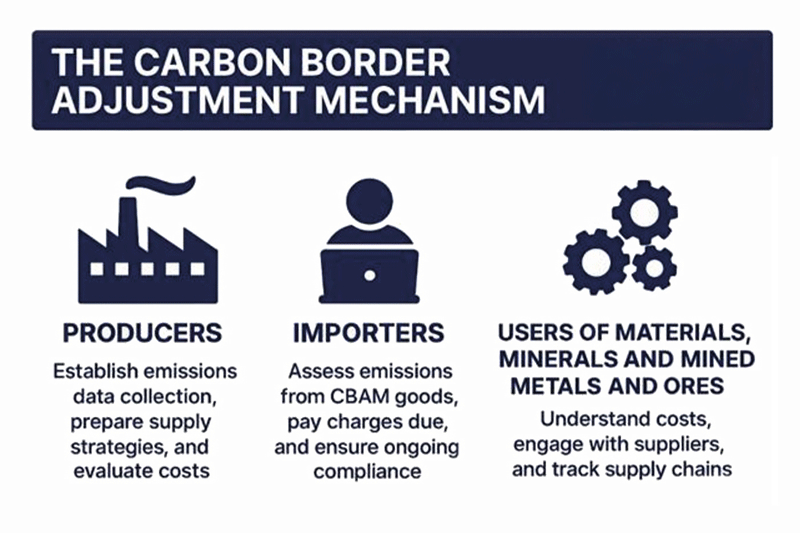
It’s important for producers and importers of minerals and materials to pay attention to CBAM now. Early engagement and awareness will allow companies time to collect accurate emissions data, adjust supply chains, alter cost forecasting and avoid compliance penalties. Acting now will reduce the risk of operational disruption and unexpected cost increases once full carbon pricing applies.
Producers and importers of aluminium, cement, and iron and steel goods, for example, who interact with UK and EU markets should understand what steps they must take to assess their exposure to CBAM, how to act accordingly, and the key differences between the UK and EU mechanisms.
Importers of CBAM goods must declare the embedded emissions of their imports in tonnes of CO2 equivalent. This forms the basis of their financial obligation, which must be paid at defined points in time. EU importers must pay by surrendering CBAM certificates, while UK importers must pay a carbon tax.
The obligation is designed to replicate the cost of manufacturing a product within a country’s domestic carbon pricing system, in this case the EU or UK Emissions Trading Schemes (ETS). To ensure emissions are not double charged, importers can receive a deduction of their CBAM obligation if they can prove a carbon price has already been paid during production. For example, a UK importer of EU steel can receive a deduction with proof of earlier payment under the EU ETS.
The pricing structure of CBAM encourages importers to declare actual emissions data received directly from their suppliers. Actual emissions data must be third-party verified. If unable to acquire verified actual emissions data, importers must declare default emission values, which are designed to be punitive and may result in increased costs to organisations.
The EU mechanism generally applies to importers whose cumulative annual imports of CBAM-covered goods exceed a 50t de minimis threshold, although specific rules apply for electricity and hydrogen. The UK CBAM targets the import value of £50,000 or more of those goods, from 1 January 2027.
CBAM goods are defined using commodity codes, published independently by the European Commission and UK Government. A commodity code, known as a CN (combined nomenclature) code in the EU, is a digital numerical identifier used to classify goods for international trade.
If they have not already registered, EU importers who expect to be within scope of CBAM should register as an Authorised CBAM Declarant.
By 30 September 2027, EU importers of CBAM goods must submit their first declaration, covering embedded emissions from 2026 imports, and surrender the corresponding certificates. EU CBAM certificates are first available to purchase from 1 February 2027. The first UK CBAM declaration and payment are due by 31 May 2028 for the 2027 calendar year.
Meanwhile, exporters should assess which of their products are within the scope of each CBAM by assessing the published lists of commodity codes for each jurisdiction.
Exporters are urged to ensure effective record keeping and to prepare for third-party verification. For exporters into the EU, the verification window will open in January 2027 for 2026 data. As of September 2026, verifiers who have recieved CBAM accreditation are able to self-register in the official registry. Providing verified emissions data is important for exporters to avoid unnecessary costs from punitive default emissions data.
The CBAMs may transform how business strategies incorporate carbon management. In the short term, importers should consider scenario planning to better understand how they will impact working capital. Importers give themselves the best chance of avoiding default values by engaging with their supply chain early and ensuring the necessary steps to obtain third-party verified emissions data.
This article provides general advice only. It does not constitute legal or regulatory advice. CBAM is detailed and evolving, and readers should refer to the full, publicly available regulatory documentation and seek independent advice where necessary to ensure compliance.