Why do we only maintain machines?
As we celebrate Disability Pride month, Animesh Anand MIMMM reflects on how we should be intervening and providing support for people before they approach a ‘shut down’.

In maintenance engineering, waiting for an asset to fail completely before intervening is universally acknowledged as the most inefficient and costly mode of operation.
Instead, every world-class engineering asset operates under a strict regime of preventative maintenance. We use non-destructive testing (NDT), ultrasonic scans and regular visual inspections to identify microscopic defects long before they propagate. We calculate fatigue life and schedule planned downtime to preserve a system’s structural integrity.
Yet, when it comes to the human ‘systems’ running our industry, particularly professionals with specific accessibility requirements, chronic health conditions or neurodivergence, we frequently default to a primitive and reactive ‘run-to-failure’ model.
We often wait for an employee with accessibility requirements to hit a wall of physical exhaustion, or a neurodivergent colleague to experience severe sensory burnout, before we trigger the formal reasonable adjustments process.
This reactive approach is the human equivalent of ignoring a growing fatigue crack until the entire structure undergoes catastrophic failure. By the time a crisis occurs, the employee’s wellbeing is depleted, project delivery is compromised and highly skilled talent often leaves the sector entirely.
If we want a resilient and sustainable engineering sector, we must apply our rigorous testing and inspection mindset to our working environments.
In materials testing, we use NDT to locate stress concentrations, those sharp internal corners or structural notches where external forces multiply dangerously. In an office, laboratory, or manufacturing site, architectural and cultural barriers act exactly like those physical notches.
A poorly lit workshop, an uninsulated testing bay with high ambient noise, or a digital system incompatible with assistive technology creates a localised stress concentration for an employee with accessibility requirements.
Materials fatigue is dictated by cyclic stress. If the localised stress amplitude remains below the endurance limit, the component can theoretically cycle indefinitely. Raise that stress and the component’s operational life plummets.
Engineers with accessibility requirements and neurodivergent professionals navigate a massive baseline of hidden cyclic stress just trying to operate in uninspected environments. This total environmental loading combines core technical tasks with physical barriers and sensory overload.
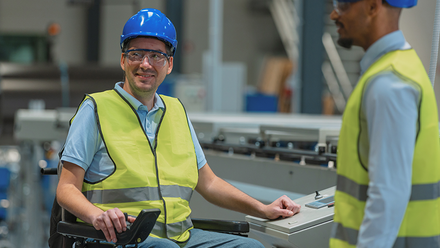
For a wheelchair user, navigating a site with broken lifts, or heavy, non-automated manual doors, adds physical cycles of fatigue to their day. For an autistic engineer, coping
with flickering fluorescent glare or unmitigated industrial hums adds sensory cycles. This extra loading shortens their human fatigue life.
Preventative maintenance for human sustainability means conducting regular, proactive inspections of our physical and digital spaces. We should treat a lack of level access, poor acoustic damping, or rigid and unadjustable workstations as a critical non-conformance during a routine site inspection, rather than waiting for an individual to flag it as a barrier.
By proactively identifying and removing these stressors through universal design, we effectively lower the stress amplitude, shifting the human S-N curve so talent can thrive long term.
Closing the loop requires engineering organisations to embed accessibility directly into their standard asset management and inspection regimes.
First, we must shift from making individual and reactive modifications to a universal design baseline. Workplace adjustments should be built-in as standard practice, not retrofitted on request. Height-adjustable desks, clear wayfinding and flexible working frameworks should be treated as standard factory settings.
Second, we must treat accessibility as a safety-critical inspection metric. If an emergency exit must be kept clear during a routine audit, then the accessible pathways, ramps and lifts must be inspected with the same regulatory weight.
Finally, we must value the expertise of engineers with accessibility requirements who identify these systemic flaws. Their lived experience provides a highly advanced form of human failure analysis, pointing out exactly where our operational systems are brittle.
We understand that a machine requires precise calibration, proper lubrication and tailored operating conditions to function at peak efficiency. We do not blame the machine when it fails due to poor operating parameters. We blame the maintenance strategy.
It is time to afford our colleagues the same engineering respect we grant our equipment. By shifting from a reactive run-to-failure model to a preventative and inspection-led culture, we stop treating unmet accessibility requirements as an inevitable failure mode and engineer an environment where everyone can perform.