The difference between thriving and surviving
Kat Culyer of EqualEngineers reports on a workshop on ‘Disability Inclusion in the Engineering Workforce’.
Engineering and technology are at the forefront of solving some of society’s most complex challenges. However, the sector itself continues to struggle with diversity, equity and inclusion, particularly in relation to disability and neurodiversity (hereby discussed as disability alone).
While the engineering sector faces a critical talent challenge, it continues to under-utilise one of the largest and most capable talent pools available – disabled professionals.
Research from the Royal Academy of Engineering reports bullying, discrimination, harassment and microaggressions that are often overlooked and unidentified.
A collaborative workshop between EqualEngineers’ Disability Network and representatives of Rolls-Royce SMR, using sector data and research, explored how disabled professionals demonstrate high levels of resilience, adaptability and problem-solving capability. However, they remain significantly underrepresented, under-supported and often excluded from thriving in engineering environments.
Key challenges include persistent bias and stereotyping, inaccessible recruitment processes, limited career progression and workplace cultures that tolerate exclusionary behaviours.
When discussing disability, it is important to note that anyone can become disabled. Disability is often acquired during a person’s lifetime, meaning that inclusion should not only focus on recruitment. There must be a focus on retention and support put in place for workers with a disability. It is not a niche issue – it is a mainstream workforce reality.
Nearly one-in-four working-age people in the UK are disabled. Yet disabled people are significantly less likely to be employed, with an average salary less than their non-disabled peers, while facing systemic barriers across education and employment pathways.
Wider societal perceptions continue to shape workplace experiences for disabled employees. In wider society, nearly 40% of people view disabled individuals as a burden, 67% avoid interacting with disabled people due to uncertainty, and 180 disability hate crimes occur daily in the UK.
These attitudes do not disappear as people enter their workplace. They manifest in different ways. Attendees noted that 'Stigma is still one of the biggest barriers – it shapes everything else'.
Disabled people report that they consistently deal with social exclusion from their colleagues, and lower expectations that are not reflective of their ability. Alongside this, their colleagues exhibit discomfort and avoidance behaviours. Not necessarily due to malicious intentions, but a discomfort with their own preconceptions of what a disabled person can complete.
Regardless of intent, this creates environments where disabled employees feel marginalised, underestimated and/or unsupported.
In engineering, employers often cite perceived challenges when hiring disabled candidates. From the concept of employers having to invest large sums of money for workplace adjustments and the practicalities of implementing them, to concerns about the capability of the person and meeting the accessibility requirements in the recruitment process. These perceptions frequently outweigh reality and contribute to exclusionary hiring practices.
This compounds the lived experience of disabled employees, leading to a culture where they fear highlighting their experience of exclusion.
For those who developed their disability earlier in life, they find that these barriers exist long before employment in the engineering sector. There is persistent ableism in engineering education that reduces entry into the profession and the confidence levels of those within it.
Despite these challenges, the evidence is very clear. Disability inclusion is a strategic advantage to employers. Disabled employees demonstrate exceptional resilience and adaptability, and have very strong creative problem-solving skills. These skills are commonly developed over a lifetime of social exclusion and advocation for themselves and their own ability.
There is a perception that disabled employees will require more time off or sick leave when the reality is that disabled employees demonstrate lower sickness absence. The research also shows that disabled employees showcase comparable or higher productivity than their non-disabled colleagues. Alongside this, disabled employees have higher retention rates and show up to 48% lower turnover globally.
Organisations that prioritise disability inclusion report higher revenue generation and achieve up to 25% greater productivity than a comparable organisation, while demonstrating stronger overall financial performance. Engineering organisations that have inclusive teams design more accessible, user-centred solutions and, overall, better reflect a diverse range of user needs. This leads to these organisations capturing greater market shares.
Breaking barriers
The event explored practical and strategic recommendations for engineering organisations to move from passive inclusion to actively enabling disabled employees to thrive.
The session brought together professionals to explore:
- The lived experiences of disabled people in engineering
- Structural and cultural barriers within organisations
- Opportunities to create more inclusive and high-performing workplaces
It was led by EqualEngineers’ Disability Network Co-Chairs Simon Houghton, who spoke about hearing loss; Sue Richards, who explored the experience of cancer and chronic illness in the workplace; and Charlotte Wessels, who spoke about the impact of her neurodiversity.
The event also featured Chartered Engineer Katy Deacon, Founder and Managing Director of Towards Belonging. Following her diagnosis of multiple sclerosis in 2012, Katy established Towards Belonging to help bridge the gap between the disabled community and the engineering industry, championing inclusive design approaches that move beyond compliance and enable genuine accessibility and belonging.
Her contribution to the event drew on extensive experience as a leader in equity, diversity and inclusion across the engineering profession, with a particular focus on the relationship between engineering, accessibility and inclusive design.
A central theme emerging from the workshop was the distinction between surviving and thriving. Many disabled professionals remain in roles despite the barriers that exist, rather than staying in employment because of support. They regularly self-manage challenges without organisational backing and hesitate in seeking out support, while navigating workplaces that were designed without considering disabled people.
Thriving, by contrast, requires accessible systems and processes within a culture of respect and belonging. This is led by inclusive leadership in a psychologically safe workplace.
Some of the enduring quotes from the workshop include the importance of 'not having to ask' for inclusion 'because it’s already there, that’s what good looks like'.
Attendees asserted that 'barriers are design choices', and 'having things in place beforehand changes everything'.
The gap between the reality of surviving in the workplace to thriving is where organisations must focus their efforts. Understanding disability is key to addressing this effectively.
Traditional models of understanding disability include the charity model, where disabled people are viewed as objects of pity, and the medical model, which frames disability as a problem to be fixed. Both models place responsibility on the individual. A more effective approach is the social model of disability, which recognises that people are disabled by barriers in society, not by their condition alone.
This allows for a subtle but important shift. It shifts the focus from the individual as an object of pity, to the organisation and the environment around the disabled person. It shifts from treating people as problems to be fixed, towards removing barriers for that person.
Workshop participants were clear that action must move beyond intention. They asserted, 'Stop performative actions.' 'Start listening actively.' 'Managers need to take responsibility for removing barriers.'
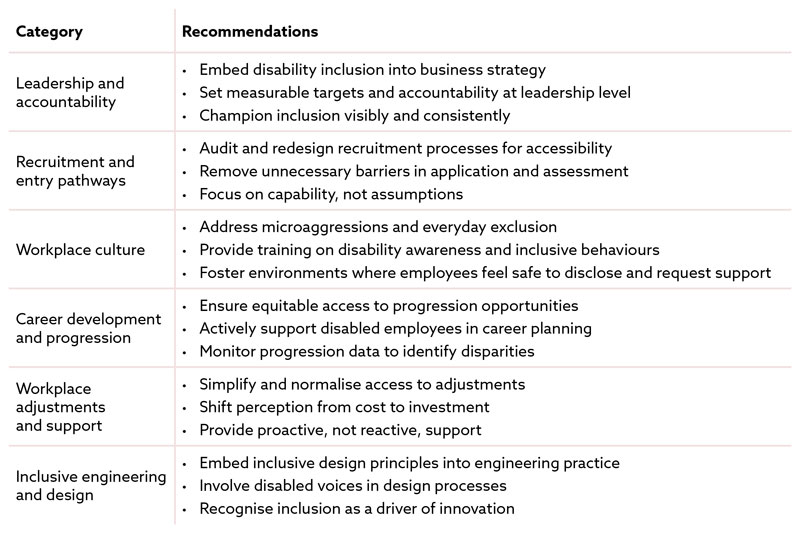
To move from general awareness to impact, organisations must take deliberate action. These actions are categorised in the table below.
Missed opportunity
The engineering sector can continue to operate within systems that unintentionally exclude and underutilise disabled talent, or it can recognise disability inclusion as a critical lever for innovation, performance and growth.
The evidence is clear. Disabled professionals are not a risk to be managed, but an asset to be unlocked. The challenge now is not whether organisations should act, but how quickly and effectively they can move from enabling people to survive, to empowering them to thrive.
To conclude the session, attendees were asked to identify one thing that the engineering sector should start, stop and keep in relation to disability inclusion. These three things should be the priority for all in creating a more disability inclusive environment. The message from attendees was emphatic: 'Stop assuming. Start listening. Keep learning.'
IOM3 announces partnership with EqualEngineers
IOM3 is working with EqualEngineers to help create a more inclusive engineering profession.
At IOM3, we are committed to creating a profession where everyone feels they belong and can thrive. Supporting equity, diversity and inclusion is central to how we serve our members and the wider materials, minerals and mining community.
We support this work through our valued member networks, which bring together members from underrepresented groups in our profession. These include the Ethnic Minorities in Materials, Minerals & Mining Group (EMM3), Ably Different Group (ADM3), Student & Early Career Group (SEC), Women in Materials, Minerals & Mining Group (WIM3) and IOM3Pride. Together, they help us support members at every stage of their careers and build a more inclusive professional community.
We’re excited to be partnering with EqualEngineers to build on this work and support more inclusive and safe cultures across the engineering community.
We share a commitment to ensuring professionals at every career stage can contribute with confidence and work in environments that prioritise safety and wellbeing. Through this collaboration, we’ll champion inclusivity across education, industry practice, leadership development and professional registration.
By combining our sector knowledge and networks, we will work together on initiatives that broaden access to opportunities, support underrepresented groups and promote inclusive engineering design. We will also encourage cross-sector learning and help show collective progress to members, partners and stakeholders across the UK and beyond.
Throughout 2026, we’ll collaborate on events that bring people together to share ideas and experiences, explore how inclusive and safe cultures can be strengthened, and support learning across materials science, minerals processing, mining and related engineering fields.
Listen to an EqualEngineers’ webinar on ‘Accessibility in Engineering with IOM3'. It features IOM3 ADM3 Group Chair Animesh Anand MIMMM.