Alloyed to their development
UK spin-out Alloyed believes passionately in furthering early-career development in materials science and advanced manufacturing through its apprenticeship scheme.
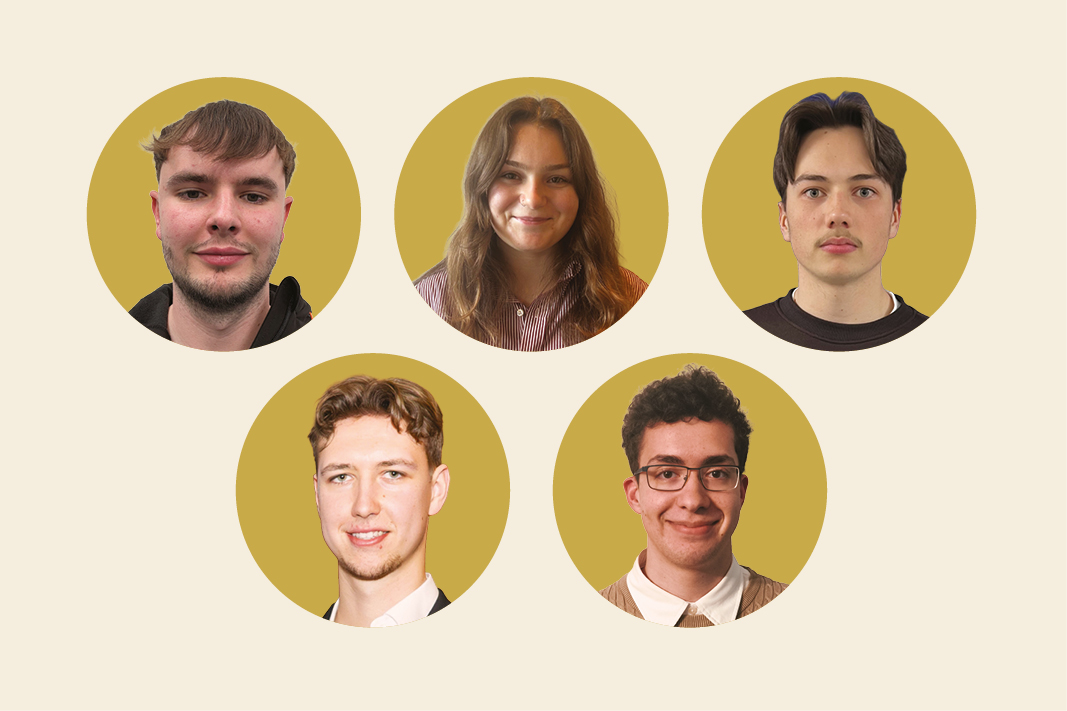
Alloyed apprentices (top left to right) Morgan Phillips, Violet Constable-Cole, Harley Langford, (bottom left to right) Ewan Morgan and Alexander Merrell Brown
© All headshots from AlloyedFive rising stars speak on the value of the apprenticeship route and what advice they can give graduates and school leavers looking for similar opportunities.
Morgan Phillips, Test and Assembly Technician Apprentice in Alloyed’s Argive division to manufacture microturbines for defence applications in the UK
You’ve been with Argive for about 18 months. Can you explain what you currently do in your role?
As a Test and Assembly Technician Apprentice, my role involves supporting the build, assembly and testing of microturbine engines. I work with procedures to assemble precision components, ensuring everything meets strict quality standards.
A key part of my role is to test the engines once they are assembled. This includes setting up test equipment, monitoring performance, recording data, and identifying any faults or inconsistencies. I then assist in troubleshooting and adjusting to improve performance and reliability.
What materials science skills do you use?
In my role within Argive, I apply a range of practical materials science skills while working with ABD900 and ABD1000 alloys. As a Test and Assembly Technician, I rely on an understanding of material properties such as strength and thermal behaviour. I carry out inspection and quality control, identifying defects and ensuring consistency across builds when taking microturbines to test. These skills help ensure reliable part production and maintain the high standards required in manufacturing environments.
What attracted you to this apprenticeship route?
I realised during my A-levels that I preferred a more hands-on way of learning rather than purely classroom-based study. That led me to look into apprenticeships, as they offer the opportunity to gain practical experience while still developing technical knowledge.
I was particularly attracted to Alloyed’s apprenticeship because it allows me to work directly in the engineering industry, build real skills and understand how things work in a professional environment. Being able to contribute to projects like building and testing microturbine engines while learning has been a valuable experience for me.
What skills and talents do you think early-career professionals can bring to this field of work?
They bring a lot of enthusiasm and a willingness to learn, which is important in engineering. As someone starting out, I’m open to feedback and keen to develop my skills quickly. We also tend to be adaptable with new technology, which is useful in a field that’s constantly evolving.
Working on microturbine engines, I’ve found that being curious and asking questions helps me understand systems deeply and improve how I work. Other key strengths are attention to detail and patience, especially when assembling and testing. Overall, you can bring a fresh perspective, strong motivation to grow and the ability to pick up new skills quickly.
What practical advice would you give graduates and school leavers considering apprenticeships in this field?
Graduates and school leavers considering apprenticeships in additive manufacturing (AM) should approach the field with realistic expectations and a willingness to learn broadly. Choose apprenticeships and graduate schemes that offer exposure to multiple technologies and real industry applications. You should be proactive and always ask questions. Finally, view the apprenticeship or graduate scheme as a long-term investment, where continuous learning and adaptability are key in this evolving industry.
Violet Constable-Cole, Manufacturing Technician Apprentice in Alloyed’s Central Operations
What does your role involve?
As a Manufacturing Technician Apprentice, I cover a variety of different areas, from setting up AM machines for builds to preparing the parts to be shipped after post-processing. My favourite tasks include running programmes on the electrical discharge machine, laser engraving and tumbling to create perfect components. Alloyed made sure I was taught each step chronologically, and this has made me appreciate how meticulous AM is.
What materials science skills do you use?
Materials science is a core element in central operations at Alloyed. In particular, data analysis is taken from every build and its prototypes to continuously improve development.
Each AM project is determined by which metal powder is most appropriate. Once this is calculated, the machine must be adjusted to suit the properties of the metal that is being built, for example, by amending the temperature.
What attracted you to this apprenticeship?
I was drawn to this apprenticeship as Alloyed offered the hands-on experience that I could not get at university. I knew that applying what I learnt at college would help me significantly more than just studying the theory.
There are multiple departments within Alloyed, so they have incorporated six-month cycles where I can rotate between different areas to find what suits me the best, which is incredibly unique within this field of work.
What skills and talents do you think early-career professionals can bring to this field of work?
Early-career professionals can bring a fresh pair of eyes and a new perspective on projects or procedures. Creativity and problem-solving are common characteristics, particularly if they have previously studied subjects that involve engineering aspects. Anyone new to engineering and eager to learn can offer innovative ideas that could be pivotal in the way that this field of work operates.
What practical advice would you give graduates and school leavers considering apprenticeships in this field?
Do not be afraid to ask questions or try something new. Communication is key between operators and engineers for processes to run smoothly and for improvements to be made. The more you learn about different components and projects, the better insight you will gain in engineering as a whole, and this can be applied to any field.
Harley Langford, Manufacturing Technician Apprentice in Alloyed’s Lab Services
What experience have you gained since you joined Alloyed about six months ago?
Being a Manufacturing Technician Apprentice enables me to learn about the different sectors of the business. I am able to operate all machinery, including for multi-laser volume production, heat treatment systems and post-processing systems. I have also recently had the pleasure of working within Lab Services, where I do characterisation on metal components made of materials like aluminium, nickel and titanium. I use a wide range of techniques and machines to do hardness testing, microscopy and failure analysis.
What materials science skills do you use?
At Lab Services, I use a range of materials science skills to help me to understand the properties and structures of materials. Metallography is a materials science skill that I use to prepare samples for microscopy and grain size measuring, and to check for micro-cracks within high-strength materials. I also do tensile and hardness testing, paired with failure analysis.
What skills and talents do you think early-career professionals can bring to this field of work?
As engineering is a vast sector with different career paths requiring different skills, they can bring new ideas, techniques and experiences that can help companies like Alloyed grow.
What advantages do you think apprenticeships like yours offer over the traditional degree route?
I enjoy how apprenticeships offer different learning methods compared to studying at university. Typically, apprenticeships allow you to apply your learning through real-life applications while earning a salary. I have found this helps expand my knowledge base.
For graduates and school leavers thinking about apprenticeships in this field, what advice would you give?
If you see an apprenticeship opportunity that interests you, I would highly recommend taking it. The experiences you are exposed to at such a young age are amazing, as is being able to work with and learn from colleagues who are more experienced. I believe this gives you a huge advantage for your career growth.
Ewan Morgan, Manufacturing Design Engineer in Alloyed’s Components Engineering Division
You’ve been with Alloyed for about three-and-a-half years. Can you explain what you currently do in your role?
As a Manufacturing Design Engineer, I spend my time creating and improving processes for components that we manufacture. My focus is on processes post-AM – from depowdering through to delivering parts to computer numerical control machining. This can include surface finishing and the electrical discharge machine. I’m also constantly looking for new and innovative machines and techniques, such as electrochemical polishing, that we could use to improve our processes and create even better components.
What materials science skills do you use?
My materials skills are typically focused on how different materials act in post-processing situations, such as vibratory tumbling and bandsaw – which require different techniques and processes. I am also interested in how the safety precautions for different materials affect how we work with them, especially in processes like depowdering, where we work inertly to reduce risk of ignition.
Tell us about one of the most rewarding projects that you’ve worked on so far.
I would say the most rewarding project to date is an automotive project. The deliverables were intricate metal pieces that sat within the interior of a prestigious car brand. I played a key role in the development process – from first prototype to selling 3D printing to the customer and doing the initial finishing trials, all the way to setting up a transatlantic production workflow across both our UK and US sites. Once the product was released, I felt so proud. I also made sure that all of my colleagues felt the satisfaction from putting many hours of hard work into the components.
In what ways can apprenticeships like yours offer a more direct and hands-on route into advanced manufacturing?
I believe an apprenticeship enables you to learn in a very unique way. You study in the classroom then very quickly back it up by physically doing the task. The same applies the other way round – we learn how to do complex tasks that we may then be taught about at a later date to reinforce the learning. This means you can have a broad and strong understanding about many subjects.
What practical advice would you give graduates and school leavers considering apprenticeships in this field?
Be prepared to learn and take in as much information as possible. AM is still establishing itself as a manufacturing method, so the entire industry is learning. That is what I love about Alloyed – everyone is here to learn, there are no silly questions and everyone wants to help you improve. So be open, ask those questions and push yourself.
Alexander Merrell Brown, Vapour Chamber Technician in Alloyed’s Components Engineering Division
You’ve been with Alloyed for about three-and-a-half years. Can you explain what you currently do in your role?
My role primarily focuses on the R&D of our vapour chamber technology. This includes designing experimental plans, carrying out testing and analysing data for in-house-designed components. A key part of my role is streamlining production steps, so a lot of my work is centred on improving both the efficiency and quality of our testing methods.
What materials science skills do you use?
Data analysis is the predominant skill in my day-to-day work. Materials science is key to AM. It directly influences many of our decisions, such as developing and refining our experiment plans and feeds into our material and parameter choices.
Tell us about one of the most rewarding projects that you’ve worked on so far.
One of the most rewarding projects I’ve worked on involved the visualisation of data following a production run. By tracking failure points and trends across parts, we were able to identify causes of common failures, such as leaks across parts, and work towards mitigating these issues to improve our production yield.
In what ways can apprenticeships like yours offer valuable experience of advanced manufacturing?
Apprenticeships are incredibly valuable for a career in the engineering field. They provide a combination of hands-on experience and the ability to study the theory behind what we do. This allows you to quickly develop your technical skills and theoretical knowledge.
From your experience, what are employers looking for from graduates and school leavers?
Employers primarily look for a willingness to learn, the initiative to apply that learning and strong adaptability. Materials science is a complex field, so being able to learn quickly and adapt is essential. Combined with strong initiative, these qualities help drive process improvements and increase productivity for experimentation and production.