Stretchy sensor works by tuning fibres
A fibre-based electronic sensor is said to function even when stretched to more than 10 times its original length.
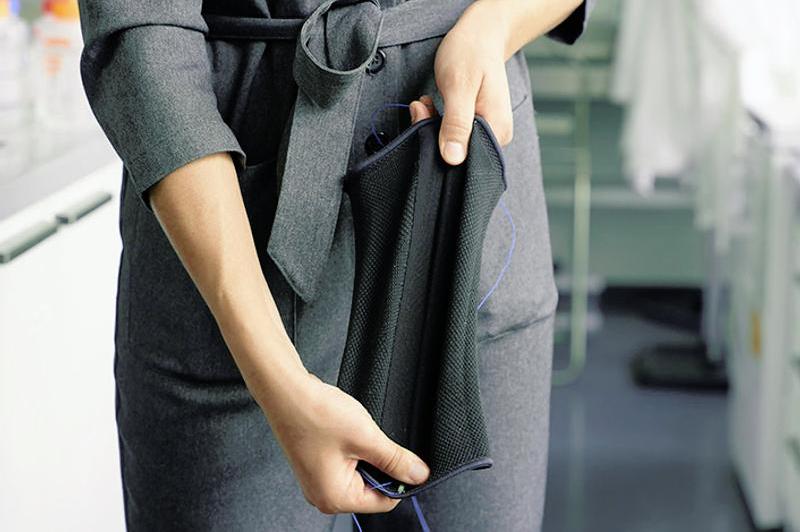
Researchers from EPFL, Switzerland, say the device is promising for smart textiles, physical rehabilitation devices and soft robotics.
This device is a mixture of indium and gallium that remains liquid at room temperature.
The team has used thermal drawing to make the device, which is traditionally used to engineer fibre optics.
They used the process to build a smart knee brace to monitor a user's movements and joint function during activity.
It involves creating a macroscopic version of the electronic fibre called a preform, which contains liquid-metal components carefully arranged in a 3D pattern. The preform is then heated and stretched out, like melted plastic, to make fibres of diameters from a few hundred micronmetres to millimetres in diameter that retain the same 3D pattern.
The team say this pattern allows them to control which areas of each fibre are electrically conductive or insulating.
'When the liquid metal is mixed with a soft elastomer matrix, it forms many small droplets,' explains PhD student and first author Stella Laperrousaz. 'The process of heating and stretching the preform breaks these droplets and activates the liquid metal. This means that we can finely tune the functionality of a single fibre by controlling which areas become active through the shear stress caused by the preform stretching process.'
Their knee brace is reported to reliably monitor the bending angle of the wearer’s knee and can accurately reconstruct their gait during running.