Bio-based fabric with sensors monitor asphalt road conditions
The centrepiece of the system is a fabric made of flax fibres and integrated sensor components.

The current process of assessing the structural condition of the asphalt base layer involves drilling down to take a core sample — a time-consuming method of measurement that can further damage the road and require road closures.
Researchers at the Fraunhofer Institute for Wood Research, Germany, have teamed up with partners in the SenAD2 project to tackle this challenge.
They are developing a smart measurement and analysis system that can be used to monitor the condition of the asphalt base layer nondestructively, over a large area and on an ongoing basis, to improve planners’ ability to address road resurfacing.
Going forward, the objective is to make it possible to determine and forecast the level of degradation affecting asphalt roads.
The sensor wire has a diameter of under one millimetre. It is incorporated during the weaving process into the natural fibre fabric, which is highly resistant to slippage or displacement. Thick, heavy yarns and wide spacing stabilise the material, say the scientists.
Christina Haxter, a Research Scientist at Fraunhofer WKI, says, 'The fabric has to be designed in such a way that there is no breakdown of the structure in the asphalt. The sensors must also not be damaged either during the weaving process or when the fabric is inserted into the roadbed.'
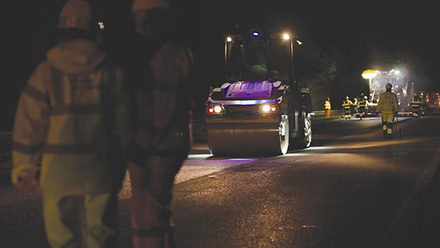
On top of that, the fabric has to withstand the weight of trucks and road pavers during construction work. The sensor fabric is produced using a double rapier loom belonging to Fraunhofer WKI, in a width of 50 centimetres, at any length desired.
Once embedded in the asphalt, the sensor fabric’s job is to provide continuous measurements, allowing for conclusions regarding the internal condition of the asphalt base layer.
The stresses that apply to roads create strain on the asphalt base layer, which also causes changes in the condition of the electrically conductive sensors.
As the sensor material expands, its electrical resistance also changes. This can be measured, and the change in resistance can be set in relation to the damage to the asphalt base layer or to the road’s condition. The sensor wire is connected to a measurement unit at the side of the road that stores the data and transfers the information to the analysis software.
After lab-based feasibility tests, demonstrator has been installed on a flat test segment of road in an industrial zone. The sensor fabric has been installed across the full width of the roadbed.
Measurement and analysis nodes record the changes in resistance in the sensors when a vehicle travels over the demonstrator.
For more like this