Scaling graphene for quantum devices
Paragraf and Archer Materials will explore if wafer-scale graphene fabrication can support emerging quantum computing hardware.

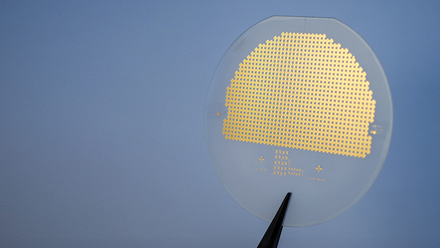
A single graphene field effect transistor (GFET) die on top of two wafers of graphene hall sensor (GHS) die
© ParagrafThe project will investigate whether graphene devices can be fabricated using scaleable processes, and will evaluate their performance in quantum-relevant settings.
A core challenge in quantum hardware is not only achieving functional quantum bits (qubits), but producing device structures that can be scaled and reproduced consistently.
Existing quantum systems are highly sensitive to noise, temperature and external interference, and many rely on architectures that are difficult to manufacture repeatably. Graphene offers potential advantages for quantum device development, including high electronic mobility, low noise characteristics and atomic-scale thickness.
The partners will conduct ongoing research into novel graphene device architectures for qubit detection, including graphene structures capable of interfacing with emerging quantum systems. The collaborative nature of the programme aims to speed the translation of fundamental research concepts into practical device prototypes.