Quantum metacrystal works at room temperature
The material can distinguish subtle quantum differences between incoming light.
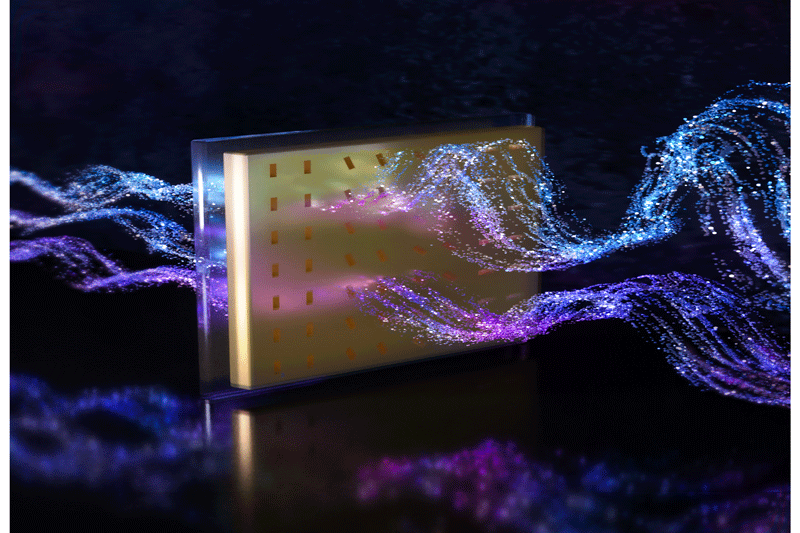
Developers at Louisiana State University, USA, claim their quantum material is the first of its kind capable of operating at room temperature.
The 'quantum statistical plasmonic metacrystal' is reportedly able to distinguish subtle quantum differences between incoming light – photons – and guide each quantum state along a different pathway, with limited changes to their information.
Nearly all known quantum materials only exhibit these properties when cooled to temperatures close to absolute zero (-273°C). Heat creates constant atomic vibrations that can overwhelm quantum behaviour, and so keeping the vibrations in check requires bulky cryogenic refrigeration systems, making the materials difficult to translate into practical technologies.
Rather than looking for a naturally occurring material with the properties they wanted, the team designed one. They believe it could be useful for quantum computing, ultra-secure communications, sensing technologies and advanced energy systems.
Associate Professor Omar Magaña-Loaiza from the university explains this was achieved by patterning gold onto a polished, 175µm-thick, borosilicate glass substrate.
The substrate is cleaned with acetone, methanol, isopropyl alcohol and deionised water, dried with nitrogen, then baked for 15 minutes. Gold is sputter-deposited in a 110nm-thick film onto the glass, and focused gallium-ion beam milling is used to etch nanoscale patterns into the gold.
The metacrystal is formed from a grating coupler and array of 100 nanoantennas on the device, with individual meta-atoms measuring ~400x200nm and a centre-to-centre spacing of 1µm.
When light enters the chip, it travels across the gold surface and interacts with the meta-atoms, converting incident light into a propagating plasmonic field.
The researchers also discovered that the metacrystal naturally forms what they call ‘quantum statistical bands’, analogous to electronic band structures that determine how semiconductors conduct electricity. The size of the individual meta-atoms determines which quantum statistics are allowed to pass through, while their number and relative spacing control the width of the statistical bands.
Magaña-Loaiza explains, 'Conventional metasurfaces can manipulate properties such as polarisation, frequency, phase, or orbital angular momentum, [but] previous quantum metasurfaces have largely focused on single photons or photon pairs. Our material instead interacts with the statistical fluctuations and quantum coherence.'
He continues, 'Multiphoton fields whose statistics lie in an allowed band can propagate while preserving their statistical properties, whereas fields in a forbidden band are suppressed or transformed toward an accessible statistical state.' The engineered gold is, in turn, said to support surface-plasmon excitations at ambient conditions, without cooling.
The metacrystal’s tuneability for different applications is one of its strengths, suggests Magaña-Loaiza. It can be 'engineered for a particular response by modifying the geometry and collective arrangement of its meta-atoms. Rather than having a single, universal metacrystal, we envision families of structures designed for different optical sources and applications'.
For example, a structure meant for coherence-sensitive energy harvesting would be optimised differently to one designed for quantum information processing.
The same properties that are useful for quantum computers could also enable more practical quantum communication networks and ultra-sensitive sensors, and even benefit renewable energy, claim the researchers. By guiding sunlight along more robust pathways, a specialised metacrystal could move more energy through a solar material instead of losing it as heat.
Magaña-Loaiza says the team’s work 'introduces a new design parameter for materials', so they can be designed around the quantum statistical properties of the light interacting with them.
More like this...