Is ESG Dead? Why sustainability is now core business for mining
Grace Yungwirth CEng MIMMM and Dan McLaughlin from WSP write on the evolving role of sustainability in mining.
Grace Yungwirth CEng MIMMM is Director - Mining, Mine Water & Sustainability at WSP, and Dan McLaughlin is the Global Client Mining Director at WSP.
Is Environmental, Social, and Governance (ESG) dead, or has it simply evolved into something far more powerful? One would not be mistaken if they observed that the industry is no longer speaking about ESG in the same way they were a few years ago. While corporate social responsibility was defined in the 1950s, its concepts gained widespread uptake in the 1990s corporate landscape, which then further evolved into ESG in the mid-2000s. ESG language in many forums has recently reverted to ‘sustainability’ and ‘risk management’, but is the discussion still relevant?

EY’s Top 10 risks and opportunities for mining and metals companies in 2026 – Accessed on 17 Nov 2025 at Risks and opportunities for mining and metals in 2026 | EY - Global
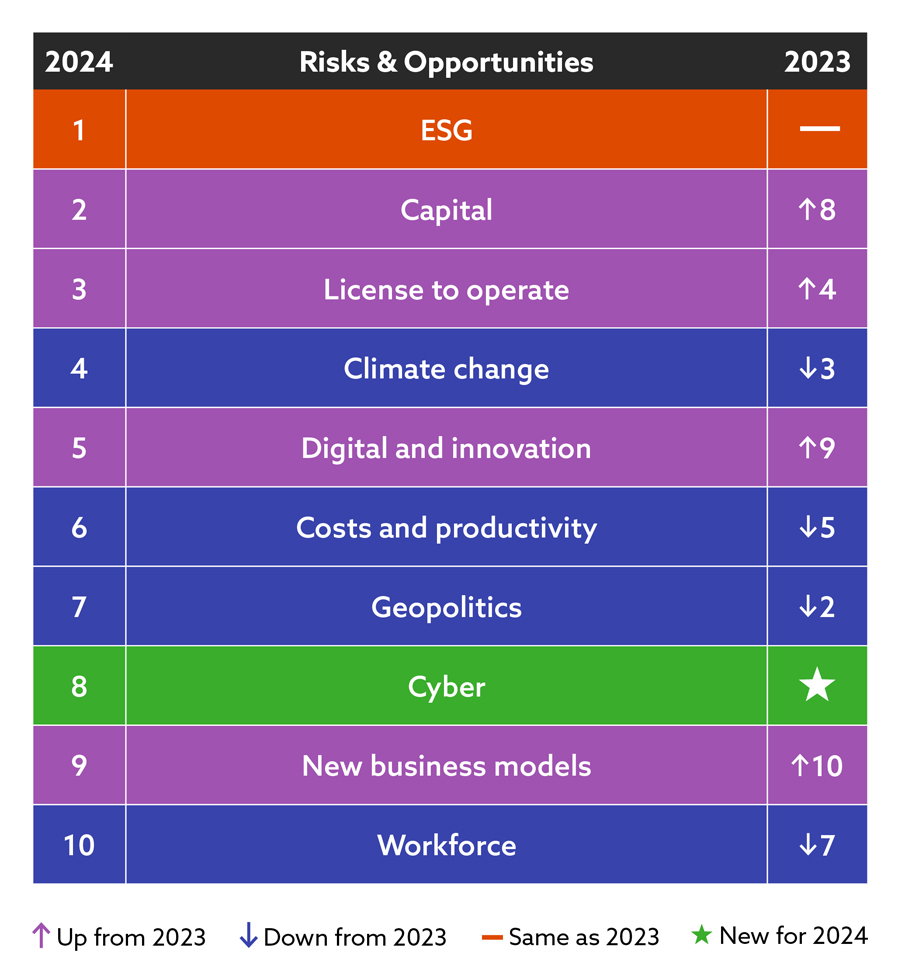
EY’s top 10 risks and opportunities for mining and metals companies in 2024 – Accessed on 17 Nov 2025 at ey-top-10-business-risks-and-opportunities-for-mining-and-metals-in-2024-final.pdf
Some might point to politicisation, regulatory fatigue, and the perceived burden of compliance for the term ESG to fall out of favour, however, the reality is that ESG considerations have continued to evolve and be embedded in business processes and practice over the last 20-30 years and hence remain a business imperative for mining companies. The increased focus on ESG over the past few years has demonstrated that responsible ESG practices have become mainstream and are just good business. There are hints of this in the EY top 10 risks and opportunities for mining and metals companies which has dropped ESG completely in the last two years after listing it as number one in 2023 and 2024, however it retains ‘license to operate’ as the fifth position, with mention of ‘environmental stewardship’ and ‘sustainability’ also retained in the top 10 over the last two years.
In reality, ESG is not dead, it has matured. For mining companies, sustainability and ESG are now a mainstream strategic consideration, fundamental to value creation, risk management, future planning, and resilience in a rapidly changing world.
From compliance to core value
The perceived backlash against ESG has, paradoxically, assisted in refocusing around its true purpose. ESG may have lost credibility when some parts of industry treated it as a box-ticking exercise, divorced from the realities of good governance, risk management and operational practice. This unsurprisingly led to some decline in stakeholder and investor confidence in the corporate ESG conversation with increased accusations of ‘greenwashing’ and lawsuits aimed at companies that couldn’t demonstrate achievement of stated ESG performance. At the same time, other companies had advanced their journey to integrating focused ESG principles and practices into their business.
The discussion refocused from being about compliance for its own sake, to instead, ESG being reimagined as a resilience strategy - one that enables companies to differentiate and thrive amid uncertainty, not just survive it. This shift is especially pronounced in mining, where water, energy, nature, and community impacts are not abstract risks but daily operational realities. There is an increasing business advantage to those who plan for the future by mining responsibly, using less energy, water and biophysical resources to do so, responsibly managing their waste and legacy, and positively integrating with their environment and communities from project start up through to mine closure.
The geopolitical landscape is also changing, with selective deglobalisation, security of supply, and nationalising value chains, emerging as common themes alongside the energy transition. This means the demands for local mining projects will increase, as will sources of capital to fund these projects. These multiple sources of demand pressure will lead to increased scrutiny from investors, regulators, and society looking to limit risk through strong ESG performance and business resilience.
The business case
The evidence is clear: ESG is good business.
- Operational efficiency: Improved management of the resources required to support operations including, water, energy, human capital etc reduces costs, limits operational risks, and enhances productivity. Technologies and strategies that promote innovation, resource efficiency, advanced monitoring, and greater extraction with lower legacy cost, enable companies and mines to do more with less, often with clear cashflow, production and balance sheet advantages.
- Risk mitigation: By addressing ESG factors including social and environmental stewardship, mining companies reduce their exposure to regulatory penalties, community opposition (loss of social licence), and supply chain disruptions. Physical risks to operations and mine infrastructure are reduced when proactive management of these risks is prioritised.
- Adaptation and resilience: Climate change also is expected to increase the volatility of water supply and energy costs. Proactive stewardship of shared resources becomes a form of insurance reducing multiple risks including the potential impacts on production.
- Access to capital: Investors and lenders increasingly demand robust ESG performance through solid risk management and governance frameworks. Companies that can demonstrate credible, data-driven ESG strategies enjoy better access to finance and lower costs of capital.
- Social Licence and Reputation: Transparent engagement with stakeholders, grounded in real data and meaningful action, builds trust and secures the social licence to operate, which is critical for long-term success.
ESG and Sustainability are now about building businesses that attract capital, are robust, adaptable, and positioned for change and long-term success.
Water, energy and nature as strategic assets
Mining’s relationship with water, energy, and nature is a powerful illustration of why ESG matters. At New Zealand’s Institute of Directors’ annual leadership conference, Izzy Fenwick, Board Member at The Aotearoa Circle, recently emphasised a powerful truth: ‘Nature is our most critical supplier’. There is an increasing understanding that we are reliant on finite resources to support our civilisation and competition for these shared resources will increase as climates change, populations grow and economies transition. With that in mind, it is reasonable to assume that regardless of a company or site's current position on water, energy, and nature, competition for the natural resources necessary for successful operation of their businesses will increase. Therefore, proactive management and stewardship of these resources and related investment is needed to protect both the ability and social licence to operate in areas where these resources are scarce or in demand.
Driving business resilience
The mining industry faces a future of increasing complexity: climate change, resource scarcity, operational complexity, evolving stakeholder expectations, and technological disruption. In this context, ESG and sustainability are not a luxury or a distraction; they are a toolkit for future-proofing the business.
To be successful, focus must be placed on understanding project specific material ESG risks (not just corporate risks) and aligning with the appropriate targets. Clear and transparent engagement with project stakeholders is an advantage in identifying materiality and focusing ESG and Sustainability initiatives to align with management of business risks. Where there are trade-offs, these must be considered transparently and communicated to stakeholders.
A portfolio approach is becoming the standard when target setting, recognising that material considerations differ by operation where substantive risks or gains in one area can vary widely dependent on location. For example, water use or biodiversity considerations may be more impactful at operations based in water scarce regions and may have to be traded off against other factors such as carbon. Investment can then be focused on the projects that drive the greatest business and stakeholder impact, as opposed to cascading broad brush commitments to operations which will not benefit. Mining companies are increasingly using quantitative data, benchmarking, and stakeholder engagement to set realistic, defensible targets, prioritise investments across their portfolio, and transparently manage trade-offs and engage stakeholders.
This approach is not just about meeting ESG and Sustainability commitments, it is about making better business decisions, optimising capital allocation, and building resilience against future uncertainty and competition.
The path forward
For mining companies, the path forward is clear. Integrating sustainability and ESG provides a practical, data-driven approach to managing business risk and resilience. Setting and delivering on meaningful targets will not only support mining companies to meet their ESG commitments to stakeholders, but they will also build stronger, more resilient businesses, ready to thrive in an uncertain world.
Related resources from IOM3

Authors

Dan McLaughlin