Plasma spray delivers tungsten-copper coatings for fusion
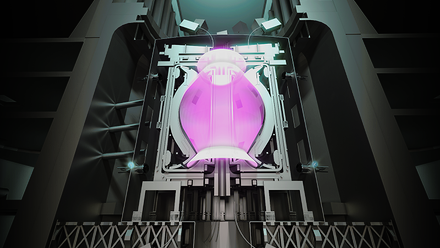
The coatings are designed for high heat flux plasma-facing components in fusion reactors.
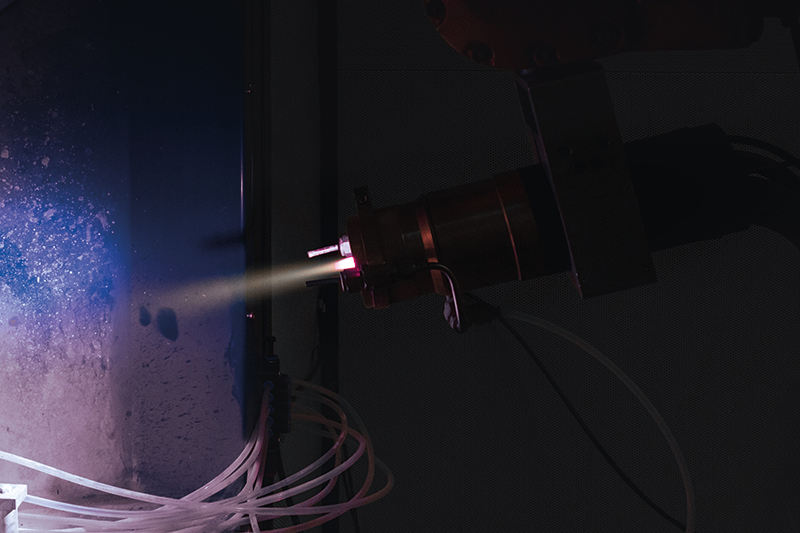
Researchers at the University of Nottingham, UK, claim they are the first to demonstrate that axial injection plasma spray can be used to build these coatings in a single step without the need for a highly specialised vacuum chamber.
Plasma spraying works by injecting powdered metal into a high-temperature plasma jet, where it melts and is projected onto a surface to form a coating.
However, in conventional systems, oxidation can weaken the material. In this case, the researchers surround the plasma jet with an inert gas 'shroud' to shield the molten particles from unwanted reactions with air. By spraying inside a protective bubble, the material solidifies in a cleaner and more controlled way.
Professor Tanvir Hussain FIMMM from the university says this 'reduces oxygen ingress, improves particle heating efficiency and promotes better splat formation on impact'.
The team also continuously grade the coating from 0-100wt.% tungsten, reportedly achieving a dense and structurally stable material. Functionally grading the composition, rather than stacking distinct layers, so it transitions from copper-rich at the base to tungsten-rich at the surface is said to reduce stress and improve bonding.
Tungsten and copper are used for high-temperature engineering applications because of their complementary properties – tungsten’s high-temperature and wear resistance alongside copper’s thermal conductivity. However, they are difficult to combine because their different thermal expansion rates lead to internal stress, cracking and early failure.
Hussain explains that the team carried out 'feasibility trials to establish stable deposition', as well as systematic optimisation of key parameters, including stand-off distance, plasma power and gas composition.
The coating is said to exhibit ultra-low porosity compared to conventionally produced coatings, which means fewer weak points, greater durability and lower copper oxide content. A post-spray heat treatment further reduces microcracks in the tungsten-rich regions, enhances inter-layer metallurgical bonding and improves densification.
Hussain shares, 'The motivation came from a persistent challenge in [conventional] APS – depositing tungsten in a dense, well-bonded form...This limits coating quality and repeatability.
'Copper-tungsten components are essential for…cleaner fusion energy. By reducing oxidation, minimising porosity and tailoring mechanical properties across the coating thickness, the technology could extend component lifetimes, improve reliability and reduce maintenance costs.
'The approach is broadly applicable to other systems requiring combined thermal management and high-temperature resilience…[including] aerospace components, space propulsion systems, high-heat industrial tooling and erosion-resistant surfaces.
'More generally, the method is relevant to any functionally graded or refractory-ductile material system where oxidation control and compositional tailoring are challenging under conventional APS conditions.'
The team believes that eliminating high-vacuum systems could make their technique more cost-effective than existing methods.
Hussain emphasises, 'Further work is required to validate mechanical and functional performance under realistic service conditions, including thermal shock resistance, cyclic fatigue, oxidation behaviour, adhesion strength, and plasma or particle exposure.'
To expand from lab to industrial scale, it is also necessary to demonstrate 'consistent reproducibility across larger geometries and more complex component shapes', as well as refine the process window and show long-term stability of the graded structure.
He believes, 'The shrouded axial-injection strategy opens new possibilities for depositing other oxidation-sensitive, refractory-ductile material combinations that are currently difficult to achieve.'