Amplifying resources
Jeremy Ramsden FIMMM lays out his vision for achieving circularity.

Jeremy Ramsden FIMMM
© Jeremy RamsdenA familiar sense of resource amplification is the use of tools and machines to extend the productive capacity of human labour. A hoe, a plough, a tractor and a combine harvester progressively amplify the productive capacity of a single person. It would be hard to find a more powerful illustration than the succession of inventions made in the late 18th Century in and around Manchester, UK, and continuing thereafter. James Hargreaves’ spinning jenny in 1764 allowed eight spools to be spun at once instead of one, swiftly followed by Samuel Crompton’s spinning mule in 1779, which allowed hundreds of spools to be spun by one person. By the late 19th Century, textiles were being overwhelmingly produced in large factories powered by fossil fuel.
The concomitant exponential increase in the exploitation of Earth’s resources has ultimately led to concerns about surpassing viable planetary boundaries, a notion introduced by Johan Rockström in 2009, or about depleting Earth’s 'battery', outlined in Human domination of the biosphere: Rapid discharge of the earth-space battery foretells the future of humankind in Proceedings of the National Academy of Sciences of the United States of America. These concerns motivate the circular economy as a way of increasing resource efficiency. A collateral benefit is decreasing adverse environmental impacts – increasing resource efficiency is understood to imply creating less waste.
Walter Stahel, speaking at the November 2019 IOM3 Resources Strategy Group conference on ‘Balancing Resource Efficiency with Climate Change’, sees the circular industrial economy as 'a giant opportunity and challenge to the mining and materials industry'. He put emphasis on maintaining the value and utility of our stocks of objects. Encouragingly, steps are already being taken to achieve that with initiatives such as Extended Producer Responsibility (EPR) – implying profound changes in the notion of ‘ownership’ and its legal framework.
However, the simple contrast with the linear economy obscures major paradoxes associated with the circular economy concept.
Using a discarded modern product like a mobile phone as feedstock for fresh production implies demixing which, as we learn from thermodynamics, has a significant minimum energy cost proportional to Σxilogxi, where xi is the (mole) fraction of the ith element. The sum runs from i = 1 up to however many elements there are. The actual cost may be a great deal more. Essentially, all stages of the circular economy require significant energy input.
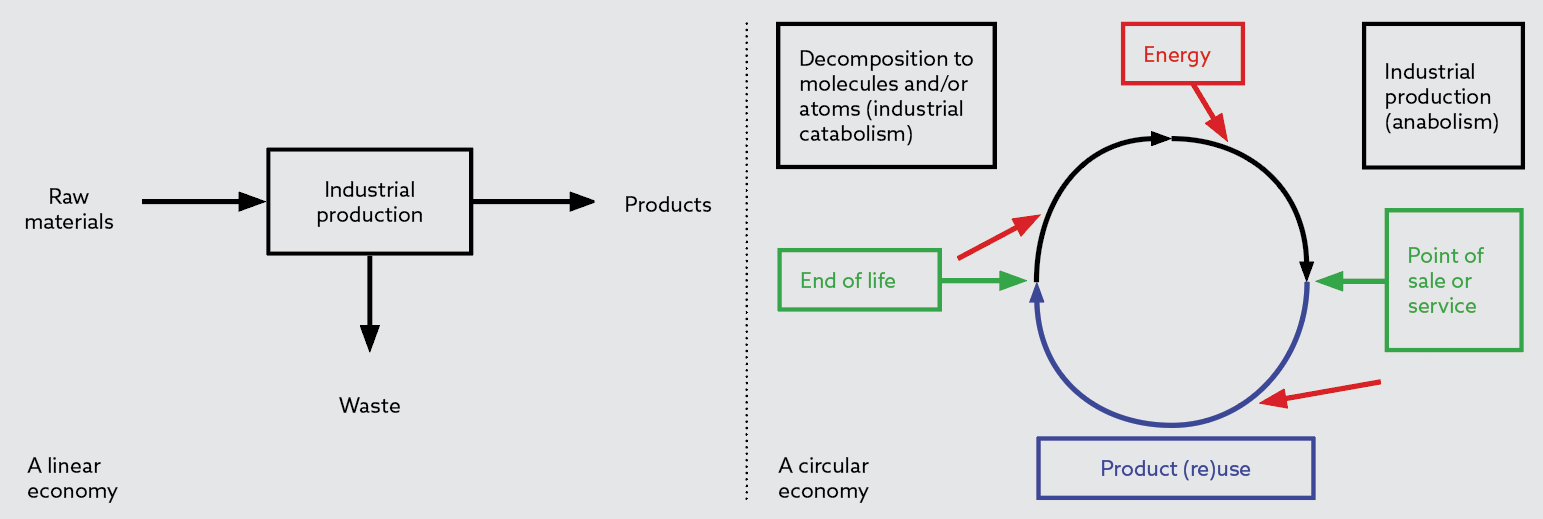
Diagrams illustrating the difference between a linear and circular economy
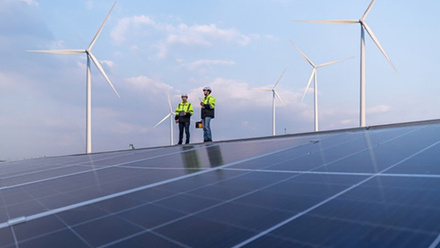
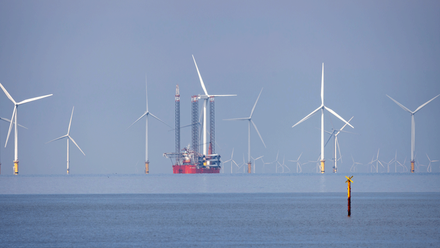
© Jeremy RamsdenFurthermore, the energy inputs required for the demixing implicit in molecular recovery are supposed to be obtained from abundant and readily available sources, namely sunlight and wind. For all practical purposes, they are inexhaustible, but unfortunately diffuse. The elaborate technologies required for collection and concentration themselves tend to wear out, and not all are recyclable (e.g., wind turbine blades), which results in some leakage – the loop is not completely closed.
Yet achieving circularity is often associated with retrenchment. For example, the 2019 UK FIRES report on Absolute Zero, which was led by Professor Julian Allwood HonFIMMM, estimates that, by 2050, we will need to use about 40% less energy – and all electrical – assuming reasonable maximum energy can be generated from renewable sources using existing technologies, based on their continual capacity expansion until 2050.
The 40% reduction in energy use discussed in Absolute Zero factors in an 11% population increase as an apparently immutable and independent process. While many countries are debating the social and economic implications of a decreasing population, the average fertility rate lowering to achieve a 40% diminution of population would concomitantly reduce global energy requirements as well as environmental pressures.
In his 1964 New Scientist article, How many people can the world support?, John Heaver Fremlin estimated that Earth could support as many as 1,000 million million human beings. It is unlikely that such a goal would find many supporters.
In 1960, an alarming prediction about population was made in the pithily named study, Doomsday: Friday, 13 November, A.D. 2026. At this date human population will approach infinity if it grows as it has grown in the last two millenia, published in Science. Evidently, humanity has had some success in limiting unbridled growth.
Two very different approaches – Can a collapse of global civilization be avoided? in Proceedings of the Royal Society B: Biological Sciences and A sustainable world population in the Journal of Biological Physics and Chemistry – converge on an estimate of the sustainable world population level as only about two billion.
The third paradox of the circular economy is that another way of overcoming predicted resource shortages is to mine extraplanetary resources such as our Moon and asteroids, but achieving that will require even greater terrestrial resource amplification.
Turning up the volume
Let us have a closer look at power amplification. In electronics, tiny fluctuations are enlarged, drawing on a power supply. In mechanical engineering, a similar concept is found in servomechanisms. In other words, an amplifier is a device that, given a little of something, will emit a lot of it, and works by having a generous reservoir of what is to be emitted; the input merely controls its flow from the reservoir. Hence, there is no violation of the principles of conservation of energy and matter, and this kind of amplification cannot be used to replenish the losses from leakage.
Is there anything that is not subject to this limitation? One very familiar one is money, which can, apparently, be amplified without limit. This will not directly solve our problem, but seems worthy of some consideration. For example, most, if not all, the metals we need are in the oceans – the problem is not resource depletion, but the prohibitive cost of extracting them from such a dilute feedstock.
At the very end of his book An Introduction to Cybernetics, W. Ross Ashby touches on the possibility of intelligence amplification. A few years later in Speculations concerning the first ultraintelligent machine in Advances in Computers, I.J. Good wrote, 'The survival of man depends on the early construction of an ultraintelligent machine'. Prescient words indeed. Does intelligent thinking need more resources than unintelligent thinking? Apparently not, and intelligent thinking can in effect be amplified merely by copying it, which requires negligible resources. The innovations of Arkwright and Cartwright et al. were swiftly copied with enormous effect, so much so that for several decades preceding World War I, Lancashire alone accounted for almost three-quarters of world trade in cotton textiles. Can such intelligence amplification be applied to get ‘something for nothing’, which is in effect what we want to do, to be able to endlessly keep going around our circle?
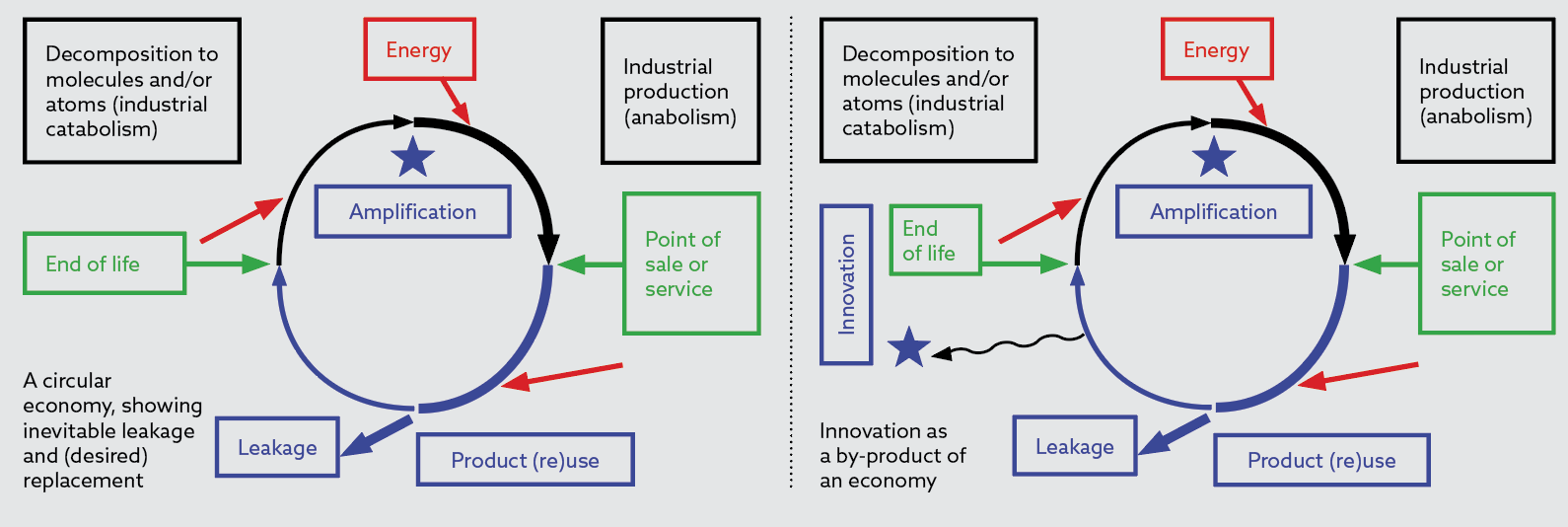
Diagram illustrating leakage and amplification in the circular economy
© Jeremy RamsdenThe modern phenomena of artificial intelligence, or artificial general intelligence (AGI), presently epitomised by generative large language models (LLMs), have advanced inordinately in the last few years. With their help, are we not finally able to carry out a global optimal allocation of resources, using and developing the pioneering work of the Soviet mathematician and economist Leonid Kantorovich?
Although the problem still seems hopelessly intractable, progress in AGI is so rapid that the challenge should be continually revisited. It boils down to a process of selection – choosing the right thing to do. Selection can be amplified in stages, only limited by the information capacity of the channels connecting the stages. Most problem-solving is largely a matter of appropriate selection, so if that can be amplified without limit and without implying the consumption of physical resources, then we should be able to achieve true circularity. A striking example of such amplification is the brain, the specification of which is quantitatively much greater than the amount of information supplied by the genes.
Spinning sparks for humanity
There remains the question of what to select for, which leads to the far-reaching question of social value. What do we actually want? During the decades preceding WWI, the circular economy was a paradigm of futility, illustrated by the story of a squire who had succeeded to an estate and was walking round it for the first time with the bailiff. 'What are those fields for?' he asked. 'To grow oats, sir.' 'And what are the oats for?' 'To feed our horses, sir.' 'And what are the horses for?' 'To plough the fields, sir.' The circular – and indeed any kind of – economy only makes sense if something is tapped off, not waste, but something far reaching that promotes the distant goals of humanity, whatever they are.
If these ‘sparks’ inspire and enable access to whatever distant resources we may require, then we have a path to humanity’s survival. This is surely preferable to a circular economy without sparks, continuously striving to husband an ever-dwindling stock of terrestrial resources and fretting about minute occurrences of inadvertent waste. The circular economy can operate with different diameters, the diameter being proportional to the intensity of economic activity. Sophisticated technologies, such as the ability to mine the Moon, require striving for the greatest possible intensity of economic activity, which is only sustainable if the power of selection is amplified as much as necessary.
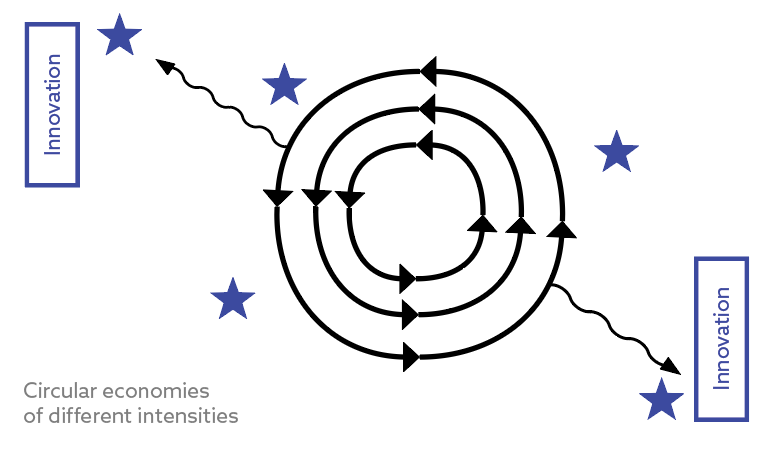
Diagram illustrating circular economies of different intensities
© Jeremy RamsdenJumping to light speed
Selection also applies to our choice of goal. The elaborate technologies required for the artificial collection and storage of sunlight require a great deal of energy to manufacture. We seem to be disconcertingly close to the futility of renewably generating energy merely to manufacture the generating infrastructure. In his book Energy or Extinction?, Fred Hoyle points out the marvel of the biological dissemination of embryonic solar energy collectors as seeds which, when fully grown, also store the collected energy.
The fundamental problem of the abundance of solar energy is that it is diffuse. While it is true that covering a field with photovoltaic solar panels saves much more CO2 from being emitted than what would be sustainably sequestered by the vegetation, this assumes that the electricity would otherwise be generated by burning fossil fuels. The sense of doing this, however, vanishes if no electricity is being generated in that way.
Although nature was often seen as an obstacle during the heady growth of the Industrial Revolution, we now need to work in more intelligent symbiosis with it, not least in the matter of energy supply. While not knowing exactly the path this will take, I feel confident that the model of amplified intelligence will light the way.
Policy declarations regarding the circular economy, net-zero and so forth seem to invariably assume that the general tenor of life will continue as is. One iteration is that we shall still motor around, but in electric rather than petrol-powered vehicles. The FIRES report does perceive that aviation and shipping will have to be eliminated between now and 2050, but assumes that the desire to travel will persist – 'Most of what we most enjoy…can continue and grow unhindered'. Such declarations are presumably felt to be necessary to gain popular assent, but reluctance to change has been the downfall of many civilisations.
Any superintelligent global allocation of resources requires one or more constraints to be asseverated if it is to have any sense. Using 40% less energy is certainly a constraint, but, like sustainability being self-evident as a goal, it is insufficient in itself, begging the question 'Why?'
Some goals must be prioritised over others. The overarching goal, most suited to humanity’s survival, is surely to find out as much as possible about our universe. To achieve such a lofty aim, it might even be advantageous to run down Earth’s 'battery' a little more to gain some edge in helping us to make a big jump.