Alkali modifiers tune metal-organic framework glasses
A glassmaking principle used for thousands of years has been transferred to metal-organic framework (MOF) glasses.
The porous hybrid glass is tuned to soften at lower temperatures without losing its structure.
Metal-organic frameworks are porous materials made from metal ions or clusters connected by organic linkers, with potential applications gas separation, chemical storage and catalysis. However, many MOF glasses soften only above 300°C – close to their degradation temperature – making them difficult to process.
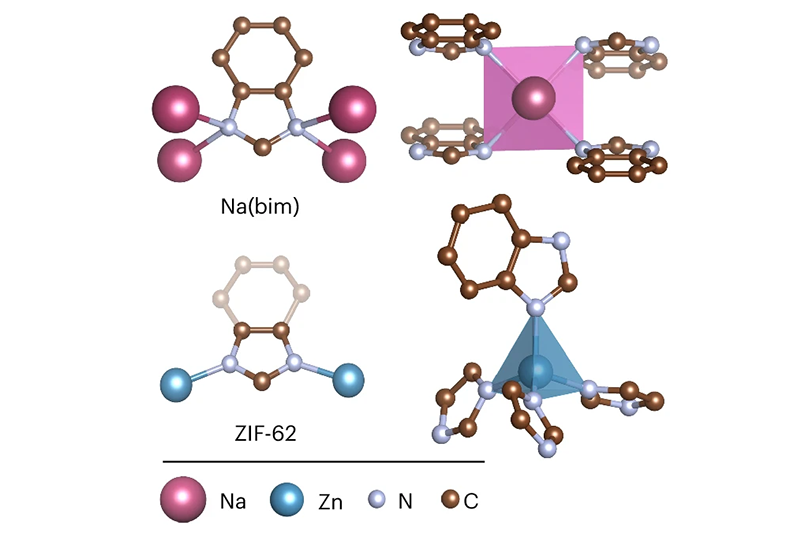
An international team, including researchers from the University of Birmingham, UK, and TU Dortmund University, Germany, has shown that adding alkali-containing modifiers based on sodium or lithium can lower the softening temperature of ZIF-62, a porous MOF that can be melted and cooled into a glass while retaining some of its internal structure.
They used high-temperature, solid-state, NMR spectroscopy and machine-learning-assisted simulations to show that sodium modifies the connectivity of the glass network by replacing some of the zinc atoms, rather than simply occupying pores. This reduces network rigidity in a way comparable to traditional glass modifiers.
The approach could provide a new route to designing MOF glasses with improved processability for membranes, coatings and other advanced technologies.