Defence, Safety & Security Group: Advancing Materials for National Resilience
From critical materials to Defence Materials 2050, explore how IOM3 experts are helping shape the future of defence and security.
The IOM3 Defence, Safety & Security Group brings together experts from industry, government and academia to tackle some of the UK's most important materials challenges. Through technical networking activities, policy engagement, advocacy on critical minerals and materials, and the ambitious Defence Materials 2050 programme, the Group is helping to shape a resilient and innovative future for defence and security materials.
In an increasingly uncertain world, materials are playing a pivotal role in national resilience. From protecting critical infrastructure and enabling secure communications to supporting advanced defence platforms and safeguarding supply chains, materials science sits at the heart of modern defence and security capability. Against this backdrop, the IOM3 Defence, Safety & Security Group (DSSG) provides a unique forum for bringing together experts from industry, government, academia and the wider defence community to address some of the UK's most pressing technological challenges.
A community focused on national capability
The Defence, Safety & Security Group is one of the Institute's technical communities and provides a focus for the technical, educational and professional aspects of materials used across defence, safety and security applications. The Group connects professionals from defence primes, SMEs, government organisations, universities and research establishments, enabling the exchange of knowledge, experience and best practice across a broad range of disciplines.
The current leadership team reflects this diversity, bringing together representatives from organisations including AWE Nuclear Security Technologies, Dstl, BAE Systems, QinetiQ, Lucideon and leading universities. The Group continues to expand its reach and influence across the UK defence materials community.
During 2024, the Leadership Group held regular meetings, increased engagement across the sector and expanded its membership. Collaboration with other IOM3 groups has also strengthened, creating opportunities for cross-cutting discussions on sustainability, manufacturing, advanced materials and defence capability.
Materials at the centre of defence innovation
Recent geopolitical developments have highlighted the critical importance of secure and resilient supply chains, advanced manufacturing capabilities and long-term investment in materials innovation. Materials underpin almost every defence technology, from lightweight aerospace structures and advanced armour systems to quantum technologies, secure communications and next-generation energy storage solutions.
Recognising this, the DSSG has increasingly focused its activities on strategic materials challenges. The Group has supported discussions around critical materials, advanced manufacturing, supply chain resilience and skills development, all of which are essential to maintaining sovereign capability and ensuring operational advantage. These themes were reflected in IOM3's response to the UK Government's Defence Industrial Strategy, which emphasised the need for stronger supply chains, sustained innovation and investment in the materials workforce.
Securing the foundations: critical minerals and materials
A key area of focus for the Group has been the resilience of critical mineral and material supply chains. While advanced materials innovation is essential, innovation alone cannot deliver defence capability if access to the necessary raw materials, processing routes and manufacturing infrastructure is constrained.
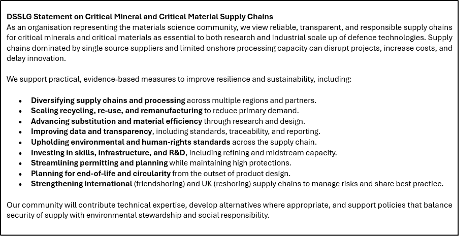
To address this challenge, the DSSG recently issued a position statement on Critical Mineral and Critical Material Supply Chains. The statement highlights that reliable, transparent and responsible supply chains are essential to both research and the industrial scale-up of defence technologies. It notes that reliance on single-source suppliers and limited domestic processing capability can increase costs, delay innovation and create vulnerabilities within strategically important sectors.
The statement advocates a series of practical, evidence-based measures to improve resilience and sustainability. These include diversifying supply chains and processing capability across multiple regions and partners; scaling recycling, reuse and remanufacturing; advancing substitution technologies and material efficiency; improving traceability and data transparency; investing in skills, infrastructure and research and development; and strengthening both international partnerships and UK industrial capability.
Importantly, the statement recognises that security of supply must be balanced with environmental stewardship and social responsibility. The materials community therefore has an important role to play in developing alternatives where appropriate, providing technical expertise and supporting policy decisions that are grounded in sound science and engineering practice.
As defence systems become increasingly dependent on specialist materials, the challenge of securing resilient supply chains is likely to become as important as developing the next generation of technologies themselves.
Building networks through technical engagement
One of the DSSG's greatest strengths lies in its ability to convene diverse communities around shared challenges.
In November 2024, the Group hosted the Defence Safety & Security Group Technical Networking: Additive Manufacturing in Defence, bringing together experts to explore how advanced manufacturing technologies can accelerate capability development and increase flexibility across the defence sector. The event demonstrated the growing appetite for collaboration between researchers, manufacturers and end users.
The Group has also supported webinars and technical discussions covering topics ranging from advanced joining technologies through to future defence materials requirements. Such events help bridge the gap between academic research, industrial capability and operational needs, enabling innovative ideas to be translated into practical solutions.
Beyond individual events, the Group provides an enduring community where members can share knowledge, discuss emerging challenges and identify opportunities for collaboration across disciplines and organisations.
Defence Materials 2050: preparing for the future
Perhaps the most ambitious initiative currently being led by the DSSG is Defence Materials 2050 (DM2050). Conceived as a multi-year programme of workshops, seminars and thought leadership activities, DM2050 seeks to identify the materials, technologies, skills and industrial capabilities required to meet defence needs through to the middle of the century.
The programme recognises a fundamental challenge within the defence sector: materials innovations often take decades to move from laboratory discovery to operational deployment. At the same time, defence organisations must respond to evolving threats, changing regulations, supply chain vulnerabilities and increasing sustainability expectations.
Recent workshops have explored themes including materials discovery and design, manufacturing and processing, supply chain resilience, digital technologies and workforce development. Participants have consistently highlighted the importance of creating an integrated ecosystem that combines advanced manufacturing, digital engineering, automation, qualification reform, skills development and national infrastructure investment.
The outputs from DM2050 are expected to contribute to future strategic recommendations and policy discussions involving government, industry and academia, helping to shape the UK's long-term approach to defence materials capability.
Supporting the profession
Alongside its technical activities, the DSSG remains committed to supporting professional development across the materials community. Through engagement with universities, employers, early-career professionals and other IOM3 technical groups, the Group helps promote networking opportunities, career development and professional registration.
Developing the next generation of materials scientists and engineers will be critical if the UK is to maintain sovereign capabilities in defence and security. The Group therefore sees skills, education and knowledge transfer as essential components of future resilience, alongside research, innovation and industrial capability.
Looking ahead
The future security environment will require materials solutions that are lighter, stronger, smarter and more resilient than ever before. Equally, it will require secure access to the critical minerals and materials needed to manufacture and sustain those technologies. From advanced manufacturing and digital engineering to strategic resource availability and workforce development, the challenges are increasingly interconnected.
The Defence, Safety & Security Group is helping to build the partnerships needed to address those challenges. Through technical networking, policy engagement, advocacy on critical mineral and material supply chains, and strategic initiatives such as Defence Materials 2050, the Group is ensuring that materials science remains central to discussions on national resilience, security and prosperity. As the defence landscape evolves, the DSSG will play an increasingly important role in shaping the technologies, skills, and supply chains that underpin future UK defence capability. Future defence capability depends not only on developing advanced materials, but also on securing resilient and responsible supply chains for the critical minerals and materials that underpin them.